Noah Feldman: Originalism could save birthright citizenship in America
Published in Op Eds
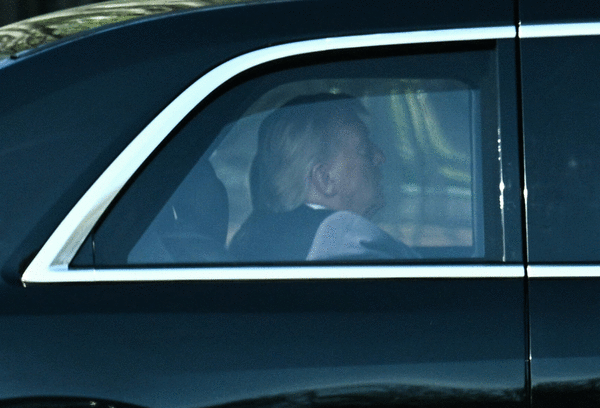
President Donald Trump must have come to the Supreme Court for oral arguments in the birthright citizenship case hoping to hear “his” justices inveigh against what he has called illegal aliens. Instead, he heard a lot about the original meaning of the 14th Amendment.
Whether the president knew it or not, originalism sounds the death knell for his executive order ending birthright citizenship. When his spokesman, Solicitor General John Sauer, ended his part of the oral argument, Trump got up and left.
The justices, including Trump’s appointees, left little reason to doubt that the court will do what sanity requires — namely, strike down this outrageous executive order as a violation of the Constitution. And a key part of the reasoning is not without irony — a point made clear by Justice Neil Gorsuch, a Trump appointee. The problem with the administration’s arguments for why the children of undocumented people who are in the U.S. without visas shouldn’t be birthright citizens, he said, is that when the 14th Amendment was enacted, there was no such thing as an illegal alien.
Put another way: The 14th Amendment couldn’t have been intended to exclude a category of people who, legally speaking, didn’t yet exist.
At issue in the case is the first part of the 14th Amendment, which reads: “All persons born or naturalized in the United States, and subject to the jurisdiction thereof, are citizens of the United States.” On its face, the language covers anyone born in the U.S. and also subject to U.S. jurisdiction.
In defending Trump’s executive order, the Department of Justice argued that someone who isn’t lawfully present in the U.S. isn’t “subject to the jurisdiction” of the U.S. because they owe their allegiance to their home country. On that basis, the solicitor general said that the children of undocumented people aren’t covered by the 14th Amendment. The best argument in support of that view is that children of ambassadors who were in the U.S. may not have been considered citizens under the 14th Amendment because their parents, as ambassadors, were subject to the jurisdiction of their home countries.
But there’s a big difference between an ambassador in the U.S. to represent a foreign government and a person who comes to the U.S. intending to establish a domicile and live here. Since 1898, when the Supreme Court first addressed the question in the famous case of U.S. v. Wong Kim Ark, it’s been settled law that children born in the U.S. become citizens regardless of their parents’ citizenship.
Wong Kim Ark himself was born sometime between 1868 and 1873 in San Francisco, to Chinese parents who were living in the U.S. but weren’t U.S. citizens. After he was born, his parents moved back to China with him, never to return. Wong himself went back and forth several times. In 1895, after a visit home, he was denied entrance to the U.S. under the Chinese Exclusion Act, which had been passed in 1882. He argued that he was a U.S. citizen by virtue of having been born in the U.S., and the Supreme Court agreed with him, allowing him back into the country.
Wang’s personal history nicely illustrates the fact that Gorsuch alluded to in the oral argument: Until the 1880s, there were no federal laws barring classes of people from entering the U.S., or requiring them to have a visa. Partly this was because the U.S. was a young country and needed to grow its population. Partly it was because relatively few countries at the time had sophisticated border controls. The Chinese Exclusion Act was the product of a revolution in thinking about who could come into the U.S., and what their legal status would be once here.
From an originalist perspective, the words of the 14th Amendment must be understood in terms of what they meant in 1868 — not what they might mean today. In 1868, anyone (except official representatives of foreign governments, such as ambassadors) who came to the U.S. became subject to the jurisdiction of the U.S., even if they weren’t yet citizens. In those days, you could immigrate to the U.S. and live out your life here without ever becoming a naturalized citizen, and the government would not make you leave. And you were certainly under the jurisdiction of the U.S. while you lived here.
The Trump administration’s theory — that today’s undocumented people aren’t subject to U.S. jurisdiction — is based on a misconception: It is trying to retrofit a contemporary understanding of the legal permissions necessary to live in the U.S. onto a historical past where no such conceptual category existed.
If, as appears likely, Trump’s originalist appointees follow the logic of originalism, Trump’s executive order is unconstitutional. To be sure, that won’t make originalism the most persuasive theory for how to interpret the Constitution. But it will be an opportunity for the justices who claim to be originalists — including all of Trump’s appointees — to rule consistently with their principles. The president could learn something from that.
____
This column reflects the personal views of the author and does not necessarily reflect the opinion of the editorial board or Bloomberg LP and its owners.
Noah Feldman is a Bloomberg Opinion columnist. A professor of law at Harvard University, he is author, most recently, of “To Be a Jew Today: A New Guide to God, Israel, and the Jewish People."
©2026 Bloomberg L.P. Visit bloomberg.com/opinion. Distributed by Tribune Content Agency, LLC.




















Comments