Aaron Brown: Improving kids' mental health will take more than social media lawsuits
Published in Op Eds
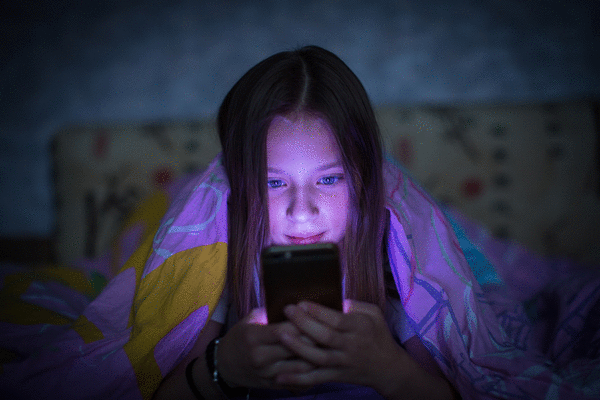
One of the most powerful addictions of our times is also one of the most vexing to treat. After all, there’s a good chance you’re on this drug. It’s called social media.
Like anything potentially addictive, social media isn’t particularly good for anyone and might be uniquely bad for kids. And yet, I use it all the time, a small dose of hypocrisy that reveals the real problem. Social media digs a canyon between what we show and what we are, a phenomenon that also correlates with mental illness.
Outright prohibition of social media is neither practical (or constitutional), nor will it necessarily heal our society. Nevertheless, we are right to seek remedies for its negative impact. Thus, the best policy for social media might be a mix of targeted regulations and substitutions. Government has a role to play, but so do we.
Though causation is hard to prove, more research shows harmful links between social media and children’s mental health — including bullying, peer pressure and exploitation. This came up in conversations last year when I wrote a series of columns about the rural mental health crisis in Minnesota.
“If you look at the charts, you can trace it back to 2010 and 2011,” said Marnie Werner, a researcher at the Center for Rural Policy and Development. “What happened there? That was the introduction of the smartphone and the apps that go on it. Social media has been very bad for kids.”
In response to similar observations, governments around the world are banning children from using social media with laws targeting companies that provide these networks.
In December 2025, Australia launched the world’s most restrictive child protection laws regarding social media, disallowing social media accounts for anyone 16 or younger. Today, the country is preparing action against social media services like Facebook, Instagram, TikTok, Snapchat and YouTube for failing to meet the strict age verification terms of the new law.
Other countries have also weighed in with some version of a social media ban for kids, including France, Indonesia, Norway, Malaysia, Spain and the United Kingdom. Several other European nations, along with New Zealand and some regions of India, are considering similar policies.
The U.S. lags in this regard, though that’s not surprising. Here, the world’s most powerful social media companies hold significant political influence. Certain states have taken a run at social media regulation, but it’s hard to pin down something so ubiquitous. And yet, these companies now face legal reckoning.
On March 25, a jury in Los Angeles found Meta, which owns Facebook and Instagram, and Google’s YouTube to be liable for harm to children using their platforms. Another jury in New Mexico agreed there was a link between social media and children’s mental health, along with concealment of company knowledge about child sexual exploitation.
For those looking for some kind of restraint on Big Tech’s growing power over our lives, this was a major victory. We might compare these rulings to early negative findings against tobacco companies that paved the way for major class-action suits and anti-smoking laws.
It’s hard to deny that social media is addictive. We’re familiar with addictions to alcohol, nicotine and other drugs. These are chemicals, and most of us took chemistry in school, or at least saw “Breaking Bad.”
Some might struggle to empathize with addictions to gambling, sex and overeating, but they are part of the same disorder. Anything that changes the way we think is potentially addicting, and that is perhaps a better way to understand this condition.
Addiction to social media alters our brain chemistry in much the same way as alcohol or drug abuse. Like these other addictions, not all will succumb to abuse of social media, but many do. The effects become deeply tied to our well-being, which begins to explain the seemingly inexplicable mental health crisis facing people of all ages.
And yet, American mental health and happiness statistics remain worse than other countries where people use social media. Furthermore, social media platforms contain many examples of legitimate discourse and public information, even though it can also be used to manipulate. So, social media is not a cigarette. It’s half free speech and half cult, neither of which are illegal, even when they’re harmful.
Arguments that certain forms of speech endanger children were applied to books and records long before the existence of TikTok and Instagram. Now, as before, we might acknowledge that free speech is worth a nuanced approach to the problem.
Kids need to make friends, explore their world, try new things and learn how to be a person without parents looming over them. Social media can function alongside these important goals, but it also runs the risk of replacing these noble aims with something crueler and more artificial.
Should we keep our kids off social media? The benefits of doing so are clear, and yet we cannot hold them to higher standards than we hold ourselves. The reason why kids should wait to join these networks is the same reason adults should limit their own use of them. We can do much better things with our time.
Limiting access to social media for kids might be a good policy within a limited scope. But the government can’t do it alone.
After two decades, social media patterns are no longer new; they’re a cycle. If we don’t like the cycle, we need to break it.
____
Aaron Brown is a columnist for the Minnesota Star Tribune Editorial Board.
_____
©2026 The Minnesota Star Tribune. Visit at startribune.com. Distributed by Tribune Content Agency, LLC.






























Comments