Stephen Mihm: Slavery's atrocities had many global masters
Published in Op Eds
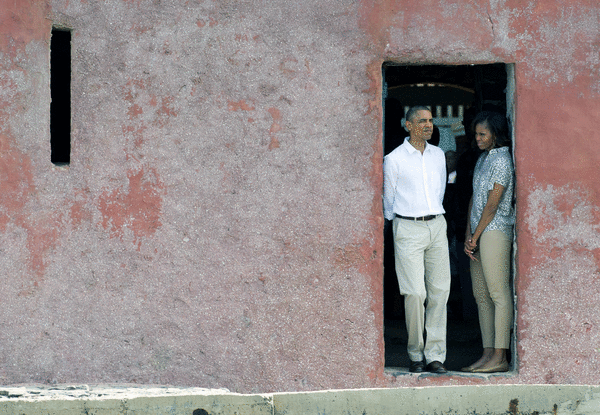
Two numbers — 123 and three — quickly became the focal point of reactions after the United Nations General Assembly voted to declare the trafficking of Africans in the transatlantic slave trade the “gravest crime against humanity” and affirmed the need for reparations.
They represent the nations that voted for and against the resolution. The willingness of the U.S. to vote against the proclamation drew predictable condemnation in the press and on social media. But the 52 nations that abstained from voting — entering what could be described as a collective plea of nolo contendere — didn’t get enough attention.
Their stance is a reminder that while the U.S. bears no shortage of responsibility for slavery, it was by no means the only one implicated in the tragedy. From the very beginning, slavery was a global phenomenon, one that relied on the greed and cruelty of many nations.
Most historians date the beginning of the transatlantic slave trade to the year 1500, when Portuguese traders sailed down the coast of Africa. Though they initially sought to trade for gold and spices, they quickly shifted their attention to enslaved human beings, whom they put to work in the Canary Islands, which became a kind of laboratory for extracting as much labor as possible from African captives.
The plantation system then spread to the New World, thanks to a growing number of colonial powers eager to exploit the riches that awaited. For the most part, the enslavement and forced transportation of Africans would play a central role. Between 1500 and 1900, enslavers forced an estimated 12.5 million Africans onto what one historian has aptly called “floating dungeons” — the slave ships. At least 1 million died making the passage.
Survivors ended up in very different places. Approximately 4.5%, or roughly half a million people, ended up in what is now the U.S. The rest of the enslaved population went elsewhere: Brazil, Guyana, Venezuela, and above all, the Caribbean — a point made in vivid detail in animated maps of the transatlantic slave trade.
This pattern of dispersal reflected a basic fact: Upward of 80% of all enslaved Africans ended up in areas that grew sugar cane. It would not be an exaggeration to say that the histories of sugar and slavery are inseparable. Once a luxury good, sugar became a staple throughout the Western world. The brutal exploitation of the enslaved people forced to cultivate it made that transformation possible. It was only much later, and almost exclusively in the U.S., that slavery underwrote large-scale cotton cultivation.
Slavery was a crime against humanity that had many perpetrators and many accessories. Ironically (or perhaps not), they are among the 52 nations that abstained. In Ghana alone, European traders set up dozens of castles and forts to funnel the trade in human beings. Portugal had its fair share, but eventually, so did Spain, England, Denmark, Sweden, the Netherlands and Germany. This short list, though, only begins to hint at the culpability of nations in the transatlantic trafficking of enslaved people, to say nothing of the business of plantation slavery itself. The Slave Voyages website, a database that documents the details of the slave trade, lists over 25 different nations and city-states involved.
Then there were the plantations scattered throughout the Western Hemisphere. These began as colonial possessions belonging to the English, Spanish, Portuguese, French, Dutch and other nations. The Africans who survived the “Middle Passage” encountered horrific working conditions, with many perishing after arrival.
On Caribbean sugar plantations, for example, it’s estimated that upward of half of all new arrivals died within three years of arriving on islands such as Jamaica. In colonial Virginia, where tobacco was the primary cash crop, the death rate wasn’t much better: One in four Africans died in the first year alone.
For the nations that grew rich on this brutal system of exploitation, death was simply the cost of doing business. That attitude persisted even as colonial rule began to end. Brazil, for example, gained its independence from Portugal in the 1820s but would continue significant trafficking in enslaved people until at least the 1850s. It did not fully abolish slavery until 1888. As both a colony and an independent nation, Brazil received around 5 million enslaved Africans — the largest total in the transatlantic slave trade. The country was among the 123 nations that supported the resolution.
Debate about reparations and slavey often centers on the U.S. for understandable reasons. Here, systemic racism remains entrenched in everyday life and central to public discourse, often used to explain disparities in access to education, housing, food, jobs, wealth, health care and voting power. But the focus on one country is far too narrow and limits an understanding of what went into the enslavement and exile of more than 10 million human beings.
Whether or not you agree that the slave trade and the larger system of chattel slavery it created was the “gravest crime against humanity,” there is no disputing that it was a crime in which many nations played a part. Any reckoning with its legacy needs to start with that ugly reality.
____
This column reflects the personal views of the author and does not necessarily reflect the opinion of the editorial board or Bloomberg LP and its owners.
Stephen Mihm, a professor of history at the University of Georgia, is coauthor of “Crisis Economics: A Crash Course in the Future of Finance.”
©2026 Bloomberg L.P. Visit bloomberg.com/opinion. Distributed by Tribune Content Agency, LLC.
















































Comments