Commentary: Shelters are turning away homeless cats. This should worry you
Published in Op Eds
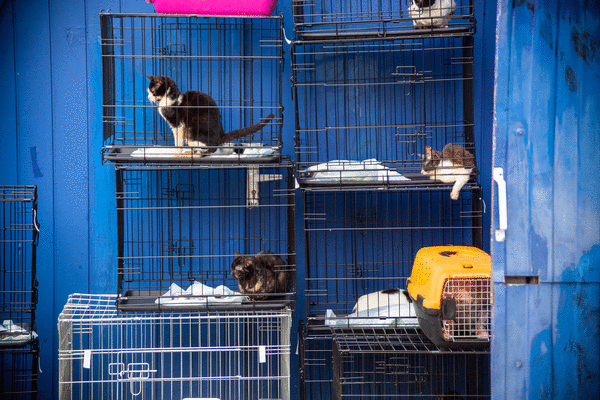
It’s spring, which means kitten season—the time of year when shelters are inundated with calls from people who find tiny, defenseless kittens outdoors and want to help. Increasingly, the response they hear is not “bring them in,” but “leave them where you found them.” Yes, really.
At the same time, a multimillion-dollar “no-kill” advocacy organization released data claiming that the number of cats euthanized in shelters has dropped by nearly 75% over the last decade. People who care about animals must ask a simple question: Where did those cats go?
The answer is shameful. Of course, no one wants animals to die. But that statistic is dangerously misleading because it excludes the countless cats and kittens who suffer and die out of sight because shelters refuse—under pressure from well-funded “no-kill” fanatics—to take them in to begin with.
Euthanasia rates are “dropping” in part because many shelters are turning away sick, injured, neonatal or otherwise challenging-to-place cats. Some won’t accept cats at all. These animals only disappear from intake logs, from euthanasia reports and from public scrutiny—but in real life, they struggle, suffer and die on the streets.
Cats are domesticated animals, and life on the streets is not kind to them. Predators, cars, disease, poisoning, extreme weather and cruel people kill countless cats every year. Research published in the Journal of the American Veterinary Medical Association found that roughly 75% of kittens born outdoors die or disappear before reaching 6 months of age, with trauma as the leading cause.
For those who survive, suffering defines their existence. Cats left to fend for themselves outdoors are not “super felines.” They are biologically identical to the cats we share our homes with. They endure untreated infections, broken bones, parasites, kidney and/or heart disease, urinary issues and more.
Most survive only two to five years, compared to 12 to 15 years for cats kept safely indoors. When shelters tell people to leave kittens outside, they are effectively shutting those animals out of the very system meant to protect them. This doesn’t solve the crisis—it deceives the public and causes animals to suffer.
Much of this shift is tied to the growing emphasis on obtaining “no-kill” status. At face value, it sounds appealing. But “no-kill” policies don’t save animals. They make shelters’ statistics look good to donors and to the public while harming the animals who depend on them for help. Animals left off the books may not be counted, but they count.
When a statistic becomes the measure of success, exclusion becomes the strategy. The numbers improve, but the outcome does not.
And the outcome can be harrowing. Across the country, cats forced to live outdoors endure horrific cruelty. In Texas, surveillance footage shows a man chasing down and strangling a kitten. In another case, rescuers removed a dart that had pierced a kitten’s face. In New York, a driver deliberately crossed into oncoming traffic to run over a homeless kitten, shattering his leg. In Florida, a man threw a kitten to the ground, killing him.
Even when kittens survive, the outcome is not a happy one. Many will go on to reproduce, fueling an endless cycle of suffering. And because cats—nonnative and invasive predators—instinctively hunt wildlife, even when they have a food source, the harm extends beyond them, injuring and killing birds and small mammals, too.
The only real way to help homeless animals is to open shelter doors to all domestic animals and confront what’s driving this crisis: uncontrolled breeding and the continued breeding and sale of animals while millions already lack homes.
If you see kittens outdoors, please do everything you can to get them to safety. Leaving them to fend for themselves isn’t saving lives—it’s cruelty to animals. Please don’t turn your back on vulnerable animals who depend on humans for their every need.
____
Melissa Rae Sanger is a licensed veterinary technician and a senior writer for the PETA Foundation, 501 Front St., Norfolk, VA 23510; www.PETA.org.
_____
©2026 Tribune Content Agency, LLC.





















































Comments