Commentary: Video gamers alone can't keep our skies safe
Published in Op Eds
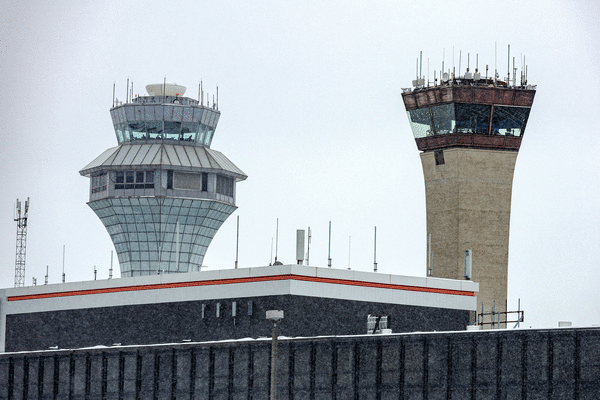
The Federal Aviation Administration is recruiting video gamers for air traffic controller job openings. This effort has yielded more than 2,000 recruits being added to the pipeline, offering a novel approach to resolve a staffing problem that has persisted for many years.
The issue is not whether video gamers will be the breakthrough that finally ends the problem. They are a welcome addition. What is apparent, though, is that adding more people into the existing system does little to resolve the structural issues that have led to persistent shortages in the first place.
Skills developed by video gamers, including concentration, pattern recognition and multitasking, are similar to the skills used to manage dozens of flights in the sky in real time, which is why gamers have been actively recruited. Air traffic control is a high-stress job, with thousands of people’s lives at risk every day. It is difficult to know in advance whether a person can shoulder the responsibility of managing dozens of flights in the air around a busy hub airport. However, given that the skills of gaming appear relevant to what air traffic controllers experience, it certainly seems worth trying.
Yet growing the pool of applicants alone does little to address such long-term staffing needs when the pathway from recruitment to certification continues to have a high attrition rate. Applicants must be under 31 years old, be U.S. citizens, and meet an extensive list of security and medical thresholds. Only 10% of all applicants end up meeting these standards and eventually enroll in the training program. Because air traffic controllers are vital to airspace safety and operate under extreme stress, lowering these standards can never be an option.
An alternative approach is the NAV program in Canada, a private nonprofit venture that has been in existence since 1996. Transport Canada serves as its regulator, while NAV oversees day-to-day functions and operations, including the recruitment of controllers.
Note that NAV has reported a shortage of around 10% of the number of air traffic controllers that it needs, so privatization alone is not a “silver bullet” in resolving controller shortages. However, given that the U.S. is working to grow airport security privatization through its TSA Gold+ program, a similar move toward privatization should be on the table for discussion.
Much like the Canadian NAV program, this would place air traffic controller recruitment and employment in a private-sector organization, while the government would continue to oversee standards and training as it does today, with stringent controls in place to meet the necessary safety standards. Moving air traffic control into the private sector could also shelter controllers from pay lapses that occur with government shutdowns, as was observed in late 2025.
What must also be discussed is injecting more artificial intelligence into air traffic control functions to relieve some of the pressures during shortages. Given how AI has been successful in supporting numerous human tasks, it could be a viable approach for supporting how air traffic controllers do their job.
Many of the most routine and repetitive airplane ground movements, as well as the most basic flight management tasks once a flight reaches cruising altitude, could be supported by AI. Of course, takeoff and landing operations should remain under human management. The goal is not to replace controllers, but rather to reduce their workload and allow them to focus their attention on situations where human judgment is most needed. Although such a transformation would be a long-term plan, with research and testing required before AI can be safely and effectively blended into air traffic control functions, it could be critical to reducing future shortages.
Recruiting video gamers to be air traffic controllers makes good sound bites but falls short of resolving staffing shortages. The Federal Aviation Administration must provide the widest possible pool of qualified, interested and responsible candidates, provide appropriate compensation packages for retention, ensure that everyone continues to be paid when the government shuts down, and incorporate AI into air traffic control to reduce controllers’ workload. Video gamers may be part of the solution, but they alone cannot be the entire solution. Without all such changes, air traffic control shortages will continue to be a topic of discussion in Washington.
If the federal government wants to continue to claim to operate the safest and most efficient airspace in the world, it must first address the structural issues that have made it difficult to recruit and retain the very people who oversee day-to-day operations and keep our airspace safe.
_____
Sheldon H. Jacobson, Ph.D., is a professor of Computer Science at the University of Illinois Urbana-Champaign. He applies his expertise in data-driven risk-based decision-making to evaluate and inform public policy. This piece was originally published by The Hill.
____
©2026 Tribune Content Agency, LLC.















































Comments