Commentary: Northwestern's deal with the federal government is not about antisemitism
Published in Political News
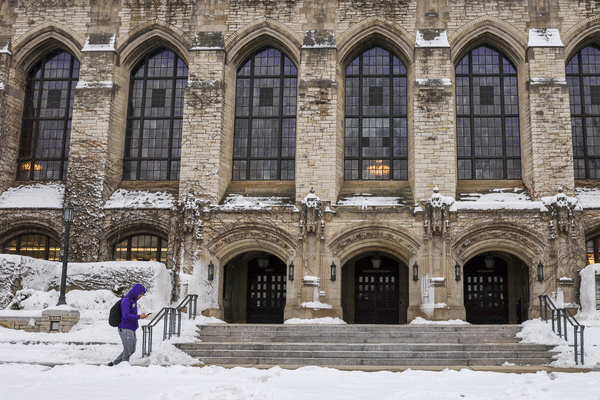
Reading week is quiet at Northwestern University. It’s a time for students to write papers and study for exams and for professors to grade and prepare new courses for winter quarter. But right now, it’s a different kind of quiet. On Friday evening, Northwestern announced a “deal” with the federal government. Media reports thus far have made it seem like a no-brainer — why didn’t we do this sooner? The university will pay $75 million over three years and in return will receive 10 times that amount in the form of suspended grants that will be restored. The university will take steps, already in process, to stamp out the scourge of antisemitism on campus. What could go wrong?
Despite the matter-of-fact tone of the reporting on the terms of the deal, in fact it is not and never has been about antisemitism. It is about punishing universities and the higher education sector. It is about repressing political opponents. At times, the two overlap.
The bottom line is that the agreement, strongly opposed by many faculty members, chips away at the values and rights that have made universities such as Northwestern the envy of the world. These include academic freedom, free inquiry, free speech and expression, openness to new ideas and new conversation partners, and, most crucially, the right to dissent. The agreement is a direct hit on all these protections.
For years, members of the current U.S. administration have depicted professors as the “enemy” of the American people. In a 2021 speech, now-Vice President JD Vance stated that “we have to honestly and aggressively attack the universities in this country.” Why? Because universities are spaces in which there is freedom to think, to dissent, to change one’s mind and to learn. Students may disagree with the actions and policies of the U.S. government (and other governments). To this administration, such dissent is unacceptable. To oppose the ideas of President Donald Trump is to become his enemy. As Trump baldly stated in September at a memorial for Charlie Kirk: “I hate my opponent, and I don’t want the best for them.”
First and foremost, then, the deal reflects the administration’s long-standing goal of crushing political opponents regardless of the cost. Those designated as “opponents” include many leftists and progressives, but this label also includes anyone who disagrees with the president.
The suppression of political dissent and concentration of power are hallmarks of authoritarianism. This deal contributes to its consolidation.
The deal is also about support for the state of Israel, though not in the straightforward way one might assume, equating protection for Jews with support for Israel. Northwestern has assured the government that it will make the campus safe for Jews. Of course, there is nothing wrong with the campus being safe for all communities including Jews. But it was never unsafe. And the presumption that it was, and that it perhaps remains unsafe, is a pretext that is being used to justify repression of free speech and dissent against U.S. and Israeli government policy at Northwestern and on other campuses around the country, as documented by the advocacy group Concerned Jewish Faculty & Staff.
Jewish faculty members at Northwestern have spoken up to oppose the manipulation of their collective identity for purposes of political repression. As reported in The Daily Northwestern, in late April, a group of over 100 NU Jewish faculty members signed a letter protesting the use of antisemitism as a smoke screen for repression of political dissent. “To punish Northwestern financially or to limit academic freedom in the name of protecting Jewish students could itself spark antisemitism — and would be an injustice to those very students and an injury to American society at large,” the statement reads in part.
Philosophy professor Sandy Goldberg told The Daily Northwestern that “as a Jewish faculty member, the one thing that’s really important to me (is) I don’t want the federal government acting in my name. They are using antisemitism as a cudgel to beat elite universities into submission, and that’s deeply disturbing to me.” History professor and director of Jewish and Israel studies David Shyovitz insisted that the public perception of Northwestern in the media is “dramatically disconnected” to his experience on campus. The director of Jewish and Israel studies said that Northwestern’s besmirched reputation is being used to justify policies that are counterproductive to combating antisemitism.
And this is the twisted and dispiriting takeaway of the deal: Policies that are alleged by the Trump administration to protect Jews on campus are creating the conditions for the suppression of free speech and action for the entire Northwestern community, Jewish and non-Jewish.
Singling out Jews in the agreement may seem like a way of protecting them. It isn’t. Singling out the state of Israel for special protection as a state exclusively for Jews may seem like a way of protecting Jews. Those premises and promises are up for debate. And should remain so.
For the government to punish dissent and debate on our campus protects no one. It is a sad day for Northwestern, and for the United States.
____
Elizabeth Shakman Hurd is a professor and chair of religious studies and a professor of political science at Northwestern University.
___
©2025 Chicago Tribune. Visit at chicagotribune.com. Distributed by Tribune Content Agency, LLC.
















Comments