Supreme Court to hear arguments on campaign finance limits
Published in Political News
WASHINGTON — Republicans and the Trump administration are set to urge the Supreme Court during oral arguments Tuesday to continue its long-term trend of overturning campaign finance limits.
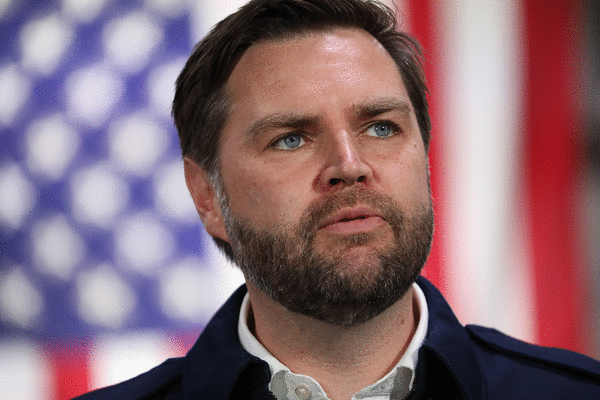
The challenge, from the National Republican Senatorial Committee, as well as Vice President JD Vance from when he was a senator, and former Rep. Steve Chabot, R-Ohio, targets the constitutionality of a law restricting the amounts that party political committees can spend alongside federal candidates.
They argue those limits violate the free-speech rights of political committees to act on behalf of candidates they support.
Experts said a Supreme Court decision overturning the limit would line up with the conservative majority’s long-standing skepticism about campaign finance limits and make it easier for large donors to effectively have more of their money spent on their preferred candidates’ campaigns.
Scott Nelson, counsel at the Public Citizen Litigation Group, said the case could erode the limits on how much donor money can be spent on a single campaign.
“The stakes are really whether the court is going to allow a situation where large donors can make gifts that will go directly to the benefit of candidates that are far in excess of the limits to donations to candidates,” Nelson said.
The law was upheld by the U.S. Court of Appeals for the 6th Circuit, citing a 2001 Supreme Court decision on the same law referred to as Colorado II. The Trump administration took the unusual step of declining to defend the law, and the Supreme Court justices appointed an outside attorney to defend the 6th Circuit decision in favor of the restriction.
At the Supreme Court, the NRSC brief called the 2001 decision upholding the law an “aberration” that violates the free-speech rights of political committees.
“The point of a political party, as opposed to a debating society, is to get its candidates elected. And to do that effectively, a party must be able to consult with its candidates as they work toward their shared goal,” the brief said.
The brief argued that the limits were not based on any concerns about corruption, pointing to the fact that donation limits were tied to a state’s population rather than any concerns about bribery.
The brief said the limits have effectively shepherded donors to less-regulated political action committees, weakened party power and “helped fuel a spike in polarization and fragmentation across the board.”
The Trump administration made similar arguments in its own brief, calling the coordinated spending limit an unconstitutional restriction on political speech.
“A party performs that function most effectively in cooperation with the candidates themselves. By restricting that cooperation, the party-expenditure limit severely burdens the rights of parties and candidates alike,” the brief said.
The justices will likely issue a decision in the case before the conclusion of the court’s term at the end of June.
Outside advocates
Because the Trump administration declined to defend the law, the justices appointed an outside group of attorneys to defend it.
That group argued in favor of the 6th Circuit decision in its brief, arguing that the limits on party coordination with candidates are needed to make sure that the base contribution limits to candidates stick.
“Limits on coordinated expenditures are a vital bulwark against circumvention of the base limits—an interest this Court has repeatedly reaffirmed,” the brief argued.
The group also argued that the mere fact that the Trump administration viewed the law as unconstitutional means that there’s no threat of it being enforced, and therefore no legal case to challenge.
Additionally, the brief argued that the limit being challenged applies to the Republican National Committee, which did not bring the case, and that both Vance and Chabot are not candidates for office currently.
“In its current posture, this case is just a naked request for an advisory opinion,” the brief said.
Nelson called that argument a “wild card” in the case and said the public may get a hint of how seriously the justices take that potential off-ramp during oral arguments. If justices pepper attorneys for the NRSC and Trump administration with questions about it, that could be an early sign that the justices could avoid deciding the constitutionality of the coordination limit.
“They keep taking cases with these weighty and important issues and often find themselves desperately looking for any way to avoid the issues that caused them to take up the issue in the first place,” Nelson said.
The Democratic National Committee, Democratic Senatorial Campaign Committee and Democratic Congressional Campaign Committee together filed a brief that contends the limits are a key to preventing bribery and will argue that point Tuesday.
“The potential for actual or apparent corruption is obvious. And if this gambit becomes legal, parties will face extraordinary competitive pressure to assume an ever-growing share of candidates’ expenses, starving parties of the resources needed for long-term, party- building activities,” the brief said.
Campaign finance limits
The coordinated party expenditure limits challenged in the case started when Congress passed the Federal Election Campaign Act and amended it in 1974. Congress changed the law in 2014, increasing the amounts that could be spent, and allowing new expenditures like for nominating conventions, party headquarters and election court challenges.
The Federal Election Commission sets those limits each year depending on the state and the office of the candidate. The FEC caps the limit for most House races at $63,600, but in states with only one representative, committees can spend up to $127,200, according to the FEC. Senate race caps vary by state, from as low as $127,000 in Alaska up to $3,946,100 in California.
Tara Malloy, a senior litigation strategist at the Campaign Legal Center, said the caps are meant to make sure that the individual donor limits — currently $3,500 per election and $7,000 per cycle — have real effect. If the Supreme Court abolishes the party coordinated spending limit, a large donor could make much larger donations to the national and other party committees and have it earmarked for a particular candidate.
“That would basically be a conveyor belt to go from the donor to the party to the candidate that benefits. That’s just one degree of separation to outright giving money to a candidate,” Malloy said.
Malloy said there have been a string of cases in the last 15 years cutting against campaign finance limits. In 2010, in Citizens United v. FEC, the court threw out limits on corporate and union independent political expenditures, and in 2014 in McCutcheon v. FEC, the justices invalidated a law setting an aggregate limit on how much an individual donor could give across political campaigns.
In 2022, the justices sided with Sen. Ted Cruz, R-Texas, in a challenge to the amount that campaigns can repay candidates for loans. Malloy said that throughout that time the court’s majority has downplayed concerns that lifting those limits would increase perceptions of political corruption.
“The court was very much expressing skepticism about the importance of preventing corruption,” Malloy said.
The case is the National Republican Senatorial Committee, et al. v. Federal Election Commission, et al.
_____
©2025 CQ-Roll Call, Inc., All Rights Reserved. Visit cqrollcall.com. Distributed by Tribune Content Agency, LLC.

































Comments