Congress inches toward reclaiming war powers with AUMF repeals
Published in Political News
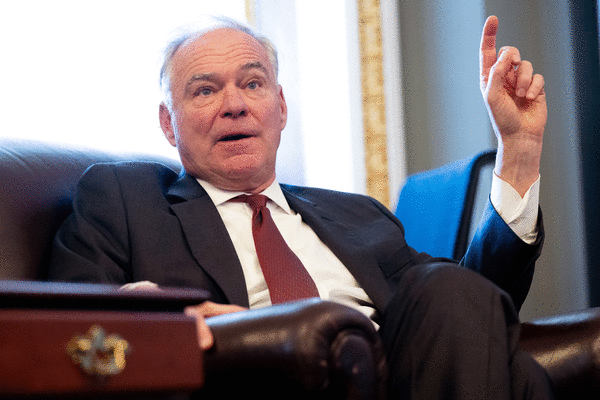
WASHINGTON — It took more than 20 years, but Congress has finally flexed a war powers muscle.
After several fits and starts, lawmakers this month repealed the 2002 Iraq War and 1991 Gulf War authorizations through the fiscal 2026 National Defense Authorization Act.
It’s the first time Congress has clawed back a war authorization since the 1971 repeal of the Gulf of Tonkin resolution, and the first significant war powers measure of any kind signed into law since Congress passed the Iraq War authorization in 2002.
Still, the heavier lift of asserting their authority over current military operations remains elusive for lawmakers as efforts to rein in President Donald Trump’s boat bombing campaign struggle to gain traction.
Repealing the Iraq and Gulf war authorizations “is the beginning of Congress starting to take this seriously,” said Sen. Tim Kaine, D-Va., who sponsored the war authorization repeals. “But now let’s take seriously the ongoing war that Congress thus far has not taken seriously.”
The repeal of the 2002 and 1991 authorizations for the use of military force, or AUMFs, was years in the making.
The House first voted to include a repeal of the 2002 AUMF in 2019 as part of the fiscal 2020 NDAA, but it was stripped out of the version of the bill that became law.
The repeal efforts gained momentum in earnest a year later, after Trump, during his first term, cited the 2002 AUMF as his legal authority for killing Iranian Gen. Qassem Soleimani.
After the Soleimani drone strike in 2020, the Democratic-led House approved a standalone bill to repeal the Iraq War AUMF. At the time, Trump was adamantly opposed to repealing it, so the GOP-controlled Senate never took it up.
The next year, the House voted again to repeal the 2002 AUMF.
And again in 2022.
It wasn’t until 2023 — a week after the 20th anniversary of the 2003 invasion of Iraq — that the Democratic-controlled Senate took up and passed a standalone bill to repeal both the 2002 and 1991 AUMFs. But the repeal still couldn’t get across the finish line that year, and it appeared the moment had passed for Congress to act.
Then, this year, the Senate surprisingly voted by unanimous consent to approve an amendment to its NDAA to repeal the 2002 and 1991 AUMFs — marking the first time repeals were included in both the Senate and House versions of the NDAA.
With repeals in both bills, the compromise version kept the amendment in, and the repeal was finally enacted into law by Trump when he signed the fiscal 2026 NDAA on Dec. 18.
While Trump had threatened to veto a 2002 AUMF repeal in his first term, he made no public comment on it this time.
Boat strikes under scrutiny
The ultimately low-drama repeal of the 2002 and 1991 AUMFs in 2025 stands in stark contrast to lawmakers’ sputtering efforts to pass a war powers resolution to halt Trump’s military strikes against alleged drug boats in the Caribbean and Pacific or to prevent strikes against Venezuela.
“I always feel like the ice melts, but slowly,” Kaine said when asked about the contrast between the repeal of the Iraq authorizations and the struggle to build momentum on the Venezuela-related measures. “On a secret ballot on [the Venezuela] question, I know what the vote would be in the Senate. It’d be like 97 to 3 if people weren’t afraid of alienating Donald Trump.”
The Senate has held two votes on boat strike and Venezuela strike measures, both of which did not advance, while the House also rejected a pair of similar resolutions.
Sen. Rand Paul, R-Ky., a co-sponsor of the Senate proposals to constrain Trump’s ability to strike boats or Venezuela, offered a grim assessment of the overall state of Congress’ war powers.
“The administration does an end run around war powers by simply saying, ‘Oh, these people are terrorists,” he said. “It’s sort of a self-reinforcing congratulatory loop. They do it and then they commit war, but they say, ‘It’s not war. Congress would declare war, and this is obviously not a war, but we can do kinetic action because they’re terrorists.’ Why are they terrorists? ‘Because we said they’re terrorists.’”
Still, with their war power muscles a little less stiff after the repeal of the Iraq-related AUMFs, some lawmakers are already working to flex them further.
Reps. Pramila Jayapal, D-Wash., and Thomas Massie, R-Ky., recently launched a longshot bid to repeal the 2001 AUMF that has undergirded U.S. counterterrorism operations since the Sept. 11 terrorist attacks.
“The American people do not want these forever wars,” Jayapal said in a statement about introducing the bill to repeal the 2001 AUMF. “As the Trump administration threatens military force in Nigeria and as they conduct strikes against alleged narco-terrorists, Congress must reassert our constitutional power to declare war to protect our servicemembers and our national security.”
©2025 CQ-Roll Call, Inc., All Rights Reserved. Visit cqrollcall.com. Distributed by Tribune Content Agency, LLC.

















































Comments