Congress poised to weigh in on Venezuela campaign
Published in Political News
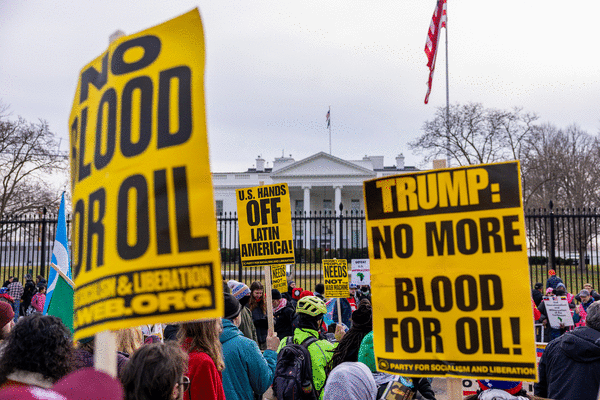
WASHINGTON — What the United States does next in Venezuela and in the Western Hemisphere more broadly are questions that loom large as the 119th Congress returns to work this week for its second session.
On the heels of the U.S. military’s abduction of Venezuelan President Nicolás Maduro early Saturday morning and the administration’s planned prosecution of Maduro on weapons and drug charges, Democrats and at least a handful of Republicans will push for Congress to make its voice heard on the matter — starting this week.
At least one vote appears likely in the Senate in the days ahead on requiring congressional authorization for additional U.S. military actions in or against Venezuela.
By the end of January, lawmakers may also decide whether to withhold Defense appropriations for such operations.
At least classified briefings on Venezuela, if not public hearings, are also in the works.
“It’s time for Congress to get its ass off the couch and do what the Constitution mandates that we do,” Sen. Tim Kaine, D-Va., a member of the Armed Services and Foreign Relations panels, told reporters on Saturday.
Votes ahead
The Senate is poised to vote next week on a resolution by Kaine that would block U.S. military action within or against Venezuela unless authorized by Congress, he said. It would be the latest of several so far ill-fated attempts to assert congressional prerogatives.
What’s more, Kaine said, whenever the House-Senate compromise version of the two chambers’ 2026 Defense appropriations bills comes up for a vote, the Senate will decide whether to consider an amendment by Sen. Jeff Merkley, D-Ore., that would prohibit use of funds to prosecute military action in or against Venezuela.
Lawmakers hope to clear the Defense spending measure by Jan. 30, when stopgap funding will expire.
If past is prologue, however, the attempts to rein in the president’s military actions will fall narrowly short in partisan votes.
Lawmakers’ reactions on Saturday to the president’s actions in Venezuela — with Republicans almost universally backing him and virtually all Democrats decrying the action — only confirmed Congress’s ossified divisions.
Cuba and beyond
Trump’s military operation in Venezuela is just the opening chapter of an as yet unwritten story.
Trump told reporters Saturday the U.S. will “run” Venezuela for the time being. The president said a small number of American forces may be needed in that country for that purpose, and he did not rule out additional and potentially lethal U.S. military action there.
“We’ve been in quagmires in the Americas for decades, if not centuries, because of decisions just like this,” Kaine said.
The unresolved questions only start with how the U.S. will oversee governance in Venezuela and whether there will be resistance from Venezuelans.
Many lawmakers are also wondering aloud if the ouster of Maduro is part of a larger plan to remake the Western Hemisphere, and perhaps Greenland, by force if necessary.
The White House’s November National Security Strategy said some U.S. military forces should be repositioned from other regions to the Western Hemisphere to deal with problems such as drug trafficking and migration and to establish or expand access in “strategically important locations.”
The strategy also called for bolstering U.S. maritime forces in the region and for “targeted deployments to secure the border and defeat cartels, including where necessary the use of lethal force to replace the failed law enforcement-only strategy of the last several decades.”
At a news conference Saturday, Secretary of State Marco Rubio described the taking of Maduro as a law enforcement operation supported by the U.S. military.
But Rubio suggested that Cuba’s leaders, in particular, should worry about their own future.
“If I lived in Havana and I was in the government, I’d be concerned at least a little bit,” Rubio said.
Trump, for his part, told reporters his administration “wants to surround ourselves with good neighbors.” He said Cuba is “not doing very well right now” and is a “failing nation.”
Trump said Cuba is “very similar” to Venezuela “in the sense that we want to help the people in Cuba.”
Rep. Adam Smith of Washington, the top Democrat on the Armed Services Committee, is worried about what might come next across the region.
“Based on the administration’s National Security Strategy, I am deeply concerned that this may be an indication of more to come as the administration seeks to dominate the Western Hemisphere,” Smith said in a statement.
‘What comes next’
But Smith and others are concerned, first off, about the administration’s plans in Venezuela.
“It appears the Trump Administration gave no consideration or plan for what comes next in terms of a functioning government in Venezuela,” Smith said, echoing a widespread Democratic view. “This vacuum threatens to destabilize South America, will likely have no impact on the drug cartels, and could make the situation worse.”
Sen. Elizabeth Warren, D-Mass., a member of the Armed Services Committee, asked in a statement: “What does it mean that the U.S. will ‘run’ Venezuela, and what will Trump do next around the world?”
No public hearings have yet been held on the four-month-old campaign of strikes against alleged drug running boats in the Caribbean and Pacific, or on the deployment of a vast U.S. naval armada in those waters or on U.S. military plans regarding Venezuela.
But even top Republicans who have been critical of the Trump administration’s foreign policy efforts largely fell in line Saturday, while expressing a desire to learn more about the operation and its aftermath.
Sen. Roger Wicker, R-Miss., chairman of the Armed Services Committee, said he would soon convene a briefing about the administration’s plans.
“This arrest was the culmination of a monthslong effort by the Trump administration to degrade the narco-terrorist organizations that Maduro oversaw,” Wicker said in a statement Saturday. “The Venezuelan people must now act swiftly to put their country back on a path to peace and prosperity, which will redound to the benefit of all their neighbors.”
Senate Defense Appropriations Subcommittee Chair Mitch McConnell similarly commended Trump’s move to sack Maduro. The president “has broad constitutional authority and long historical precedent for the limited use of military force,” McConnell wrote on the social platform X.
But McConnell, R-Ky., made clear he didn’t think it was America’s job to “run” Venezuela for long.
“A free, democratic, and stable Venezuela, led by Venezuelans, is in America’s national security interests,” he wrote. “I expect the Administration to brief Congress soon on how it intends to secure this outcome.”
Some Democrats said Saturday that administration officials, in briefings to lawmakers less than a month ago, lied about their goal to change the leadership of Venezuela — either by not acknowledging it or even, in some cases, allegedly denying it.
“The administration has assured me three separate times that it was not pursuing regime change or taking military action in Venezuela,” said Senate Minority Leader Charles E. Schumer, D-N.Y. “Clearly, they are not being straight with Americans.”
Members were not notified in advance of the operation, Trump confirmed to reporters on Saturday.
Partisan divisions
In addition to Kaine’s war powers resolution, Sen. Ruben Gallego, D-Ariz., has drafted a joint resolution that would direct the removal of U.S. armed forces from any counterdrug strikes that have not been authorized by Congress.
Both chambers have already repeatedly defeated — in largely party-line votes — multiple resolutions opposing Trump’s Caribbean operations.
On Dec. 17, the House narrowly rejected two concurrent resolutions that would have expressed opposition to U.S. military engagements against terror organizations in the Western hemisphere and against Venezuela unless authorized by Congress.
The chamber defeated a concurrent resolution offered by top House Foreign Affairs Democrat Gregory W. Meeks of New York, that would have directed the president to remove the use of armed forces against any presidentially designated terror organization in the hemisphere.
Two Republicans, Don Bacon of Nebraska and Thomas Massie of Kentucky, broke with their party to vote for the resolution, which went down on a 210-216 vote.
On Saturday, though, Bacon was supportive of ousting Maduro.
Another House Republican, Marjorie Taylor Greene of Georgia, expressed her opposition to Saturday’s operation.
Two Texas Democrats, Henry Cuellar and Vicente Gonzalez, bucked their party to vote against Meeks’s resolution.
The House similarly voted down, 211-213, a second concurrent resolution offered by Rep. Jim McGovern, D-Mass., that would have directed the president to remove the use of armed forces from hostilities within or against Venezuela unless authorized by Congress.
Similarly, the Senate, on the strength of GOP votes, struck down two previous attempts to constrain Trump.
On Oct. 8, the Senate did not agree, 48-51, to a motion to discharge from committee a binding joint resolution by Kaine and Sen. Adam B. Schiff, D-Calif., that would bar military strikes against alleged drug boats.
Then the Senate voted 49-51 on Nov. 6 to defeat a discharge petition on another joint resolution from Kaine and Sen. Rand Paul, R-Ky., that would have blocked U.S. military action within or against Venezuela.
©2026 CQ-Roll Call, Inc., All Rights Reserved. Visit cqrollcall.com. Distributed by Tribune Content Agency, LLC.












































Comments