US Supreme Court rejects state petition to take up fight over Alaska subsistence
Published in Political News
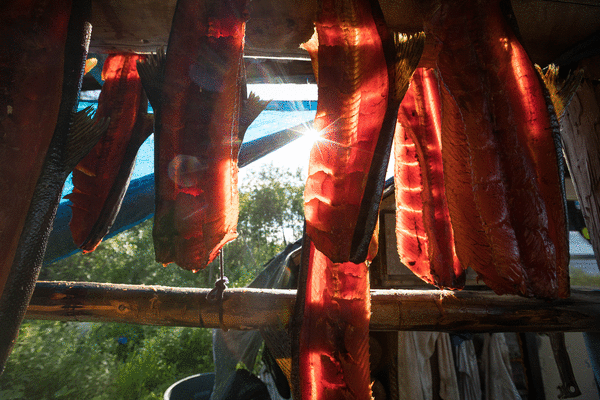
The U.S. Supreme Court said it will not review a lower court's decision in a case involving subsistence fishing in Alaska, a decision that keeps in place a unique federal protection viewed as critical by Alaska Natives.
"Petition DENIED," the Supreme Court said in the docket for the case Monday.
The decision ends a bid by the state of Alaska to have the Supreme Court take up the case, which involved subsistence fishing on a 180-mile portion of the Kuskokwim River in Southwest Alaska, as it winds through the Yukon-Delta National Wildlife Refuge.
The court's denial is considered a monumental win for Alaska Natives. They said the state's challenge struck at the heart of the long-held subsistence protection and put at risk oversight of a vital food, the salmon that has sustained Alaska villages for ages.
"We are deeply gratified by the Court's decision not to disturb the robust protections that affirm federal subsistence priorities," said Ben Mallott, president of the Alaska Federation of Natives — the state's largest Native group — in a prepared statement. "This supports the continuity of our rural subsistence rights, which are integral to our cultures, economies, and food security, and affirms the long-standing Katie John line of cases that shape federal subsistence management. We hope that this latest victory will be the final time we are called to defend our fundamental rights from legal attack by the state of Alaska."
Congress created the subsistence protection in 1980 in the Alaska National Interest Lands Conservation Act, providing rural residents — mostly Alaska Natives — with a priority for hunting and fishing in federal areas during times of shortage, over sport or commercial fishing, for example.
The state has challenged the subsistence priority in court for decades. The protection has been repeatedly upheld by the U.S. 9th Circuit Court of Appeals, while the Supreme Court has declined earlier requests from the state to review it.
The state had petitioned the highest court in September to take up the case, challenging the federal government's authority to manage the river as it passed through the federal refuge.
At the time, the state said the issue "is vital" and affects Alaska's ability to manage its lands and resources comprehensively, since the federal priority creates a patchwork of state and federal management areas throughout Alaska.
Crashing salmon stocks on the Kuskokwim River led to the dispute.
The federal government had originally brought the case against the state after Alaska wildlife managers had issued fishing orders in 2021 and 2022 along the river that conflicted with emergency issues issued by federal managers.
Native groups in the lawsuit argued that the state had issued the orders to find a new opening for attacking the federal subsistence priority.
The state lost before a three-judge panel of the 9th Circuit Court of Appeals last year, and before U.S. District Court Judge Sharon Gleason in 2024, before petitioning the Supreme Court.
Alaska Native groups joined the case on the side of the federal government, including the Alaska Federation of Natives and the Kuskokwim River Inter-Tribal Fish Commission.
"Our fish commission is very pleased with this historic victory in favor of the people of the Kuskokwim River," said Martin Andrew, chair of the Kuskokwim commission, in a prepared statement.
The tribal commission works with the federal government to manage fisheries on the river.
"The victory not only upholds rural subsistence rights in Alaska, but upholds the participation of local people, elected by the Tribes, in the co-management of Kuskokwim salmon," Andrew said. "We are encouraged that the courts have recognized our Tribes' role in the sustainable stewardship of Kuskokwim salmon, which have provided for our families' food security, culture, and well-being for tens of thousands of years, and will continue to do so in the future."
The administration of Gov. Mike Dunleavy had argued that the so-called Katie John trilogy of cases that had long upheld the subsistence protection were wrongly decided. That marked a reversal of the state's position under the administration of Dunleavy's predecessor, Gov. Bill Walker.
The Katie John cases were named after the late Athabascan elder who fought to protect subsistence fishing rights along the Copper River. She died in 2013 at age 97.
The Association of Village Council Presidents, another Native group that joined the feds in the case, said it has been 40 years since Katie John first sought to protect her traditional subsistence rights. During that time, the state has spent millions of dollars trying to undermine the protection, said the group, which represents 56 tribes in the Kuskokwim and Yukon river regions.
"This is a moment of relief for our communities, but our work is not done," said Vivian Korthuis, chief executive of the group.
"While the Supreme Court's decision allows the hard-won protections for subsistence to stand, we know that many of our families are still unable to access the resources that sustain our way of life," Korthuis said, saying the state has restricted fishing on the Yukon River without tribal consultation.
The state had asserted in the case that a Supreme Court decision in 2019 known as Sturgeon II established that navigable waters within federal conservation units are not "public lands" under the Alaska lands conservation act. The waters are therefore not subject to federal subsistence management, the state argued.
But in that earlier Sturgeon case, attorney for the state had told the U.S. Supreme Court that it "need not and should not overrule Katie John" because those cases were correctly decided, the Alaska Native groups argued.
The Supreme Court cited that view in the Sturgeon ruling in 2019 when it said the federal subsistence priority is "not at issue in this case, and we therefore do not disturb the Ninth Circuit's holdings that the (federal government) may regulate subsistence fishing on navigable waters."
In the more recent lawsuit involving fishing on the Kuskokwim River, a 9th Circuit panel ruled in August that the term "public lands" can have two different meanings within different titles in the 1980s Alaska land conservation act. Title VIII, creating the subsistence priority in rural Alaska, applies a broad interpretation of the term that includes navigable waters where subsistence fishing has traditionally taken place.
"I think what we saw here is that the U.S. Supreme Court meant what it said when it said Katie John is good law and will remain good law," said Scott Kendall, an attorney representing the Alaska Federation of Natives in the case.
Kendall said he has close family friends from Bethel in the Kuskokwim region who are rejoicing over the Supreme Court's denial.
The effort to intercept salmon and prepare them for winter consumes entire villages each summer, providing a vital source of nutrition in communities where tiny stores are often sparsely stocked and grocery prices soar.
"The state government really, unfortunately, has attacked not just food security, but the culture and traditions of folks who have been on these lands for thousands of years," Kendall said.
The long-running fight over subsistence in Alaska stems from a fundamental difference between the state and federal subsistence programs.
Alaska's program is open to all residents, not just rural ones, based on the state constitution and a 1989 Alaska Supreme Court decision.
That puts it at odds with the federal subsistence program that is limited to rural residents.
This is the third time over the decades that the U.S. Supreme Court has denied a petition from the state of Alaska to hear a case directly involving the unique subsistence protection, said Nathaniel Amdur-Clark, an attorney for the Kuskokwim River Inter-Tribal Fish Commission in the case.
"This has been essentially a four-decade-long attempt by the state of Alaska to undermine rural subsistence fishing rights," Amdur-Clark said. "And yet again, this sides with the tribes and the feds, and not with the state."
It may be some time before the state tries again to challenge the federal protection, he said.
"It's really hard to see how the state would try to get around this, but we've seen the state of Alaska try sneakier things," Amdur-Clark said. "So it'll be interesting to see what the state's response will be, if anything. But the law has always been clear, and now it's even more clear."
The state as of early Monday had not yet responded to the decision.
Outside of the court's decision, the federal subsistence program that manages fish and wildlife under the rural priority remains under scrutiny.
The Trump administration is preparing for a review of the program at the request of the Safari Club International, a sport hunting group that seeks to limit the program and require the federal government to give deference to the state on wildlife conservation matters.
The administration is seeking comments by Feb. 13 to help determine what aspects of the program will be considered in the review, according to their notice.
_____
© 2026 Anchorage Daily News. Visit www.adn.com. Distributed by Tribune Content Agency, LLC.




















































Comments