COUNTERPOINT: The 'Trump effect' is a bust for the working class
Published in Political News

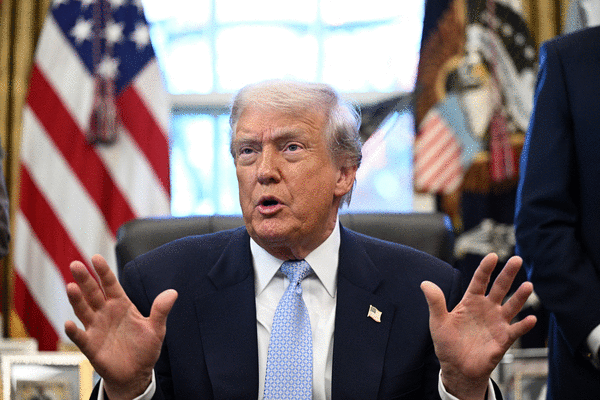

President Donald Trump returned to the White House with a signature promise: to be a “champion for the American worker” and launch a “golden age” for domestic manufacturing. By the end of year one of his second term, Trump’s rhetoric hasn’t matched economic reality. As working-class families increasingly struggle to make ends meet, it has become clear that a year of tariffs, union-busting and weakening the federal government has made it harder for Americans to deal with the rising costs of electricity, food and housing.
While the administration touts job creation figures, the manufacturers have been steadily cutting jobs. In April 2025, Trump announced “Liberation Day” with his sweeping tariffs that he claimed would bring jobs and factories “roaring back into our country.” Instead, from April to December, the United States lost 72,000 net manufacturing jobs.
American manufacturers are struggling to meet rising costs, while workers compete with one another for fewer decent jobs.
Meantime, real wage growth for the working class has slowed significantly. From January through September 2025, wage growth fell by 0.5 percentage points for those with a high school education or less, and for those with associate degrees, it dropped by 0.7 percentage points.
Workers who feel they are running faster to stay in the same place have Trump’s tariffs to blame. According to the Yale Budget Lab, the administration’s tariffs are expected to cost the average household $1,700 annually. Between March and December 2025, prices for meat rose 4.7%, household appliances 5%, and fruit 6.5%above their pre-tariff trends.
Energy costs are rising too: Data from the U.S. Energy Information Administration shows household electricity costs hit 9% higher in August than at the start of 2025.
At a time like this, workers need strong unions, labor protections and a government invested in enforcing the rules. But instead, the Trump administration is setting workers up for failure by busting unions and dismantling the legal guardrails that protect workers.
In what one labor historian called the “largest single action of union-busting in American history,” the president eliminated collective bargaining rights for more than 1 million federal workers. A bipartisan majority of the House of Representatives passed the Protect America’s Workforce Act to undo this executive action, but the damage to organizing in the United States is already profound, and the bill still has to pass the Senate and be signed into law by Trump.
The Trump administration has also taken aim at minimum-wage standards. By executive order, Trump lowered the minimum wage for federal contractors by $9,256 annually.
The administration also reversed a policy that would have prevented corporations from legally paying disabled workers less than the minimum wage, and it proposed rules that will strip minimum wage protections from up to 3.7 million domestic workers.
Even as it weakens minimum-wage standards, the administration has also reduced the government’s ability to enforce wage and safety laws. It replaced critical pro-worker leaders at federal agencies — including at the National Labor Relations Board, Department of Labor and the Equal Employment Opportunity Commission— with former management-side lawyers and appointees with an anti-union history. It also scaled back anti-discrimination protections and enforcement, and reduced penalties for workplace safety violations.
Workers should be able to depend on our justice system to give them a fair hearing when their employers cheat them on their wages or make workplaces unsafe. However, Trump’s appointments to the federal bench have a record of siding with corporations over workers. The appointment of judges with an anti-worker history of fighting local minimum-wage increases, defending so-called “right to work” laws and representing corporations in cases against unions offers little cause for optimism that workers will get their day in court.
The “Trump effect” is not a surge of prosperity for the working class. Instead, it represents a systematic weakening of families’ pocketbooks and workers’ rights.
Lower employment, slowing wage growth and higher prices for working-class people are nothing to celebrate, and the American worker is entering 2026 with little hope for reprieve.
____
ABOUT THE WRITER
Aurelia Glass is a policy analyst for the American Worker Project at the Center for American Progress. She wrote this for InsideSources.com.
___
©2026 Tribune Content Agency, LLC
















































Comments