Challengers ask Supreme Court to halt California redistricting
Published in Political News
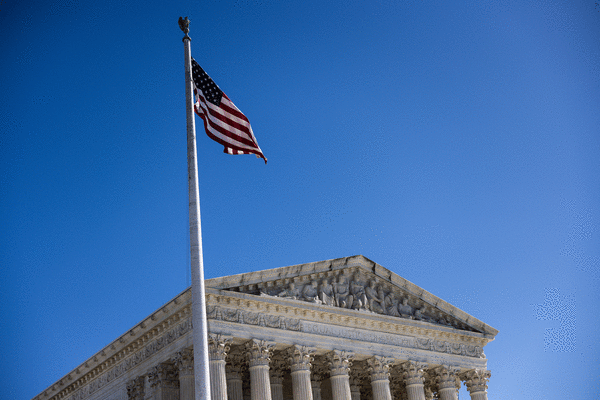
WASHINGTON — Challengers to California’s new congressional map asked the Supreme Court on Thursday to block the state from using its new map in this fall’s election, pressing claims the state racially gerrymandered its new map.
The map, passed by ballot initiative last year, would target seats held by five Republicans in the state and was the second in a wave of partisan mid-decade redistricting that swept the country last year.
Earlier this month, a 2-1 majority of a three-judge panel ruled against the challengers, finding the evidence of partisan motivations for the lines was “overwhelming” while evidence of gerrymandering in favor of the state’s Hispanic and Latino communities was “exceptionally weak.”
The ruling allowed the map for this year’s midterm elections. The legal procedure used by the challengers, which included the state Republican party and Republican officials, allowed a direct appeal to the Supreme Court.
Thursday’s appeal requested a ruling from the Supreme Court by Feb. 9, a deadline for candidates to submit petitions to run in races under the new map. Shortly after the appeal was submitted, the justices requested a response from the state by Jan. 29.
The challengers told the Supreme Court that while the officials in charge of drafting the map did so for partisan advantage, “those officials harbored another purpose as well: maximizing Latino voting strength to shore up Latino support for the Democratic Party.”
The challengers argued that the lower court discounted evidence that mapmakers in the legislature prioritized Hispanic and Latino communities, particularly in the new 13th Congressional District. Under the old plan, the district stretched from Stockton south to Fresno, while under the new plan the district would remain concentrated around Stockton.
“Under the guise of partisan line-drawing, California expressly used race as the ‘predominant factor’ in placing ‘a significant number of voters within or without’ Congressional District 13,” the filing said.
The mapmaker testified that he had tried to maximize the performance of Hispanic and Latino districts in the state, which the challengers argue violated the constitutional guarantee against racial gerrymandering.
The final map of the Stockton district avoided heavily Democratic white majority areas around Stockton in favor of less-heavily Democratic Hispanic and Latino communities, the appeal said.
The 2-1 panel decision in favor of California earlier this month came after a three-day hearing in the fall. Voters passed the map after the Democrat-controlled state legislature passed a measure to override the state’s nonpartisan mapdrawing commission following Texas’ effort to target five Democrat-held seats.
In December, the court’s conservative majority blocked a lower court ruling which said Texas’ new congressional map was likely racially gerrymandered, allowing that state to use its new map this year.
In the Texas case, the Supreme Court found a three-judge panel that made the ruling committed two serious errors when it found the state had likely improperly used race to draw the lines of four of the five most changed congressional districts in the new map.
The California case is David Tangipa et al. v. Gavin Newsom et al.
©2026 CQ-Roll Call, Inc., All Rights Reserved. Visit cqrollcall.com. Distributed by Tribune Content Agency, LLC.
















































Comments