Congress grills UnitedHealth CEO Stephen Hemsley on claim denials, insurance costs
Published in Political News
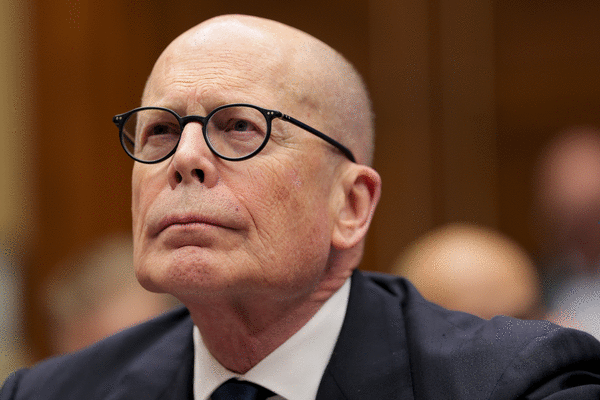
Lawmakers put tough questions to UnitedHealth Group CEO Stephen Hemsley on Jan. 21, challenging the executive on his pay and demanding answers on whether the Eden Prairie, Minnesota-based company drives up costs through its massive size while subjecting patients to wrongful claims denials.
The bipartisan grilling came from members of the U.S. House Energy and Commerce Committee, which summoned Hemsley and top executives from the nation’s largest for-profit health insurers for a subcommittee hearing on why health care is so unaffordable in the U.S.
Hemsley was the first to offer testimony, reciting the insurance industry’s long-standing refrain that coverage costs are high and primarily increasing because care itself — particularly hospital services and prescription drugs — keeps growing more expensive.
Lawmakers, however, focused on whether the insurance companies have been extracting too much profit while passing on high costs to consumers as they balloon their bureaucracies, particularly through divisions known as pharmacy benefit managers (PBMs). These units structure medication benefits within health plans but often impose rules that can block patients from receiving prescribed medicines while forcing pharmacists to deliver impossible messages, said Rep. Buddy Carter, R-Georgia.
“Have you ever personally looked a patient in the eye and explained why your company denied them a medication their doctor says was needed?” Carter asked Hemsley.
Hemsley started to say he has looked patients in the eyes many times, but Carter cut him off as the CEO began referencing prior authorization rules. Carter said as a practicing pharmacist for 40 years, he’d had many such conversations with patients about medication denials.
“I’m the one who had to tell them that, on your behalf,” Carter said.
Rep. Nanette Diaz Barragán, D-California, asked Hemsley about $60 million in stock-based pay he could receive for his work as UnitedHealth Group’s CEO. Patients want to know why CEOs make so much, Barragán said, when people struggle to pay their premiums only to find their insurance won’t pay medical bills for needed care.
She referenced a 2025 report that found UnitedHealth Group had one of the highest claim-denial rates among insurers selling coverage to individuals on the federal government’s HealthCare.gov platform. Hemsley said he wasn’t aware of the findings but maintained his company’s denial rate was less than 2%.
Rep. Debbie Dingell, D-Michigan, said the denial of essential treatments forces families to battle with insurers over care costs for loved ones with terminal illnesses.
“Should sick patients who don’t want to leave their families with bills have to spend hours on end fighting to get their treatments approved?” she asked Hemsley.
Hemsley replied: “It is very important that people don’t go through that kind of complexity. ... At the end of the day, 99% of all care is covered.”
Rep. Diana Harshbarger, R-Tennessee, said health care costs are crushing families, and the failures of health insurers are at the center of the system.
Premiums and deductibles are up, along with insurer profits and executive pay, Harshbarger said. Meanwhile, choice is down because of consolidation, with huge companies like UnitedHealth Group providing health insurance while also owning medical clinics, PBMs and businesses for data and analytics that drive decisions about patient care.
Harshbarger asked Hemsley to describe what regulations prevent his company from steering patients to UnitedHealth-owned pharmacies and clinics or designing benefit structures that disadvantage competitors.
“And if your answer is simply going to be, ‘existing law’ or ‘existing regulation,’ then you need to pinpoint specific guardrails,” she said.
Hemsley replied: “I think there are a number of factors. The objective here is to actually provide better value and a better experience to the consumer, and there are many regulations and business practices that ensure that the marketplace —"
Harshbarger cut off the response, saying Hemsley could submit a fuller answer in writing.
Hemsley was not alone in facing tough questions. Lawmakers also grilled CEOs from CVS Health, Cigna and Elevance Health, the three largest for-profit rivals of UnitedHealth Group.
Beyond company-specific scrutiny, Republicans and Democrats traded allegations about how each party’s policy decisions have contributed to health care system costs and problems. Several referenced ongoing debate about whether to reinstate enhanced tax credits for people in “Obamacare” health plans subsidized under the federal Affordable Care Act (ACA).
At the start of Jan. 22’s hearing, Hemsley pledged his company’s UnitedHealthcare insurance division would voluntarily eliminate and rebate its profits this year from selling ACA-backed health plans.
“The cost of health care insurance fundamentally reflects the cost of health care itself,” Hemsley said. “It is more an effect than a cause.”
Since last spring, Hemsley has been trying to orchestrate a turnaround at the giant health care company after it endured a massive stock sell-off in 2025. Investors soured on UnitedHealth Group as profits fell far short of expectations in its large business selling privatized Medicare health plans.
Former CEO Andrew Witty stepped down in May 2025, allowing for the return of Hemsley, who ran the company during a period of strong growth from 2006-17. The Jan. 22 hearing marked the first time a UnitedHealth Group CEO has been called to Congress since lawmakers blasted Witty in May 2024 following a massive data breach at a UnitedHealth Group subsidiary.
UnitedHealthcare is the largest health insurer in the U.S., providing coverage for about 50 million people. About 1 million of them are insured via ACA health plans the company sells.
Congress made ACA subsidies more generous during the COVID-19 pandemic, but these enhancements expired Dec. 31. The House this month passed a bill to renew these subsidies, but the legislation faces uncertain prospects in the Senate.
Hemsley and the other CEOs were scheduled to testify at a separate meeting of the House Ways and Means committee on the afternoon of Jan. 22. Near the end of the morning’s subcommittee hearing, Rep. Kim Schrier, D-Washington, offered a blunt assessment of negative public sentiment toward the health care conglomerates.
Public outrage burst into the spotlight in December 2024 following the killing of former UnitedHealthcare CEO Brian Thompson as he was walking on a public sidewalk in New York City en route to an investor meeting. Two lawmakers offered condolences to Hemsley for the incident and the social media vitriol it inspired.
Rep. Jake Auchincloss, D-Massachusetts, called the reaction “a shameful moment for this country,” while Rep. Michael Rulli, R-Ohio, called for “lowering the temperature” as policymakers address troubles with the health care system.
©2026 The Minnesota Star Tribune. Visit at startribune.com. Distributed by Tribune Content Agency, LLC.






Comments