Lawmakers in talks to avoid partial US shutdown, Thune says
Published in Political News
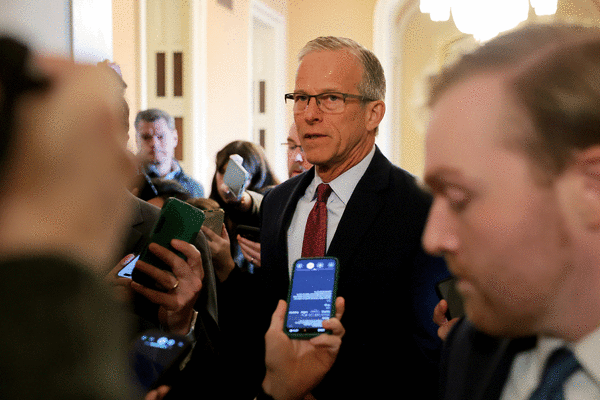
WASHINGTON — Senate Majority Leader John Thune said the two parties are in talks with the White House over U.S. government funding as Democrats threaten to force a partial U.S. government shutdown following a mounting public backlash over President Donald Trump’s immigration crackdown in Minnesota.
The fatal shooting of Minnesota nurse Alex Pretti by Border Patrol agents on Saturday quickly led to a Senate Democratic revolt against funding the Department of Homeland Security without new safeguards. Funding for several other agencies, including Defense, Health and Human Services, Labor, Treasury and Education, could become a casualty of the dispute as a Jan. 30 funding deadline nears.
The next 24 hours will likely determine whether they can reach a deal or some federal agencies shutter, Thune told reporters at the Capitol on Tuesday afternoon.
Democrats have demanded the Department of Homeland Security be stripped from a massive funding bill, or constraints put on Trump’s aggressive immigration and border tactics as their price for voting for additional agency funding.
Thune said Republicans were seeking a concrete list of Democratic demands on immigration enforcement and would then determine if they can be accommodated. “We will see how those conversations go,” he said.
The U.S. House passed the funding package last week. Lawmakers there are on recess this week and would need to vote on any changes to the measure.
Thune called it a “risky” proposition to send the bill back to the House for another vote.
Earlier, Senate Democratic leader Chuck Schumer said his party is “overwhelmingly” united in their push to put constraints on Immigration and Customs Enforcement and Border Patrol. “What ICE is doing is lawless disorder,” Schumer said. “What ICE is doing is state-sanctioned thuggery and it must be stopped.”
Chris Murphy, the top Democrat on the DHS spending panel, said he expects Democrats to coalesce around a list of demands as soon as Wednesday. Among those, he said, would be ending roving patrols in Minneapolis.
And while several tactical and policy changes could be made by a White House decree, or via executive order, several Senate Democrats said they would need to see actual legislative changes enacted.
“You cannot trust this administration,” Nevada Democrat Jacky Rosen told reporters. Even removing DHS Secretary Kristi Noem wouldn’t be enough, said Michigan Democrat Gary Peters, who added, “there have to be reforms to DHS.”
“It has to be in law,” Murphy said. “We can’t trust this administration to take action.”
Senate Republicans need the votes of at least seven Democrats to overcome procedural hurdles and pass the spending legislation.
Missouri Republican Josh Hawley signaled he’d be open to seeing what Democrats are proposing on issues like requiring ICE officers to wear body cameras. “It’s not safe” the way things are going in Minnesota, Hawley said, adding that “we need to take the temperature down.”
Yet GOP lawmakers signaled there were limits to their openness.
Hawley described Democratic calls for Noem to be impeached over her handling of Minnesota as “not serious.” And Oklahoma Republican Markwayne Mullin said while he’s open to hearing out Democratic demands, he won’t agree to provisions that hinder law enforcement from doing its job.
A shutdown could be prolonged but it would have little practical effect on ICE and Border Patrol, which received massive funding in Trump’s tax bill last year.
And while it’s one of the strongest legislative tactics out-of-power Democrats have at their disposal in Trump’s Washington, recent history shows how hard it is to extract policy changes by instigating shutdowns in funding fights.
Democrats failed to leverage the 43-day autumn government shutdown to secure an extension of Obamacare subsidies, which have since expired. However, they were able to put the White House and Republicans on the defensive on issues of affordability and the economy that they plan to campaign on in the November midterm elections.
Brian Schatz, a Hawaii Democrat, said he was optimistic about the prospect of talks given “productive” conversations ongoing. “I think we should be able to land this.”
Schatz, however, cautioned it wasn’t clear the issue could be fully resolved by Friday’s government funding deadline.
_____
©2026 Bloomberg L.P. Visit bloomberg.com. Distributed by Tribune Content Agency, LLC.

















































Comments