As threats climb, political violence debate roils Congress again
Published in Political News
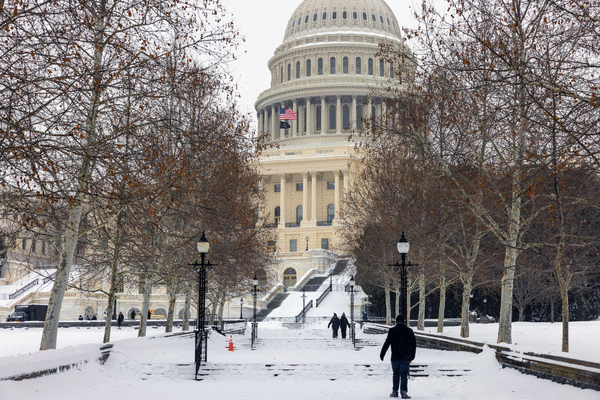
WASHINGTON — As politicians accuse each other of fanning the flames in Minnesota with dangerous rhetoric, the debate is hitting close to home for members of Congress.
In the same week that Capitol Police announced another rise in threat cases, a man sprayed an unknown substance at Rep. Ilhan Omar, D-Minn., as she was holding a town hall meeting in her district. That came after Rep. Maxwell Alejandro Frost, D-Fla., separately described being punched in the face by a man he said was “screaming racist remarks.”
“It’s unfortunate,” Senate Majority Leader John Thune, R-S.D., said Wednesday when asked about the Omar incident and rising threats. “Everybody in the country at every level needs to do what they can to just kind of dial down the temperature.”
Threat cases tracked by Capitol Police rose in 2025 for the third year in a row, according to annual totals released Tuesday. The force’s Threat Assessment Section investigated 14,938 concerning statements, behaviors and communications directed against members of Congress, their families, staff and the Capitol complex. That’s nearly double what they reported in 2022.
“Decreasing violent political rhetoric is one of the best ways to decrease the number of threats across the country,” the agency said in a news release.
That is easier said than done. When it comes to “violent political rhetoric,” Democrats and Republicans often disagree about who is to blame — a dynamic on full display amid the Trump administration’s immigration crackdown in Minnesota.
In an interview with ABC News, President Donald Trump suggested the assault on Omar was staged.
“She probably had herself sprayed, knowing her,” he said Tuesday evening.
But some Republicans are at odds with Trump’s comments.
“I am deeply disturbed to learn that Rep. Ilhan Omar was attacked at a town hall today. Regardless of how vehemently I disagree with her rhetoric — and I do — no elected official should face physical attacks. This is not who we are,” South Carolina Republican Rep. Nancy Mace said on X Tuesday evening.
Rep. Don Bacon struck a similar tone.
“I condemn the attack on Rep Ilhan Omar that occurred yesterday. Political violence is always wrong. We always have the right to free speech and to petition the government, but political violence must be dealt with sternly,” the Nebraska Republican said on X Wednesday morning.
Omar’s office said in a statement that an “agitator” had sprayed her with “an unknown substance with a syringe” but she “continued with her town hall because she doesn’t let bullies win.”
After immigration officers shot a citizen, Alex Pretti, during a Minneapolis protest over the weekend, some members of Congress offered familiar calls to turn down the rhetorical temperature. They were also quick to point fingers at the other side.
“What happened yesterday was a tragedy. But I know firsthand the impact of heated rhetoric and Democrat leaders in Minnesota and across the country need to STOP the attacks on ICE and help them safely do their jobs,” House Majority Leader Steve Scalise said on X over the weekend.
Scalise, R-La., was injured after a gunman opened fire on a GOP practice for the Congressional Baseball Game in 2017.
After Frost over the weekend described in a statement being “assaulted by a man at Sundance Festival who told me that Trump was going to deport me,” some of his fellow Democrats pointed to the president’s rhetoric on race and immigration.
“This attack is a reminder of how common political violence has become in our nation. The man who did this cited Trump’s hateful rhetoric, showing how words from our President can do real harm,” Rep. Donald Norcross, D-N.J., posted on X.
Minnesota has been a focal point for debates over political violence in recent months, including after the murder of Minnesota state lawmaker Melissa Hortman and her husband in June. And the killing of conservative commentator Charlie Kirk in September reignited fears among members of Congress over assassination and the safety of their families.
Appropriators included $30 million in the fiscal 2026 Legislative Branch measure for the Capitol Police to continue and expand its mutual aid program, which is used to reimburse local law enforcement for protecting lawmakers while in their home districts. They boosted total funding for the department to $852.4 million, up from $806.5 million in the prior fiscal year. The House Sergeant-at-Arms saw a substantial boost as well.
While the Capitol itself is sometimes compared to a heavily guarded fortress, lawmakers have long worried about their safety while traveling to and from Washington or holding events for their constituents at home.
As lawmakers push for more protections, House officials have expanded the offerings, adding a mobile duress program and allowing each member up to $350 per month for security system monitoring and up to $20,000 per month to pay for personal security while they’re away from the Capitol.
Senators can now use their office funds to pay for personal security measures after the Senate approved a rules change last fall.
“We want to make sure agencies have the resources they need to be able to enhance protection, which is critical to the democratic process,” Capitol Police Chief Michael Sullivan said in Tuesday’s news release.
Capitol Police are seeing more incidents reported through the Protective Intelligence Operations Center, which launched in 2024. The department also touted a growing number of formal agreements with local law enforcement agencies to help members of Congress in their home districts, with those agreements tripling in 2025.
“For any agency that does not have a formal agreement with us, I would encourage them to proactively reach out,” Capitol Police Intelligence Services Bureau Director Ravi Satkalmi said in the release.
©2026 CQ-Roll Call, Inc., All Rights Reserved. Visit cqrollcall.com. Distributed by Tribune Content Agency, LLC.













































Comments