Senate talks move in direction of splitting off DHS funding bill
Published in Political News
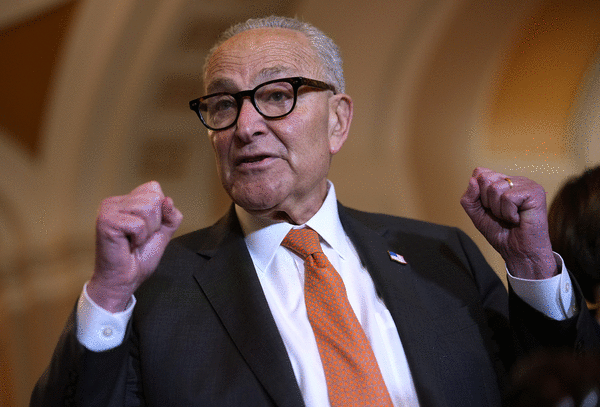
WASHINGTON — White House officials and Senate Minority Leader Charles E. Schumer were scrambling Thursday morning to ink a deal that would punt final decisions on fiscal 2026 Homeland Security funding but let five other spending bills get to President Donald Trump’s desk next week.
The plan taking shape would include removing the full-year negotiated Homeland Security bill from the underlying six-bill, $1.3 trillion spending package and replacing it with a short-term continuing resolution for that agency. This would require the Senate to send the amended version to the House, which doesn’t return until Monday.
A cloture vote to limit debate on taking up the six-bill package was scheduled for 11:30 a.m. Thursday, but was not expected to muster the 60 votes needed until a deal is reached with Democrats on a compromise path.
A White House official Thursday embraced bipartisan efforts to pass a revised multi-agency funding measure and limit the duration of a partial government shutdown.
“President Trump has been consistent – he wants the government to remain open, and the administration has been working with both parties to ensure the American people don’t have to endure another shutdown,” the official said. “A shutdown would risk disaster response funding and more vital resources for the American people.”
A White House official Thursday embraced bipartisan efforts to pass a revised multi-agency funding measure and limit the duration of a partial government shutdown.
“President Trump has been consistent – he wants the government to remain open, and the administration has been working with both parties to ensure the American people don’t have to endure another shutdown,” the official said. “A shutdown would risk disaster response funding and more vital resources for the American people.”
Senate passage alone could be a time-consuming process with lawmakers on both sides readying amendments. Sen. Rand Paul, R-Ky., for example, says he’s determined to strip $5.2 billion for a refugee assistance program run by the Department of Health and Human Services.
Thus there’s almost no way to avoid at least a short partial government shutdown, given stopgap funding for the agencies covered by the six bills in the House-passed package expires Friday night, unless both chambers clear a temporary patch by unanimous consent before the deadline.
But after a 43-day shutdown last fall, a funding lapse for a week or so seems more manageable, especially with six of the 12 appropriations bills already signed into law.
Stopgap length in question
Sources familiar with the discussions described the talks as continuing and heading in the right direction with all parties at the table. The length of the stopgap measure for DHS was still in question; Republicans have pitched giving negotiators up to six more weeks, though Democrats want a much shorter timeframe, perhaps one to two weeks.
Senate Majority Leader John Thune, R-S.D., said Thursday that the parties were getting “closer” to an agreement, but he didn’t know yet how long the stopgap extension would run. He said the goal is for the White House and Senate Democrats to be “able to produce the votes that are necessary” to get the amended package through.
One source said that any Homeland Security CR would need to be “very short term” in order to “give Congress time to negotiate and pass new legislation that protects people from abuses and reins in ICE,” the Immigration and Customs Enforcement agency.
Helping to ease tensions, White House border czar Tom Homan on Thursday announced a reduction in the federal immigration-enforcement presence in Minnesota, after agents shot and killed two U.S. citizens in Minneapolis.
Sen. Tina Smith, D-Minn., endorsed the direction the talks were moving in, but emphasized the stopgap bill for DHS needs to be short.
“We need to get serious about negotiating sensible, meaningful restrictions on the worst abuses of ICE — and negotiation should be done in days, not weeks,” Smith wrote Thursday on X. “Minnesota needs help now.”
Senate Appropriations Chair Susan Collins, R-Maine, also got some good news Thursday: she said Homeland Security Secretary Kristi Noem told her ICE had ended raids in her state. “There are currently no ongoing or planned large-scale ICE operations here,” Collins wrote on X.
Maine Gov. Janet Mills, a Democrat running to unseat Collins in November, has been pummeling Collins over ICE’s presence in their state.
After Border Patrol agents killed 37-year-old nurse Alex Pretti over the weekend, Democrats demanded the Homeland Security bill be stripped from the broader spending package.
The other five spending bills, which have bipartisan backing, include the Defense, Labor-HHS-Education, Financial Services, National Security-State and Transportation-HUD bills.
Policy divide
It’s not clear how quickly the two parties would be able to bridge their differences on DHS funding, even if both chambers clear the emerging combo package.
Schumer, D-N.Y., on Wednesday laid out Senate Democrats’ demands after a lengthy caucus discussion during their weekly policy lunches. They proposed three changes they said represented the party’s top priorities.
Those included additional restrictions on federal agent patrols that include tighter warrant requirements and collaboration with state and local law enforcement. Additionally, they’re seeking accountability through a uniform code of conduct that aligns with local law enforcement as well as a ban on masked agents and requirements for officers to carry identification and wear body cameras.
“Let me be clear, Democrats stand ready today to pass the five bipartisan bills in the Senate, but the DHS bill needs serious work,“ Schumer said Wednesday, adding that his conference was “united on a set of common sense and necessary policy goals that we need to rein in ICE and end the violence.”
A White House official rejected those demands, but left the door open to negotiations. Thune reiterated that stance on Thursday, saying changes to the DHS text aren’t going to happen as part of the current spending package, but that “there’s a path to consider some of those things” down the road.
Meanwhile, selling the amended bill in the House next week could be a tall task for Speaker Mike Johnson, R-La., with members of the House Freedom Caucus and others blasting the concept on Wednesday. But Trump’s backing has been enough to get House Republicans on board for other controversial votes.
It’s possible that House leaders could bring up the new package under suspension of the rules, which would require two-thirds support in the House. But that could cause major problems for Johnson on the right, as conservatives negotiated changes in the chamber’s rules for the 119th Congress designed to limit use of the suspension process to mostly noncontroversial bills.
Adopting a rule for debate on the bill also could be problematic, however, given the razor-thin Republican majority would likely have to carry the typically party-line vote on rules.
--------
—Niels Lesniewski, Aris Folley and Jacob Fulton contributed to this report.
---------
©2026 CQ-Roll Call, Inc. Visit at rollcall.com. Distributed by Tribune Content Agency, LLC.



















































Comments