Bipartisan deal reached on Homeland Security stopgap bill
Published in Political News
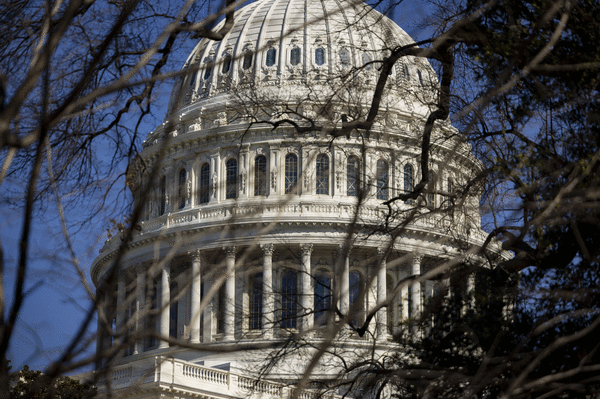
WASHINGTON — Senators reached a bipartisan deal Thursday to extend Homeland Security Department funding for two weeks as negotiations continue over how and whether to impose tighter restrictions on federal immigration agents.
The agreement on a short-term funding extension, through Feb. 13, likely clears the way for passing five other fiscal 2026 spending bills that were caught in limbo by the partisan clash over immigration policy.
Those bills — Defense, Labor-HHS-Education, Financial Services, National Security-State, and Transportation-HUD — are needed by Friday night to avoid a partial government shutdown when current funding runs out.
Under the plan, the Senate would amend a House-passed six-bill funding package to strip out the existing Homeland Security bill and replace it with the continuing resolution in the hopes of buying time to hash out further immigration-enforcement restrictions.
President Donald Trump publicly endorsed the deal Thursday night and called on both parties to support it.
“Republicans and Democrats in Congress have come together to get the vast majority of the Government funded until September, while at the same time providing an extension to the Department of Homeland Security,” Trump wrote on his Truth Social platform. “Hopefully, both Republicans and Democrats will give a very much needed Bipartisan ‘YES’ Vote.”
A temporary partial shutdown still appeared likely because another vote would be required in the House, which is in recess until Monday. But the compromise could significantly reduce the length of that shutdown to perhaps just several days.
It’s also a much more bearable funding lapse than the 43-day shutdown last fall, the longest in history, in part because six spending bills have already been signed into law, and the rest could become law within days.
The agreement still needs to get through the “hotline” process, where all senators are given a chance to raise an objection. Any one senator could make the chamber jump through procedural hoops, which could delay final passage into the weekend or later.
While the continuing resolution would simply extend Homeland Security funding for two weeks, it also retains a key provision from the discarded full-year bill to block payouts of several GOP senators whose phone records were searched in a judicially sanctioned probe but without their knowledge. House leaders had inserted that provision just before passing the full-year Homeland Security bill last week.
The payouts would apply to senators whose call records were collected as part of the Arctic Frost investigation, which lawmakers say formed the basis of former special counsel John L. “Jack” Smith’s investigation into Trump’s attempt to overturn his loss in the 2020 election.
If it passes the Senate, the bill would then have to return to the House, where some Republicans have already been signaling their opposition to reconsidering legislation they already advanced. That chamber isn’t set to return until Monday.
The White House played a key role in striking a deal with Democrats — and pressure from Trump has historically swayed many Republicans — meaning there could be enough bipartisan support to consider the measure in the House under suspension of the rules.
But conservatives successfully negotiated changes to the rules for the 119th Congress that are intended to limit use of the suspension process to mostly noncontroversial bills.
If lawmakers are looking to bring up the bill under a rule, meanwhile, Republicans could be forced to work within their razor-thin majority since rule votes often follow party lines.
Even if lawmakers send the funding package to Trump’s desk, the underlying issue of potential Homeland Security policy changes remains. Democrats on Wednesday unveiled their list of demands for inclusion in the spending bill, which includes additional restrictions on federal agent patrols such as tighter warrant requirements and collaboration with state and local law enforcement.
Democrats are also pushing for accountability through a uniform code of conduct that aligns with local law enforcement, a ban on masked agents and requirements for officers to carry identification and wear body cameras.
The White House immediately panned those proposals but left the door open to further negotiations, and though some Senate Republicans have concerns about various elements of the Democrats’ demands, there seems to be interest in negotiating among lawmakers as well.
Forging a final compromise on a full-year Homeland Security bill would still be no easy task. Sen. Lindsey Graham, R-S.C., warned on X that he would insist on coupling any new restrictions on immigration agents with an end to “sanctuary cities,” which don’t cooperate with federal immigration enforcement efforts in some cases.
_____
(John T. Bennett contributed to this report.)
_____
©2026 CQ-Roll Call, Inc., All Rights Reserved. Visit cqrollcall.com. Distributed by Tribune Content Agency, LLC.




















































Comments