Suspending family-based immigrant visas weakens US families and the economy
Published in Political News
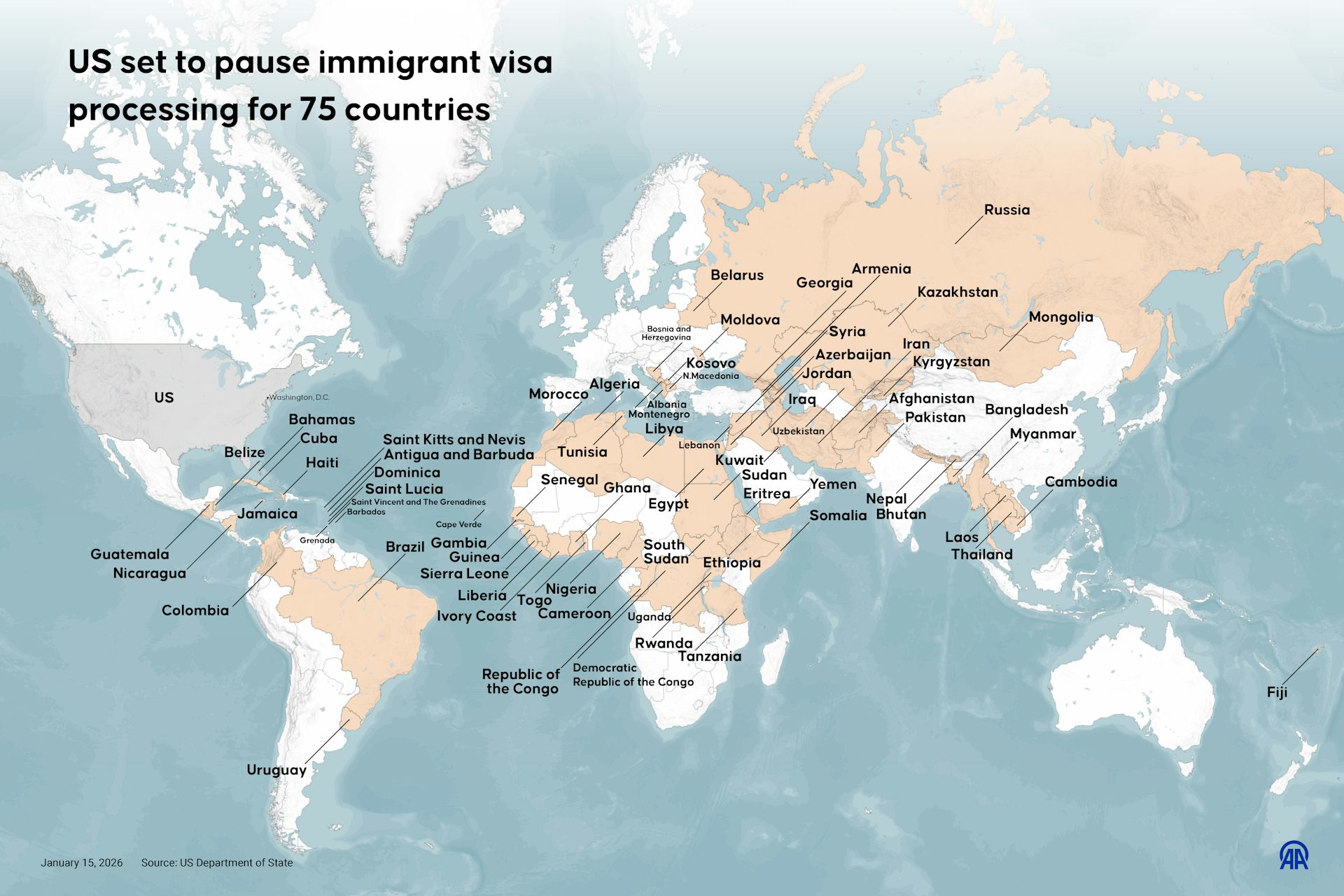


The U.S. Department of State has announced that starting on Jan. 21, 2026, it has indefinitely stopped issuing immigrant visas for people from 75 countries, claiming concerns that some immigrants may rely on public benefits once they get to the United States.
While applications may still be processed, no immigrant visas will be issued during the pause, including family-based visas for U.S. citizens to sponsor their parents.
This focus leaves little room for recognizing the unpaid caregiving and everyday family support provided by immigrant parents already living in the U.S., support that allows others, including their U.S. citizen children, to remain employed and households to stay stable.
Family-based immigration, particularly visas that allow U.S. citizens to sponsor their parents, strengthens social capital: the networks of care and shared responsibility that allow people to work, stay healthy and raise children who become productive members of society. Weakening these networks risks undermining the social foundations of long-term economic growth.
As a scholar who studies family relationship dynamics and social capital, I have observed how these family ties are not simply private family matters but a public good that sustains community well-being. When parents are present, families are better able to share child care, navigate illness and remain economically active.
The United States offers no national paid family leave, unlike countries such as Finland and Hungary, which guarantee paid time off to care for children, aging parents or ill family members. Instead, the U.S. provides only unpaid leave under federal law.
Consequently, many families rely on informal caregiving to balance work and care. Research shows that when adequate support is unavailable, workers, especially parents, are more likely to reduce hours or leave the labor force altogether.
This strain is widespread across the U.S.: Roughly 63 million Americans, nearly 1 in 4 adults, provide unpaid care for a family member with a serious health condition or disability, in addition to unpaid child care.
Sponsored immigrant parents often become part of this informal care system. They provide child care, prepare meals and supervise children.
In many U.S. states, the cost of child care now exceeds in-state college tuition, pushing families to reduce formal care or rely on relatives.
Family reunification, therefore, functions as social infrastructure, filling gaps that markets and public systems do not, a role family scholars have emphasized.
Decades of research illustrates this dynamic. In their book “Immigrant America,” sociologists Alejandro Portes and Rubén G. Rumbaut show that immigrant families often rely on close family ties when government support is limited.
Families also pool resources by living together and combining time, skills and income to cover basic needs. These arrangements help households cope with job instability, illness and long work hours. They also reduce reliance on formal child care and paid domestic labor.
Economic development does not happen in isolation from family life. The Organization for Economic Co-operation and Development’s framework on measuring well-being emphasizes that economic performance, health, social connections and family support are interconnected rather than separate policy domains. When people are supported and less stressed, they are healthier and more productive.
Sociologist James Coleman similarly has noted that children raised in stable, supportive households are more likely to succeed in school and contribute meaningfully as adults. Family reunification, therefore, is an investment in the social relationships that underpin economic prosperity.
Immigrant grandparents and extended kin often play an active role in children’s lives. They help with learning, language development and daily routines.
This kind of family involvement also helps explain what scholars call the “immigrant paradox,” in which many immigrant children achieve better-than-expected academic and emotional results despite socioeconomic challenges.
As of 2023, about 19 million U.S. children, roughly 1 in 4, have at least one parent who is an immigrant. Therefore, policies that restrict family reunification shape the everyday environments in which millions of children grow up. This influences the support they receive at home and the workforce they will help build as adults.
Concerns raised by federal policymakers that immigrants will become a “burden on taxpayers” shape restrictions on family-based immigration. These concerns are reflected in federal policy through the Department of Homeland Security’s public charge rule, which allows immigration officials to assess whether applicants are likely to rely primarily on government assistance such as cash welfare or long-term public support for basic needs.
However, analyses of 2022 U.S. Census data show that immigrants overall use public assistance at lower rates than native-born Americans.
In practice, family reunification is less about public dependency and more about sustaining the relationships that allow families and the economy to function.
The question for policymakers is not whether the U.S. can afford to support family reunification, but whether it can afford not to. In a country facing caregiver shortages, rising parental stress and limited public care infrastructure, investing in social capital through family reunification may be one of the most effective and overlooked ways to support long-term economic growth.
This article is republished from The Conversation, a nonprofit, independent news organization bringing you facts and trustworthy analysis to help you make sense of our complex world. It was written by: Sothy Eng, University of Hawaii
Read more:
Deportation fears create ripple effects for immigrants and their communities
ICE immigration tactics are shocking more Americans as US-Mexico border operations move north
Political polarization in Pittsburgh communities is rooted in economic neglect − not extremism
Sothy Eng does not work for, consult, own shares in or receive funding from any company or organization that would benefit from this article, and has disclosed no relevant affiliations beyond their academic appointment.






















































Comments