Trump says Iran should be 'very worried' as US pursues talks
Published in Political News
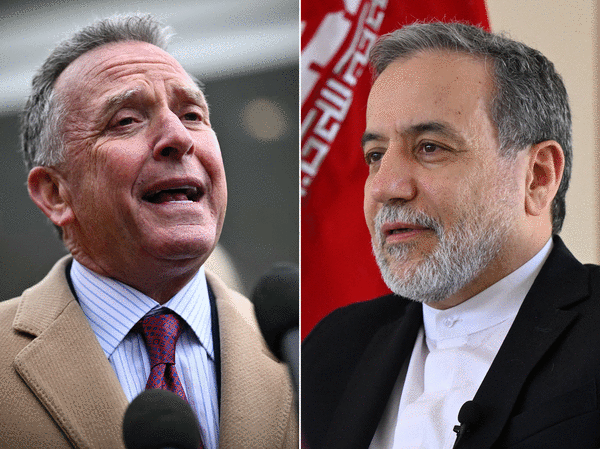
President Donald Trump sent a fresh warning to Iran’s leaders as U.S. military forces amass in the region, even as diplomatic talks between Washington and Tehran appeared to remain on track.
“I would say he should be very worried, yeah. He should be,” Trump said in an interview with NBC News on Wednesday, when asked about Iran’s supreme leader. “As you know, they are negotiating with us.”
Iranian Foreign Minister Abbas Araghchi said in a social media post Wednesday that talks with the U.S. were scheduled to be held in Muscat, Oman, on Friday morning. Secretary of State Marco Rubio had said earlier on Wednesday that the U.S. thought an agreement had been reached for the meeting to be held on Friday in Turkey.
Rubio had said Washington is open to upcoming talks with Iran and that a location is “being worked through,” but stressed the discussions can’t be restricted to nuclear issues.
“As far as the talks are concerned, you know, I think the Iranians had agreed to a certain format — for whatever reason, it’s changed in their system,” Rubio told reporters. “But the United States is prepared to meet with them.”
Iran has asked for the discussions — which follow repeated threats by Trump to strike the country if it doesn’t agree to a deal — to be moved to Oman from Turkey and to exclude the participation of regional countries, people familiar with the matter said earlier. The White House hasn’t commented on any request of that nature.
Iran also wants to limit the discussions to its nuclear program, but Rubio said that “for talks to actually lead to something meaningful, they have to include certain things.” That includes Tehran’s ballistic-missile program, sponsorship of regional militant groups and the treatment of its people, Rubio said, adding White House Middle East envoy Steve Witkoff is prepared and ready to attend a summit.
Contrasting positions over the parameters of the talks are likely to raise concerns about whether the two sides can realistically bridge major differences at a time of heightened tensions in the oil-rich region. The U.S. and Iran have long been at loggerheads over the Islamic Republic’s atomic activities, but divisions have grown — particularly after Tehran authorities crushed a recent wave of protests, leaving thousands dead.
On Tuesday, a U.S. jet shot down an Iranian drone after it “aggressively approached” the Abraham Lincoln aircraft carrier in the Arabian Sea, the American military and government said. The skirmish sent oil prices higher.
Iran has previously pushed back against negotiating with the U.S. over its conventional missile capabilities, but the country is more vulnerable than in earlier rounds due to unprecedented levels of dissent at home.
Talks between Tehran and Washington last year collapsed after Israel started airstrikes on Iran in June.
Araghchi said last week that Iran’s missiles will “never” be subject to negotiations, and Iran’s President Masoud Pezeshkian has explicitly tasked him with negotiating “within the framework of the nuclear deal.” That refers specifically to Iran’s atomic activities, with the Islamic Republic having blocked international monitors from accessing some nuclear facilities after Israel and the U.S. launched airstrikes in June.
The talks would mark the first public meeting between Iranian and U.S. officials since Tehran violently suppressed mass protests in Iran last month.
_____
—With assistance from Patrick Sykes, Carla Canivete, Iain Marlow, John Bowker and Golnar Motevalli.
_____
©2026 Bloomberg L.P. Visit bloomberg.com. Distributed by Tribune Content Agency, LLC.



































Comments