Despite impasse on CR, Thune pushes forward on DHS spending bill
Published in Political News
WASHINGTON — The battle over immigration enforcement has become a fight over whether to temporarily extend funding for the last outstanding fiscal 2026 spending bill.
With no immigration deal in sight, Senate Democrats and Republicans spent much of Tuesday at odds over whether to pass a short-term measure to buy more time before current funding for the Homeland Security Department runs out Friday night.
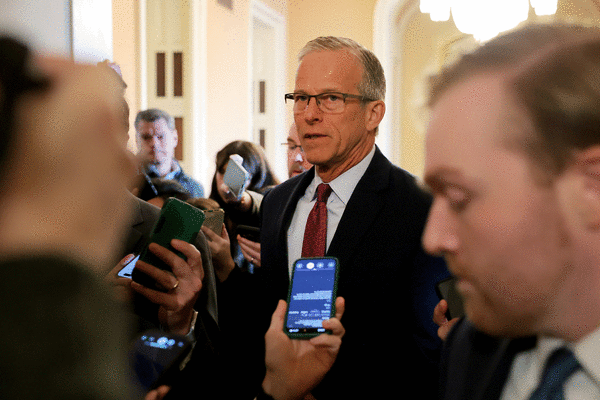
On Tuesday evening, Senate Majority Leader John Thune, R-S.D., filed cloture on the motion to proceed to the full-year, House-passed Homeland Security appropriations bill, which would serve as a vehicle for a short-term continuing resolution.
Unless an agreement is reached, a preliminary procedural vote on taking up the stopgap measure would occur on Thursday.
Thune said Tuesday he’s still uncertain on the length of the CR he is pushing for, saying it would be “subject to whatever is negotiated with the Democrats” and “if it looks like they are making sufficient progress that they are willing to vote for a CR.”
But he said “we’re kind of in a consent posture, doing anything with the amount of time that we have between now and when the funding deadline gets hit, would take consent.
“I don’t know whether they will give us that or not,” he said.
‘Asymmetry of seriousness’
Still, many Democrats said they would not support another CR at this stage and are demanding change for the DHS. It would take 60 votes to move forward and bring the measure to the floor, and top Democrats say there’s still time to reach a deal on immigration enforcement policies.
“There’s no reason we can’t get this done by Thursday,” Senate Minority Leader Charles E. Schumer, D-N.Y., told reporters on Tuesday. But he declined to explicitly rule out another short-term stopgap for DHS.
Other senators, including some who broke with their fellow Democrats last year to reopen the government, say they oppose another stopgap measure.
“I am not going to support a CR,” Sen. Catherine Cortez Masto, D-Nev., told reporters, saying she wants a deal regarding immigration enforcement. Cortez Masto was part of the group that broke ranks last fall and voted to reopen the government after a 43-day partial shutdown.
Sen. Christopher S. Murphy, D-Conn., said “there’s just an asymmetry of seriousness right now” from his conference’s view of the negotiations.
“When you’re three days away from a shutdown, we can’t be trading talking points,” said Murphy, the top Democrat on his chamber’s Homeland Security Appropriations Subcommittee.
“We’re putting language on the table. They are not even close, even the things they want. They’re not giving us language, (which) is not serious,” Murphy said. “We’re trying to be adults here, but we’re not getting a lot of reciprocity.”
Senate Appropriations ranking member Sen. Patty Murray, D-Wash., told reporters Tuesday that she’s “not for putting DHS on a CR until (Republicans) show us they are serious about doing this.”
Schumer said on the floor Tuesday that the White House’s response Monday to Senate Democrats’ list of proposed restraints on federal immigration enforcement officers “included neither details nor legislative text.”
Added Schumer: “We need to see more from Republicans very soon.”
House Democrats have also shied away from another CR, with House Minority Leader Hakeem Jeffries, D-N.Y., telling MS Now on Tuesday that ICE needs “to be reined in.”
“There need to be dramatic changes in the way DHS conducts itself before any funding bill moves forward on Friday,” Jeffries said. He separately told reporters he is still waiting for the White House “to respond in a serious way” to the demands Democrats sent over the weekend.
Democrats have been calling for further restrictions on federal agent patrols, including tighter warrant requirements, a ban on masked agents and a requirement for officers to carry identification and wear body cameras following federal immigration officials shooting and killing two U.S. citizens in Minneapolis within a span of weeks.
Thune said there are a few areas of reform that “are in the range of, I would say, common ground,” but conceded that “there are things I think on probably both sides that are non-negotiables.”
A partial government shutdown might have minimal impact on Immigrations and Custom Enforcement, which received a $75 billion boost from last year’s reconciliation law.
But other agencies under the DHS umbrella, such as the Coast Guard, Federal Emergency Management Agency and Transportation Security Administration would be harder hit by the department shuttering.
“Where we’re going to end up in the long term is if cooler heads prevail, and everybody takes their meds, we’ll end up with a CR, a clean CR, that just extends the status quo,” Sen. John Kennedy, R-La., said. “That way we can get TSA and Coast Guard and FEMA funded.”
In the House, Speaker Mike Johnson, R-La., threw tepid water on a CR, saying the Senate should move the House-passed Homeland Security spending bill.
House Republicans “offering a CR would be a concession that we don’t believe in that product,” he said. “We’ve not moved a CR here because our position is, the Senate should pass the House-passed Homeland bill.”
_____
(Jacob Fulton and John T. Bennett contributed to this report.)
_____
©2026 CQ-Roll Call, Inc., All Rights Reserved. Visit cqrollcall.com. Distributed by Tribune Content Agency, LLC.





















































Comments