Judges stop defense bid to have Maduro, Trump aide Wiles testify at Rivera trial
Published in Political News
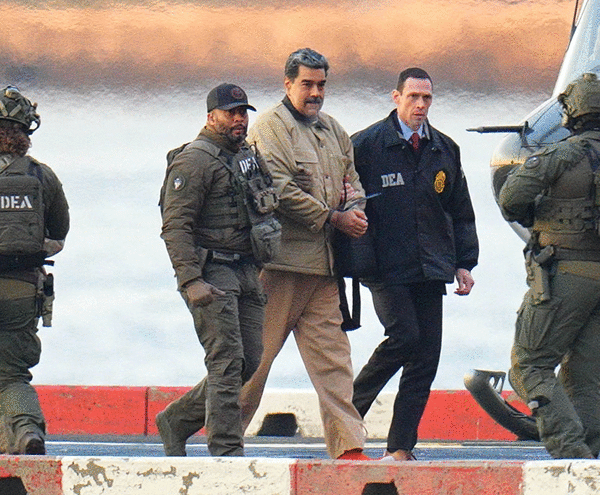
MIAMI — Two federal judges on Thursday ruled that they won’t order former Venezuelan President Nicolas Maduro and White House Chief of Staff Susie Wiles to testify as witnesses for former Miami-Dade Congressman David Rivera at his national-security trial starting next month.
“I think this issue is dead for now,” U.S. District Judge Melissa Damian said at a Miami federal-court hearing, rejecting a defense motion to compel Maduro’s testimony.
Damian based her decision on a recent letter from Maduro’s defense attorney, who indicated Maduro “will exercise his constitutional right under the Fifth Amendment to remain silent and respectfully declines to testify” at the trial of Rivera and political consultant Esther Nuhfer.
Both are charged with working as unregistered foreign agents in 2017-18 for the Venezuelan government while Maduro was president. Maduro is now in custody in New York on drug-trafficking charges.
His attorney, Barry Pollack, wrote Nuhfer’s lawyer, David O. Markus, who authored the motion to compel Maduro’s testimony with a subpoena if he refused to be a witness for the defense.
“Particularly in light of the conduct of the United States government related to the case against him in the Southern District of New York, Mr. Maduro must vigorously assert and protect his rights under the United States Constitution,” Pollack wrote last week. He added that U.S. military forces “abducted” Maduro on Jan. 3 and “brought him by force” to New York to face narcoterrorism charges. He’s being held at a federal lockup in Brooklyn.
“Accordingly, on behalf of Mr. Maduro, I ask that you withdraw your motion ... and that ... you inform the Court that Mr. Maduro opposes the motion,” Pollack wrote Markus.
At Thursday’s hearing, Markus proposed that Maduro could testify for the defense if the Justice Department and federal prosecutors in Miami granted the former Venezuelan president immunity. Damian, the federal judge, asked whether the government was willing to give Maduro immunity during his testimony at the upcoming trial.
“I’m pretty sure I’m not authorized to do that,” Assistant U.S. Attorney Harold Schimkat said.
This month, lawyers for Rivera and Nuhfer filed a motion to subpoena the former president. They said “the testimony of Mr. Maduro is material and necessary at this trial.”
According to an indictment, Rivera collaborated with politically connected Venezuelan businessman Raul Gorrin to arrange a meeting between Texas Congressman Pete Sessions, a Republican, and Maduro in Caracas. On April 2, 2018, the indictment says, Rivera, Gorrin and Sessions met with Maduro and other Venezuelan politicians to discuss normalizing relations between the United States and Venezuela. As part of the meeting, Sessions agreed to carry a letter with that proposal from Maduro to then-President Donald Trump, who was serving in his first term, but their efforts were unsuccessful.
The defense team, which includes Rivera’s attorneys Ed Shohat and David Weinstein, has already issued subpoenas to Secretary of State Marco Rubio, the former Florida senator, and Trump’s White House chief of staff, Susie Wiles, a former lobbyist with the influential Tallahassee-based firm Ballard Partners, which once represented Gorrin and his TV network, Globovision.
Judge blocks Wiles’ subpoena
While federal prosecutors recently said they plan to call Rubio as a government witness, they filed a motion to quash the defense subpoena for Wiles.
On Thursday, Magistrate Judge Edwin Torres granted the prosecutors’ motion, saying “the Chief of Staff has become the second most powerful and important person in the operation of the Federal Government” and that requiring her to testify for two days “would disrupt Ms. Wiles’ work duties.”
In his order, Torres also called into question the value of her testimony, saying: “Defendants have not shown that Ms. Wiles has a direct connection to this case.”
Damian, the federal judge, said she agreed with Torres’ analysis and told the defense team on Thursday to appeal his decision to her.
Defense lawyers said they were seeking to call Maduro, Wiles and Rubio to show that Rivera and Nuhfer were not acting as unregistered agents for the Venezuelan government to “normalize” relations with Maduro’s regime, as the indictment alleges. Instead, at meetings in 2017 and 2018, the defendants were trying to develop an exit strategy for Maduro so he could be replaced by an opposition leader who would be supported by the United States.
The Biden administration brought the criminal case in late 2022, when Rivera and Nuhfer were charged with conspiring to commit offenses against the United States and failing to register as foreign agents for Venezuela during the Maduro regime. The charges are rooted in Rivera’s $50 million consulting contract with the U.S. subsidiary of Venezuela’s national oil company, PDVSA, in March 2017 — a lobbying deal that ostensibly aimed to rebuild PDVSA’s Citgo refinery business in Houston.
The indictment accuses Rivera and Nuhfer of conspiring to “unlawfully enrich themselves by engaging in political activities in the United States on behalf of the Government of Venezuela ... in an effort to influence United States foreign policy toward Venezuela.”
It also says Venezuela’s interim president, Delcy Rodriguez, who replaced Maduro after he was seized by the U.S. military last month and brought to New York, had “ordered” Citgo executives in 2017 to hire Rivera’s company, Interamerican Consulting, to compensate him and Nuhfer for their lobbying on behalf of the Venezuelan government.
©2026 Miami Herald. Visit at miamiherald.com. Distributed by Tribune Content Agency, LLC.






Comments