Uncertainty shrouds key surveillance authority renewal in House
Published in Political News
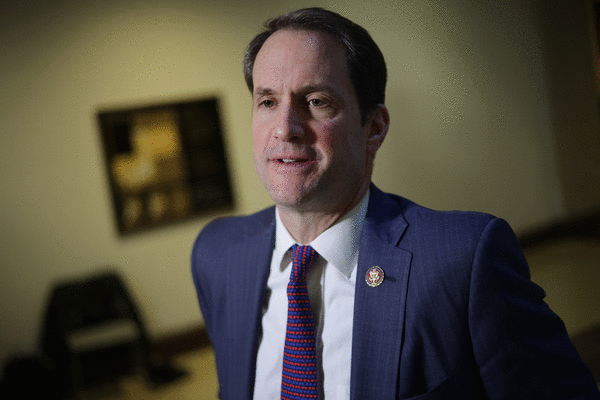
WASHINGTON — House lawmakers who met with Trump administration officials Wednesday on Capitol Hill emerged with no clear consensus, with some still undecided over whether to reauthorize a powerful surveillance authority without adding more privacy guardrails.
The administration, according to lawmakers, has said it wants Section 702 of the Foreign Intelligence Surveillance Act to continue with no changes, referred to as a “clean extension,” an approach backed by House Speaker Mike Johnson, R-La., and the head of the House Intelligence Committee.
That is a blow to privacy hawks from both parties who have long advocated for further protections, including adding a warrant requirement for the communications of Americans swept up under the program.
The authority allows the U.S. government to collect digital communications of foreigners located outside the country. But the program is controversial because it also sweeps up the communications of Americans and allows the FBI to search through data without a warrant, using information such as an email address.
The authority will expire on April 20 without congressional action.
House Intelligence Committee Chairman Rick Crawford, R-Ark., said he wants a clean 18-month reauthorization of the authority, and that a bill could come to the floor as early as next week.
“I’m doing everything I can to try to advance the 18-month clean” reauthorization, Crawford said.
On Capitol Hill Wednesday afternoon, House lawmakers gathered for a meeting with Trump administration officials, including FBI Director Kash Patel and CIA Director John Ratcliffe.
But as lawmakers filtered out, there was no clean consensus on whether to approve the authority without including more privacy protections, a debate that dominated the last reauthorization last Congress.
Progressive Democrats and staunch conservatives have often banded together to advocate for privacy protections, while national security-minded lawmakers have opposed those efforts.
Rep. Jim Himes, D-Conn., the top Democrat on the House Intelligence Committee, said the expiration of the authority would be “devastating” to the safety of Americans. But he said it’s understandable that his colleagues would have questions about renewing a surveillance authority for an administration that’s acted with contempt for the Constitution.
“This administration has not done a lot to help us in this renewal,” Himes said.
Himes said the big hurdle is whether Republicans can pass a rule to set up a final vote on the House floor.
After the meeting, some lawmakers said they were simply undecided, while others said they were leaning against supporting a clean reauthorization.
Rep. Andrew Clyde, R-Ga., said he would probably not support a clean extension but that he had not made a final call.
Another conservative voice, Rep. Andy Harris, R-Md., said his decision on a clean extension would turn on how long the program would be extended. An 18-month extension would probably be off the table for him, he said.
Several Democrats have already said they would not be backing such a proposal, including Rep. Jamie Raskin of Maryland, the top Democrat on the House Judiciary Committee.
“It’s an administration which has set itself against the privacy rights of the people and against civil liberties,” Raskin said.
The Trump administration is sure to hamper any push to add further changes to the authority, particularly among House Republicans wary of bucking the administration.
On Tuesday, at least one vocal critic of the surveillance authority softened his tone.
House Judiciary Chairman Jim Jordan, R-Ohio, a staunch Trump ally who has long pushed for a Section 702 warrant requirement, said he was not lobbying against the clean reauthorization.
Asked whether he’s OK with a clean extension, Jordan said changes added during the last reauthorization law in 2024 have made a “huge difference.”
The bill made some changes aimed at making sure the government could not misuse the authority, but it did not include a warrant requirement regarding the searching of Americans’ information.
“We’re seeing by the numbers — and the reports and things we’re getting back that were required in the bill — that there’s been a huge improvement,” Jordan said.
Those comments are a shift from months ago when the Ohio Republican held a hearing that outlined the case for further privacy changes to Section 702, with the committee inviting witnesses that slammed the current program and said the set up permitted the warrantless searches of Americans’ information.
At the hearing, Jordan himself ran through the past abuses of the authority and endorsed the idea of a warrant requirement.
“If you’re going to search this database, and you’re going to search using an American’s name, phone number, email address, we believe you should go to a separate and equal branch of government and get a warrant to do so,” Jordan said at the time. “We think that’s fundamental.”
Meanwhile, privacy advocates say that the reauthorization law actually expanded the scope of Section 702.
Rep. Darrell Issa, R-Calif., another member of the House Judiciary Committee, said he’s looking into whether the positive direction of the program is because of changes implemented during the last reauthorization, instead of simply better behavior by the Trump administration.
“I’m not saying I absolutely would not vote for a clean reauthorization. They’re going to have to convince me,” Issa said.
_____
©2026 CQ-Roll Call, Inc. Visit at rollcall.com. Distributed by Tribune Content Agency, LLC.















































Comments