In unprecedented move, Kentucky House votes to impeach Fayette Circuit Judge Goodman
Published in Political News
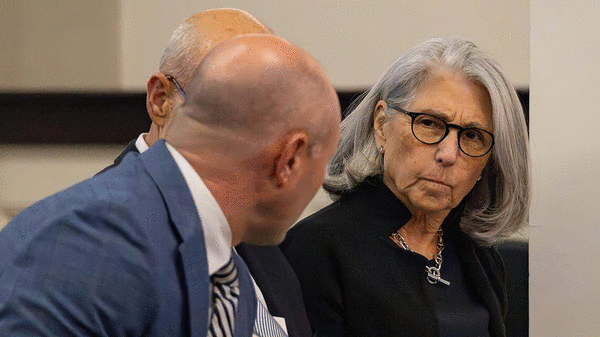
LEXINGTON, Ky. — The Kentucky House of Representatives on Friday voted to impeach a Fayette County judge after a committee issued articles of impeachment against her earlier this week.
In a 73-14 vote Friday, the House approved the articles of impeachment against Fayette Circuit Judge Julie Muth Goodman, sending the matter to the Senate for a trial.
The vote was largely along party lines. Rep. Daniel Elliott of Danville was the only Republican present to vote against it; state Rep. Adam Moore of Lexington was the only Democrat present to vote in favor.
Killian Timoney, a former Republican lawmaker seeking to win back his Lexington-area House seat this year, filed the petition in January, arguing Goodman had abused her office. The seat is currently held by Moore.
On Monday, the special Impeachment Committee heard testimony from Goodman, who has served as a judge for 18 years, having been elected by Fayette County voters six times. By Wednesday, the House committee drafted articles of impeachment that say Goodman defied binding precedents and statutes enacted by the General Assembly, and interfered with the rights and powers of judicial bodies.
“(Goodman) was intentionally wrong, she lacked legal authority, yet she proceeded and did it anyway,” Republican state Rep. Jason Nemes of Middletown said Friday. “This is not a judge who made a mistake; this is something else entirely.”
The impeachment marks the first against a sitting judge in more than 100 years in Kentucky, and the first ever under the state’s modern court system.
Nemes presents articles to full Kentucky House
Nemes, the Impeachment Committee chair, laid out six cases mentioned in the petition, all of which claim Goodman abused her office.
Nemes said he brought forth the articles of impeachment with “a heavy heart.”
“And what I want every judge in this commonwealth, every judge walking watching the proceedings on television or who might read about it in a newspaper, what I want those judges to hear?” Nemes said. “I want them to hear this directly: You need not fear impeachment for doing your job to the best of your ability.”
However, in a minority report from the committee, two lawmakers said the impeachment proceedings should not continue. Democratic state Reps. Pamela Stevenson and Al Gentry, both of Louisville, signed the report, which argued the original petition was not complete, the proceedings violated due process and that there was no impeachable conduct alleged.
Stevenson, an attorney, spoke against the impeachment Friday, as did Elliott, who said he felt impeachment was improper. Elliott, the House Judiciary chair and attorney, was a nonvoting member of the impeachment committee.
“We are setting a new standard this morning, if we do this,” Elliott urged.
Democratic state Rep. Joshua Watkins of Louisville said the House should not vote to impeach Goodman because it was not clear on what the actual “impeachable offenses” are.
“If I were to ask 10 people in this body to define the impeachable conduct in this case, I would be a betting man to believe that I would get 10 different answers,” Watkins said. “And I think that is the problem, because if that standard is unclear today, then that lack of clarity becomes the standard for tomorrow.”
What the members could agree on, was that, whatever decision they came to, it would change Kentucky political history, he said.
“This moment today is going to be discussed in classrooms and law schools and in public life for many years to come,” Watkins said. “What we do here today will matter long after each and everyone of us leaves this sacred institution, and how we leave this institution will matter to our children, to their children and to their children.”
What happens in Goodman impeachment next?
Goodman and her attorneys filed a request for an emergency injunction last week in Franklin Circuit Court saying the proceedings violated her due process. However, Franklin Circuit Judge Phillip Shepherd declined to intervene on the proceedings, twice. He said if he were to stop the proceedings as they are ongoing, it could be a violation of separation of powers.
Shepherd did say that he could consider issuing a ruling at a later time, but that the Kentucky Supreme Court was the only body that could intervene.
President Robert Stivers told reporters in January the Senate was talking with attorneys and constitutional experts at what a potential trial could look like.
“Do we have a subcommittee hearing? Do we bring it to the full body? Do we allow cross examination?” Stivers said. “... We have a lot to think through.”
Stivers added the bar to remove an elected official from office isn’t clearly defined because “nobody’s really done it in 100 years.”
The last time the state Senate voted to convict and remove an impeached official was in March 2023, when the body unanimously convicted disgraced former Eastern Kentucky prosecutor Ronnie Goldy. It was the first impeachment hearing and trial in more than a century.
_____
©2026 Lexington Herald-Leader. Visit kentucky.com. Distributed by Tribune Content Agency, LLC.















































Comments