Editorial: Bold rhetoric has consequences
Published in Political News
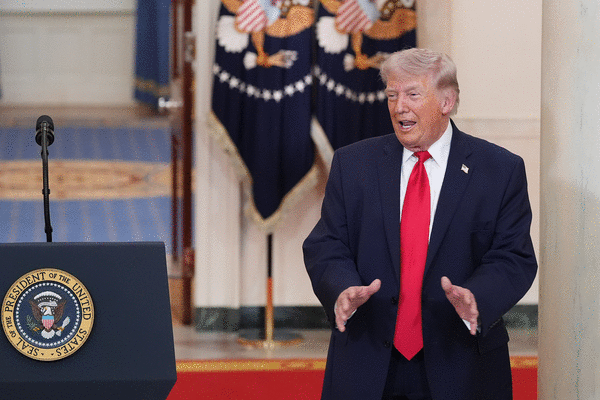
When a leader speaks of a civilization dying “tonight,” the weight of those words does not fall lightly. Language at that level does more than describe a moment; it shapes it. It can steady a nation, or it can heighten fear, harden positions and shrink the narrow space where diplomacy still has a chance to work.
President Donald Trump has long used forceful rhetoric to signal resolve. At times, that clarity has been effective. But to speak as though the outcome is already decided risks turning a volatile situation into a self-fulfilling trajectory.
We should not minimize the stakes. In the conflict with Iran, lives hang in the balance. The consequences of the decisions made now will reverberate across generations. But precisely because the stakes are so high, words must be disciplined. They must reflect not only urgency, but responsibility.
A civilization is not an abstraction. It is the accumulation of human lives: families, cultures and institutions. To invoke its destruction, even rhetorically, demands a visible commitment to preventing that outcome.
Strength is not measured by how vividly we describe catastrophe. It is measured by how effectively we avoid it.
History reminds us that even in the most tense and seemingly irreversible moments, there has often been unseen work, quiet diplomacy, back-channel communication and restraint exercised at the edge. These efforts rarely make headlines, but they have prevented escalation time and again. They depend on leaders leaving space for outcomes that are not yet written.
The American people deserve leadership that reflects both resolve and restraint, leadership that understands the power of words in moments of uncertainty. We must project seriousness without surrendering to fatalism, clarity without escalating rhetoric beyond necessity.
This is not a question of politics. It is a question of posture. Whether our language opens pathways or closes them. Whether it signals control or inevitability.
At moments like this, the world is listening closely not only to what is done, but to what is said. The responsibility is not simply to speak forcefully, but to speak wisely.
The president may think strong words and threats of destruction strengthen America’s position in this war, but history shows that when we invite chaos and catastrophe, no outcome is inevitable. It is the duty of leadership to ensure that never comes to pass.
_____
©2026 The Baltimore Sun. Visit at baltimoresun.com. Distributed by Tribune Content Agency, LLC.










































Comments