CFTC bucks trend, seeks more money from Congress and proposes fees
Published in Political News
WASHINGTON — In a time of budget austerity for most Trump administration agencies, the Commodity Futures Trading Commission stands apart as a regulator that is asking Congress for more money.
The CFTC is requesting $410 million for fiscal 2027, an increase of $45 million, or 12%, from its enacted fiscal 2026 level. The agency also wants to add 14 full-time staff for a total of 650 full-time equivalents.
The proposed funding is needed to help the agency stay on top of rapid market changes that have produced a wide range of retail derivative products and substantial increases in trading speed and volumes, CFTC Chairman Michael Selig wrote in a letter to House and Senate appropriators accompanying the request.
“The adoption of blockchain technologies, crypto assets, and smart contracts is introducing new methods for trading, clearing, settling, and collateralizing commodity price exposure,” Selig wrote. “The CFTC must invest in its own technology and capabilities in order to effectively oversee these new innovations and ensure that they flourish in the U.S.”
Selig is scheduled to appear before the House Agriculture Committee on Thursday.
The agency is also repeating its request to fund itself with user fees, proposing to base the charge on transactions in a move that would dramatically boost its revenue from the market it regulates. It currently relies on fees only for registration. That proposal has not persuaded lawmakers in the past.
The CFTC’s request for more money sets it apart from its sister agency, the Securities and Exchange Commission, as well as other regulators. The SEC asked Congress for $1.9 billion in fiscal 2027 funding, an 11% decrease from the enacted fiscal 2026 level.
The CFTC push to expand its budget “stands out to me in this administration,” said Cheryl Isaac, a partner at Alston & Bird. “In this environment, if the regulator is asking for more resources, it should be taken seriously. They need more resources to carry out their job.”
The CFTC regulates futures, options and swaps markets in agriculture, energy and other areas, such as prediction markets. The number of designated contract markets under the CFTC’s jurisdiction climbed from 18 in fiscal 2024 to 23 in fiscal 2025.
“You’re seeing some significant growth in the last year,” said Walt Lukken, who was CFTC acting chairman from 2007 to 2009. “It indicates the need for more resources and more people.”
Prediction markets have undergone rapid recent growth. The CFTC refers to them as “event contract” markets and is fighting to maintain its exclusive jurisdiction against states that want to regulate them under gambling laws.
“They are novel, and there’s an unprecedented number of product listings that are being filed with the CFTC,” Isaac said.
Even though the agency’s workload has spiked, it’s not breaking the bank with its budget request, said Lukken, who is now CEO of the Futures Industry Association, the global trade association for futures, options and cleared derivatives.
“It’s a pretty modest increase in my view,” he said.
User fees
How the administration wants to fund the CFTC, however, could meet resistance on Capitol Hill.
The White House said it would propose authorizing legislation for the CFTC to collect user fees from market participants to fund its $410 million appropriations request. No money would be spent from the government’s general fund.
The user fee idea has been floated in several administrations only to be rejected on Capitol Hill. That may be the case again this year.
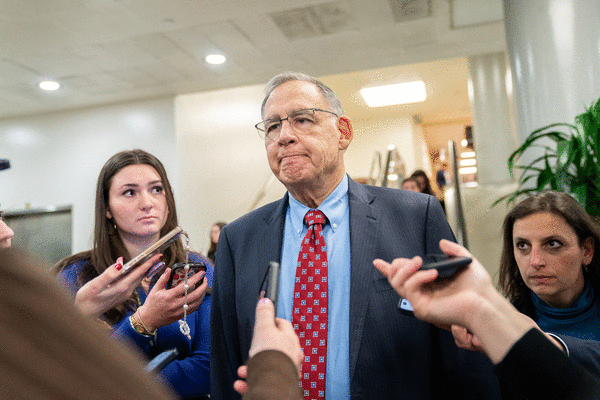
Senate Agriculture Chairman John Boozman, R-Ark., is going to be a hard sell.
“Chairman Boozman is opposed to user fees on derivatives transactions as this would make it more difficult for agricultural and energy end-users, including agricultural producers, farmers, and ranchers, to effectively and efficiently hedge and manage against commodity pricing volatility risk,” Sara Lasure, Boozman’s spokesperson, wrote in an email.
The FIA also opposes user fees.
“The FIA believes a tax on hedging is not a good thing,” Lukken said. “We don’t want to disincentivize people hedging in these markets. We think a well-financed CFTC through the appropriations process is the right approach.”
The CFTC’s budget request for fiscal 2027 reflects only its current regulatory duties. The agency is expected to need even more money and staff if it takes on the lion’s share of oversight of spot digital assets markets, as it would under cryptocurrency market structure legislation pending in Congress.
A bill approved in January by the Senate Agriculture Committee would require digital commodity exchanges brokers, dealers and custodians to register with the CFTC, which would be under new registration categories.
They would have to pay an initial registration fee and an annual volume-based fee linked to trading activity. But the legislation “does not impose user fees on derivatives transactions,” Lasure said.
Regardless of the funding mechanism, the agency would take on substantially more work with responsibility for the crypto spot market.
“It would be a significant jump similar to when Dodd-Frank was implemented,” Lukken said, referring to a major financial law enacted after the financial crisis that gave the CFTC oversight of swaps markets.
©2026 CQ-Roll Call, Inc., All Rights Reserved. Visit cqrollcall.com. Distributed by Tribune Content Agency, LLC.




















































Comments