SEC's power to recoup illicit profits challenged at Supreme Court
Published in Political News
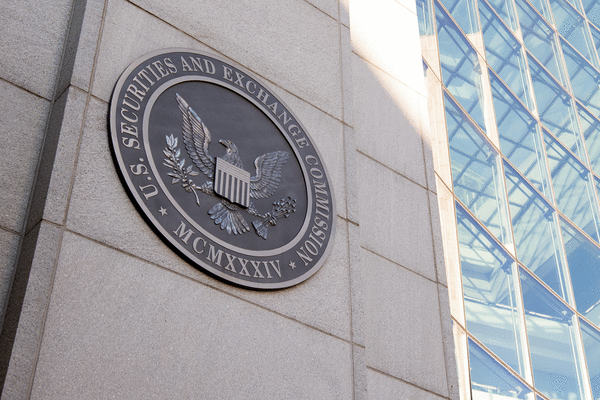
Three times over the past decade, the U.S. Supreme Court has cut the Securities and Exchange Commission’s ability to extract millions of dollars from alleged wrongdoers.
Critics of the commission say it’s not enough. In arguments Monday they are asking the justices to put new limits on “disgorgement,” one of the SEC’s most potent enforcement tools, designed to recoup illicit profits and return them to victims.
The dispute will shape a panoply of SEC cases in which victims aren’t easy to pinpoint, from low-profile record-keeping violations to major insider trading allegations. The SEC used disgorgement to secure orders for more than $6 billion in fiscal 2024 and almost $11 billion last year.
The clash could also affect the SEC’s lawsuit against Elon Musk for allegedly flouting a deadline to disclose his growing stake in Twitter and in the process saving himself more than $150 million. In a suit filed days before Trump took office, the SEC is seeking disgorgement as well as civil penalties. Musk and the SEC told a judge earlier this month they are headed toward a trial.
Supporters say disgorgement is crucial to the SEC’s investor-protection efforts. It ensures that fraudsters don’t see securities law enforcement as just the cost of doing business, said Corey Frayer, director of investor protection at the Consumer Federation of America and a former SEC adviser.
“I don’t think the detriment to the SEC’s enforcement regime could be understated here,” Frayer said. “Without disgorgement, you have enormous incentive to cheat the markets.”
Enriched Treasury
But critics say the SEC is using disgorgement to enrich the Treasury, rather than compensate victims. The commission’s fiscal 2025 financial report indicates it holds more than $5 billion in collected disgorgement and penalties that haven’t been distributed to victims.
And without clear limits, the SEC could weaponize its authority and impose heavier penalties on political opponents than on allies, says Thomas Berry, director of the Cato Institute’s Robert A. Levy Center for Constitutional Studies. The libertarian group filed a brief pointing to Justice Department and Internal Revenue Service investigations of foes of President Donald Trump.
“The biggest risk for us is the lack of a limiting principle for an upper bound for how much they can penalize people found liable in civil enforcement actions,” Berry said.
The Supreme Court ruled in 2017 that the SEC is bound by a five-year statute of limitations when it seeks disgorgement. Three years later, the court upheld the commission’s disgorgement authority against a broad attack but limited its use. The 2020 ruling said awards are permissible only if they are capped at the wrongdoer’s net profits and are “awarded for victims.”
Disgorgement is distinct from civil penalties, which the agency can use as punishment if it can meet the legal requirements. The Supreme Court said in 2024 that defendants have a constitutional right to a jury trial in federal court when the commission asks for civil penalties.
Pump and dump
The latest case involves Ongkaruck Sripetch, who was accused by the SEC of engaging in a variety of fraudulent schemes tied to at least 20 penny stock companies. The SEC said Sripetch, who controlled a website called Stockpalooza.com, joined with associates to promote shares and then dump them before the price cratered. The schemes generated $6.6 million in illicit profits, the SEC said.
Sripetch agreed to a judgment against him while continuing to fight the disgorgement award. A federal district judge then ordered Sripetch to give up $3.3 million in profits and interest. The 9th U.S. Circuit Court of Appeals affirmed, rejecting Sripetch’s contention that the SEC needed to show what lawyers call “pecuniary harm.”
Sripetch says the 2020 Supreme Court ruling – and its requirement that disgorgement be “awarded for victims” – indicates it can be used only when the SEC can show quantifiable harm that would allow for compensation.
“This court made clear what disgorgement means – it requires restoring the status quo and returning funds to victims,” who necessarily must have suffered pecuniary loss, his lawyers argued.
The SEC says that’s a misinterpretation of the 2020 decision. The government also contends that Congress later modified the law to clarify that the SEC has broad disgorgement powers.
Disgorgement “reflects the fundamental principle that it would be quintessentially inequitable to permit a known wrongdoer to profit from his own misdeed,” the SEC said in a court filing. “Disgorgement’s essential function is thus to strip wrongdoers of ill-gotten gains, not to compensate victims for monetary losses.”
As is the usual practice at the Supreme Court, the SEC is being represented by Solicitor General D. John Sauer, putting the full weight of the Trump administration behind the commission.
Power embraced
The agency said in April that it obtained $10.8 billion in disgorgement orders in fiscal 2025, though that figure is inflated by a flurry of settlements in the final months of Joe Biden’s presidency plus the finalization of a long-running case against convicted fraudster Robert Allen Stanford and other defendants.
SEC enforcement actions overall have plunged during the second Trump administration, as have the size of the penalties levied on publicly traded companies and their subsidiaries, according to a report from Cornerstone Research and the NYU Pollack Center for Law & Business.
But the SEC under Chairman Paul Atkins has continued to embrace broad disgorgement powers, says Nicolas Morgan, president of Investor Choice Advocates Network, a public interest law firm that represents people facing commission complaints.
“We certainly have active, ongoing cases where disgorgement was awarded without proof of pecuniary harm to victims, and we’ve seen no letup in those cases,” said Morgan, a former SEC litigator whose group filed two briefs urging the court to rule against the government. “So I don’t see any changing of position on the use of disgorgement by the current administration.”
The SEC last year joined Sripetch in urging the Supreme Court to take up the issue and resolve lower court disagreement.
The court will rule by July in the case, Sripetch v. SEC, 25-466.
©2026 Bloomberg L.P. Visit bloomberg.com. Distributed by Tribune Content Agency, LLC.





















































Comments