US Postal Service mail ballot curbs halted by judge for now
Published in Political News
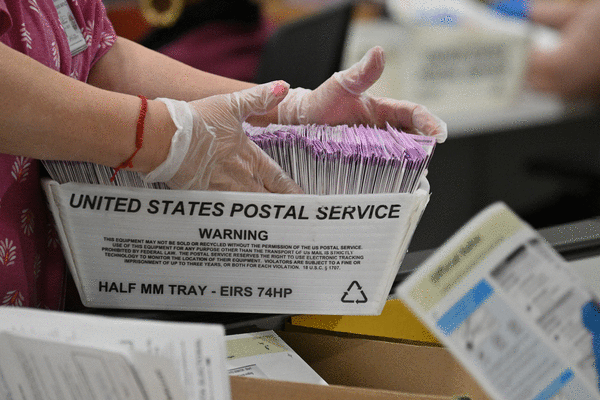
WASHINGTON— A federal judge temporarily blocked the U.S. Postal Service from enforcing key parts of its new restrictions on mail-in ballots, delivering the latest setback to President Donald Trump as Republicans defend their slim majority in Congress in the November midterm elections.
The order on Thursday from U.S. District Judge Indira Talwani in Boston pauses rules designed to carry out the president’s push for more federal control over mail-in voting. The decision follows rapid-fire legal developments in the days since the U.S. Supreme Court lifted an earlier injunction that Talwani had imposed. The fight could soon return to the justices.
Talwani’s order will prohibit the U.S. Postal Service from enacting certain changes to how it handles election mail as she weighs whether to impose a longer-term block. She has scheduled a Sept. 3 hearing on that issue. The contested rules would empower postal authorities to return election mail to state officials if they fail to comply with revised ballot design guidelines and fail to enter voter information in an online federal “portal.”
Talwani’s decision will remain in place for 14 days. The Justice Department could seek to immediately challenge her decision, although federal appeals courts often decline to act on disputes over limited-duration rulings.
The judge held that the Democratic state officials and voting rights organizations that sued had shown at this early stage of the proceedings that they were likely to win their claims that the Postal Service was unconstitutionally asserting control over elections. The states faced “irreparable harm” because complying with the new rules would be “practically impossible” as to the 2026 midterm elections, she wrote.
“The record continues to lack any evidence regarding fraudulent absentee or mail-in voting,” Talwani wrote. “In any event, the USPS’s interest in correcting an unsubstantiated problem through likely unconstitutional means is dwarfed by the overwhelming risk of pervasive disenfranchisement of citizens who need access to mail ballots in order to vote.”
Spokespeople for the Justice Department and the White House did not immediately respond to requests for comment.
The coalition of voting rights groups that sued released a statement praising Talwani for recognizing “the immediate need to protect the entire electorate from the damaging impacts of this unlawful final rule in the lead up to November’s general elections.”
California Attorney General Rob Bonta, a Democrat who is co-leading the lawsuit, also hailed the ruling.
“President Trump must keep his hands off our elections,” he said in a post on X. “The right to vote is a foundational principle of our democracy, and we’re making sure it remains protected for everyone.”
The latest legal wrangling comes as state election officials across the country prepare to send ballots to voters in the coming weeks, raising fears of a chaotic and confusing situation if late-breaking court rulings upend existing voting procedures.
North Carolina is set to start mailing ballots as early as Sept. 4. The North Carolina State Board of Elections said in a statement earlier on Thursday that it had taken steps to comply with the new Postal Service rules and submitted its envelopes to the agency to approve.
“We will do our best to comply with any court decisions, as we always do,” the board said.
Derek Bowens, director of elections in Durham County, North Carolina, said in an interview that his office has approximately 1,000 ballots ready to mail on Sept. 4, but they are waiting to seal the envelopes pending the outcome of the court fight.
The county expects to send about 13,000 ballots this election cycle, he said, and hasn’t budgeted for the thousands of dollars it would cost to order new versions of the envelopes. If his office can’t find surplus funds to use, they’d have to ask county officials for an extra appropriation, he said.
“At this point it’s a waiting game,” Bowens said.
The Postal Service adopted the new rules — which formally took effect in the past week — in response to Trump’s March executive order directing federal agencies to take steps that the president and his allies contend are needed to ensure only eligible U.S. citizens vote. Instances of noncitizen voting historically are rare.
Democrats and voting rights advocates contend Trump is unconstitutionally trying to assert power over elections that belongs to states, and have accused the administration of rushing to implement his policies to aid Republicans in their fight to keep control of Congress.
There are two cases challenging the Postal Service rules before Talwani, who was appointed by former President Barack Obama — one brought by Democratic officials in two dozen states and the District of Columbia and the other by a coalition of voting rights organizations.
The states argued in their request for a short-term order that allowing the agency to enforce the rules ahead of the Nov. 3 contest “would be a catastrophe for voting rights and elections administration” and that “compliance will be impossible” in some parts of the country.
“This new regime radically departs from the decades of practice upon which states have built their mail voting systems, and it comes after states have already put those systems in motion for this election,” the state attorneys wrote.
The Justice Department argued that the challengers’ arguments in favor of an immediate block were based on “doomsday assumptions” that didn’t match the “modest informational requirements” the Postal Service adopted. The new rules turned “longstanding recommendations” for election mail best practices “into requirements,” the government said in an Aug. 27 written brief.
“States remain entirely free to run their own elections and manage their own voter rolls in any manner that is otherwise consistent with federal law, including by using (or not using) the US mail for any part of their election process,” department attorneys wrote.
A third set of lawsuits is pending before a federal judge in Washington. One of those cases was filed by national Democratic Party leadership organizations and elected officials, who have also asked for an order blocking the Postal Service rules from being enforced while the litigation goes forward. The judge set a schedule that wraps up after Talwani hears arguments on Sept. 3.
©2026 Bloomberg L.P. Visit bloomberg.com. Distributed by Tribune Content Agency, LLC.















































Comments