Philly's political parties can now spend unlimited amounts in coordination with their candidates
Published in Political News
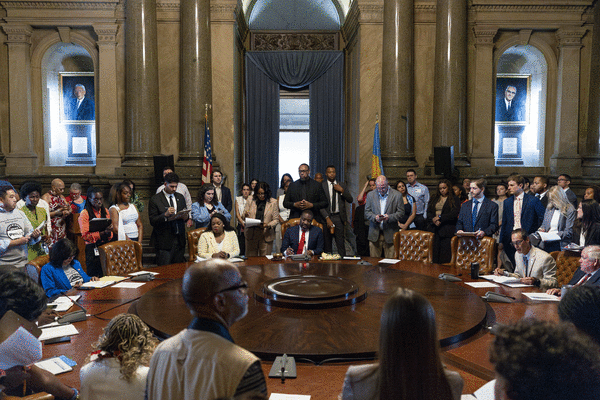
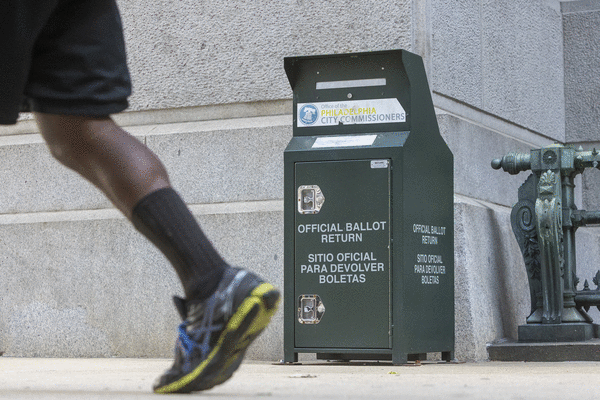


PHILADELPHIA — Political parties in Philadelphia can now spend unlimited amounts of money in coordination with their chosen candidates, according to a new board of ethics policy approved Wednesday.
The policy, which was prompted by a recent U.S. Supreme Court decision, has the potential to dramatically increase the power of parties in Philly politics.
For instance, in next year’s city elections — when Mayor Cherelle L. Parker and all 17 City Council members will be up for reelection — the candidates endorsed by the Democratic City Committee could be able to access major financial advantages over their Democratic primary rivals, if the party chooses to coordinate with them.
Candidates are still bound by the city’s strict campaign finance rules limiting the size of donations to their campaigns — no more than $3,700 per year for individual donors, and $14,800 for organizations — and prohibiting them from coordinating with independent expenditure committees, or outside groups that spend money on candidates’ behalf.
But endorsed candidates will now be the only primary contenders allowed to coordinate with a group that has no restrictions on how much money it can collect: the party. The candidates, for instance, will be able to work with the party on messaging strategy, the timing of TV ads, and where to deploy door-knocking canvassers.
While the policy does not allow donors to require that parties spend their money on particular candidates, endorsed politicians with deep-pocketed backers can encourage donors to contribute to the party, with the understanding that the party will ultimately decide how the money is spent.
The impact of the new policy will depend on how aggressively candidates, parties, and donors seek to take advantage of it. But it has the potential to steer power in some elections back toward the city’s Democratic establishment after a period in which labor unions, special interest groups, and progressive super PACs have become increasingly influential.
“This Supreme Court ruling is going to have the effect of shifting power back to political parties and away from independent expenditures in a lot of ways,” said Philadelphia elections lawyer Adam Bonin.
In National Republican Senatorial Committee v. Federal Election Commission, the Supreme Court in June overturned limits on how much money parties could spend in coordination with candidates, citing parties’ free speech rights. The 6-3 decision, with the conservative justices in the majority, was widely seen as the latest in a series of cases that have demolished longstanding rules around money in politics.
But the NRSC case centered on a law related to general elections for federal office, and it was not initially clear whether the Philadelphia Board of Ethics would determine the ruling applied to local elections and to primaries.
The board, in a 4-0 vote with member Nelson Diaz absent, approved a policy that answered both of those questions affirmatively, meaning local political parties are now able to coordinate with their chosen candidates in primaries.
In deep-blue Philadelphia, where Democrats hold a 7-1 voter registration advantage over Republicans, the party’s primary contests usually determine the outcomes of elections.
In next year’s elections, progressives are hoping to make gains in Council, and Parker is aiming to secure a second four-year term. So far, Parker has attracted one announced Democratic primary challenger, former city official Shania Bennett. No Philadelphia mayor has lost reelection since the Home Rule Charter was adopted in 1951.
The new policy holds that the party can coordinate with its nominees only in general and special elections. In primaries, the ethics board will allow the parties to set their own rules for determining their preferred candidates. The Democratic City Committee determines its endorsements by holding a vote among its ward leaders.
The policy, meant to clarify the city’s rules in advance of next year’s municipal elections, is temporary. The full details of the new rules will be fleshed out in regulations the board will tackle in the coming months.
Democratic City Committee Chairman Bob Brady said the party was “still reviewing the new guidelines.”
“Protecting constitutional rights remains a priority of the Democratic Party, especially the right to participate in our democratic process,” Brady said in a statement. “We will continue the work to ensure that the final implementation of these policies and laws will right the wrongs that have too long infringed on First Amendment rights.”
To be sure, there are significant roadblocks for candidates hoping to benefit from the new policy. In crowded primaries, for instance, the Democratic City Committee often declines to endorse when a majority of ward leaders fails to coalesce around one candidate. And the candidates and parties would have to find donors willing to give large sums knowing that they cannot control how the money will be spent.
Additionally, Bonin said, the new policy may still be more restrictive than what the Supreme Court decision appears to have envisioned because the board is seeking to maintain many of the city’s existing campaign finance rules.
“They are doing it in a way in which, initially, it seems they’re trying to change their rules as little as possible, while still recognizing they need to act,” he said.
The policy could also have an impact on elections for the two seats on Council that are set aside for minority-party or independent candidates. Republicans held those seats for about 70 years before Councilmembers Kendra Brooks and Nicolas O’Rourke of the progressive Working Families Party won them in the last two election cycles.
Before Wednesday, it appeared possible the ruling could create an uneven playing field, with the Republican City Committee being allowed to coordinate with its nominees while the Working Families Party was unable to do so because it is not a major political party under state law.
The language of the board’s approved policy, however, effectively gives the Working Families Party the same rights as the Democratic and Republican Parties because it fielded candidates in the most recent municipal election.
Republican City Committee chairman Vince Fenerty celebrated the ethics board’s decision.
“I’m very happy,” Fenerty said. “It will make our candidates be able to interact with other groups easily, and hopefully it will be a good day for the Republican Party of Philadelphia when we can have good funding to be victorious in some municipal elections.”
A Working Families Party spokesperson said this summer that the party opposed the Supreme Court’s attacks on campaign finance law, but did not rule out the possibility of the progressive group taking advantage of any new policy.
_____
©2026 The Philadelphia Inquirer. Visit inquirer.com. Distributed by Tribune Content Agency, LLC.





























Comments