New bill would compensate returned political hostages like Paul Whelan
Published in Political News
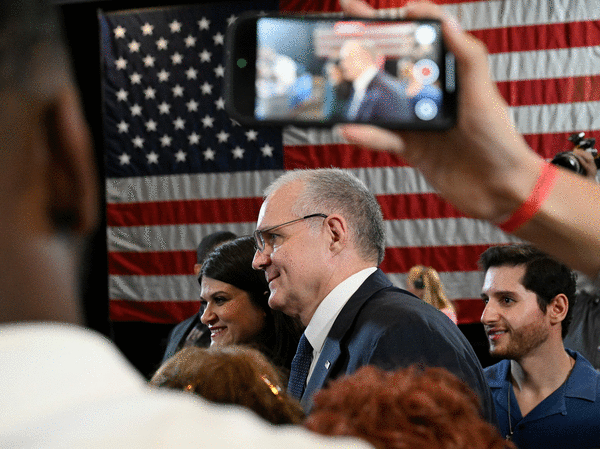
WASHINGTON ― Legislation introduced this week by Michigan U.S. Rep. Haley Stevens would allow for compensation for political prisoners who have returned after being held abroad against their will.
The bill is largely inspired by the experience of Michigan's Paul Whelan, a former security executive from Novi who was held by Russia for more than 5 1/2 years and released in August 2024.
Whelan was arrested while in Moscow for a friend's wedding on Dec. 28, 2018, on what he and U.S. officials long decried as bogus espionage charges. Convicted in a closed-door trial in Moscow in 2020, the former U.S. Marine was sentenced to 16 years of hard labor.
Whelan was released as part of a historic prisoner swap, the largest such exchange since the Cold War, covering 24 people from six countries. But Whelan struggled after his return to find employment and health insurance after having lost his home and job while imprisoned in Russia.
"Reintegration should not stop at the airport, and that was something that left me, as a lawmaker, dumbfounded ― seeing Paul Whelan's experience so up close and almost firsthand in terms of coming home, not having a place to live, no longer having his job, having five and a half years of lost earnings and a lost life," Stevens said.
"This is a very solid piece of legislation that brings some dignity to the people who I believe are American heroes."
Under the bill, the Paul Whelan Hostage Compensation and Reintegration Act, U.S. nationals would be eligible for compensation if the State Department had designated them as wrongfully detained, meaning the U.S. government considers the charges against them to be made up and that they're essentially a political hostage held in an effort to extract something of value from the U.S.
The bill, if adopted, would create an application process for hostages to apply to the Secretary of State's office for compensation of around $69,000 for each year of detention ― a rate tied to the Social Security average wage index ― paid as a one-time lump sum. If a hostage dies while detained, their next of kin may apply for compensation.
The money would come from a more than $3 billion fund at the Department of Justice of frozen assets seized as a result of sanctions against bad actors or adversarial countries, Stevens said.
"The goal is just to establish a transparent and objective formula that recognizes the serious and real economic consequences of the individual who's wrongfully detained," Stevens said. " You know, the time taken away from someone's career, their livelihood, and the ability to support themselves and their families. The families go through hell. The individual goes through hell."
Stevens partnered with Whelan on the legislation and decided to name it after him. She noted she might not ever get to vote on it, however, as the end of the term nears and after she lost last month's Senate primary election.
"I'm naming this legislation for Paul to recognize what he endured and to underscore a very simple point that when Americans survive years of wrongful detention overseas, our commitment to them is not going to end just when they return to American soil," she said. "It's to help them rebuild. It's to help them reintegrate."
The legislation is supported by the groups Hostage US and the Foley Foundation, according to Stevens' office.
"This bill represents an important step toward bridging the gap in immediate financial assistance for former wrongful detainees upon return," said Liz Cathcart, executive director of Hostage US, a non-governmental organization that supports hostages, detainees and their families.
Whelan, 56, did eventually find full-time work and now has his own place in the village of Manchester in rural Washtenaw County, about a mile from his parents' home. He said he would apply for the compensation if the bill is enacted and would encourage other former hostages who are eligible to do the same.
"When I came home, a lot of people thought, you got off the plane and the U.S. government gave you a briefcase full of money to compensate for basically what was a spat between two governments. The honest answer is that it's quite different," Whelan said.
Whelan was lucky to be able to move in with his parents, who could support him as he worked to readjust and search for work. But he encountered hurdles in trying to afford a car and secure health insurance at first and he fell behind on his retirement savings.
Whelan knows of other detainees whose families couldn't afford to help when they returned home after having lost everything, he said.
"It's a long row to hoe, and it might take the person a little while to get back into the workforce, to be able to interact with people and do things productively," Whelan said.
"We always say that for every year that you're held, it takes at least six months to get back to normal, so this compensation is extremely important, and it's going to help a few hundred people that have come home before me, as well as people that are currently being held."
Whelan and other advocates for wrongfully detained people have been trying to drum up support for the bill on Capitol Hill, saying the issue isn't partisan but "an American issue" that affects Americans from every state.
"So I'm hoping that members of the House and the Senate on both sides will do the right thing and step up and vote to approve this bill because they'll be helping out their constituents," Whelan said.
In part due to Whelan's advocacy, Congress previously adopted a provision that funds health benefits for returned hostages who need them.
_____
©2026 www.detroitnews.com. Visit at detroitnews.com. Distributed by Tribune Content Agency, LLC.









































Comments