Commentary: 'Make Education Great Again' for which children?
Published in Political News
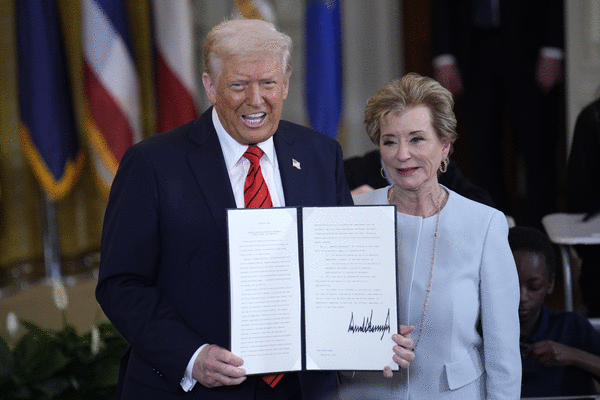
Last month, the U.S. Department of Education posted an image to Facebook styled like an old woodcut print, with President Donald Trump and Education Secretary Linda McMahon above the words MEGA and “Make Education Great Again.”
The slogan reminded me of a poem I read in high school: Langston Hughes’ “Let America Be America Again.” Published in 1936, the poem considers the distance between the country’s promise of liberty and equality and the lives of Black Americans, Indigenous people, immigrants, and poor people excluded from that promise. Hughes’ “again” reaches toward the America the country claimed to be and holds it to a promise it had never kept.
If “again” refers to a particular moment in American history, I should be able to find it. So, I went looking for the America the slogan asks us to recover. What I found were moments when schools were used to erase children’s cultures, teach them a false history, or shut them out of classrooms altogether.
The first place my search took me was 1879, when Army officer Richard Henry Pratt founded the Carlisle Indian Industrial School, with its mission summarized as “Kill the Indian, save the man.” Carlisle became a model for a federal boarding school system that, according to the Interior Department, forcibly removed tens of thousands of American Indian, Alaska Native, and Native Hawaiian children from their families to assimilate them into white American culture. Students were given English names, had their hair cut, and were discouraged or prohibited from speaking their Native languages. The schools’ legacy includes the “near extinction of numerous Indigenous languages” and deep wells of intergenerational trauma.
Four decades later, in 1919, Mildred Lewis Rutherford, historian general of the United Daughters of the Confederacy, published "A measuring rod to test text books, and reference books in schools, colleges and libraries." Her guide urged Southern schools to reject any textbook that “says the South fought to hold her slaves” and “that speaks of the slaveholder of the South as cruel or unjust to his slaves.” She also championed textbooks arguing that “the servants were very happy in their life upon the old plantation,” that secession was not rebellion, and that the North was responsible for the “war between the states.” Her criteria shaped Southern history textbooks for decades.
The years after Brown v. Board of Education offered another possibility, as white families and segregationist organizations created private schools—also known as segregation academies—to avoid integration. For example, Prince Edward County in Virginia closed its public schools from 1959 to 1964 rather than integrate them. During this time, white students could attend the academies supported by state tuition grants, while the county made no such provisions for Black children, some of whom missed as many as five years of school.
I set out to find the “again” the Trump administration wants to return to, and I found several examples in its current education policies.
The goals of Americanization and the erasure of Native languages are evident in the administration’s fiscal year 2027 budget, which proposes eliminating the $890 million English Language Acquisition program while describing bilingualism as coming at the expense of “English primacy.” The same budget eliminates Native Hawaiian Education and ends dedicated funding for Alaska Native Education, two programs that support the learning of languages that boarding schools once punished Native children for speaking.
The removal of accurate yet violent aspects of American history is present in the administration’s 2025 executive order, “Ending Radical Indoctrination in K-12 Schooling,” which reestablished the 1776 Commission and directed it to promote “patriotic education.” The order calls for federal agencies to identify and potentially restrict funding for instruction the administration defines as promoting “discriminatory equity ideology.” Rutherford gave Southern school boards a measuring rod for textbooks. This order gives the federal government a measuring rod for classroom learning throughout the country.
The administration’s 2027 budget request also proposes $2 billion for MEGA grants, consolidating funding from 17 existing programs into a single funding stream. Programs folded into MEGA include those that support homeless students, teacher training, community learning centers, civics education, rural schools, and magnet schools created to desegregate public schools. The budget eliminates a Civil Rights Act program that helps districts execute desegregation plans, while committing $500 million to expand charter schools under the guise of school choice. Prince Edward County paid for some children to leave public school and made no provisions for the rest. MEGA would expand the exits and give states less than a third of the money for the children with nowhere else to go.
The administration’s policies show that making education great again means bringing back educational spaces where children are separated from their languages and cultures, textbooks are shaped to serve a preferred account of history, and public education is divided along racial lines.
So, I can’t read “Make Education Great Again” as a promise to all of America’s children. I read the policies behind the slogan as evidence of an educational agenda being built for some children and not others. Hughes asked America to become the country it had promised to be. Nearly a century later, American education faces his question again: Who gets to be part of that promise, and how many children are we willing to let this administration leave out?
____
Stephanie Toliver is a Public Voices Fellow and a member of the OpEd Alumni Project sponsored by the University of Illinois.
_____
©2026 The Fulcrum. Visit at thefulcrum.us. Distributed by Tribune Content Agency, LLC.












































Comments