Cantwell unveils AI safety framework as Congress stalls ahead of election
Published in Political News
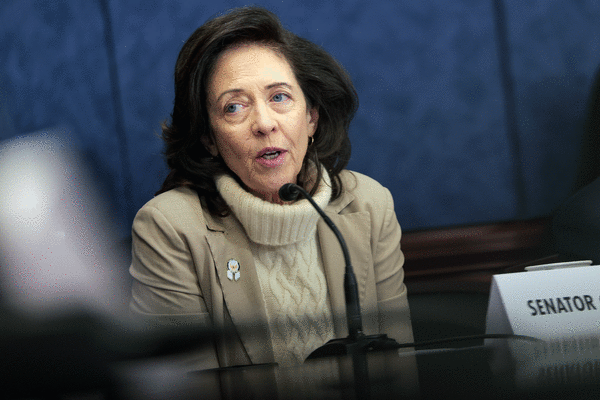
WASHINGTON, D.C. — Sen. Maria Cantwell, the top Democrat on the Senate committee overseeing artificial intelligence, on Wednesday unveiled a set of principles for regulating AI, making a fresh push for congressional action as concerns proliferate over the safety of the technology.
Cantwell's framework would put enforceable federal safety standards at the center of U.S. AI policy, including testing and third-party audits of the most advanced systems before they are released. She is betting that a rapidly changing landscape, growing public anxiety and calls from parts of the industry for government intervention could create an opening for bipartisan action.
Cantwell's proposal leaves some fundamental questions unanswered.
Tech industry leaders have increasingly called for clear federal standards to govern the development and deployment of advanced AI, arguing that a patchwork of rules or uncertainty could hinder innovation and create conflicting requirements. AI safety experts and advocates say Congress must move quickly to enact specific and rigorous rules that address who should oversee AI, whether development should slow until guardrails are in place, how to ensure independent auditing and how regulators can keep pace with the technology's rapid evolution.
Key details within Cantwell's proffered principles, including penalties for noncompliance or what a third-party auditing entity would entail, remain unresolved.
Asked whether her principles are aggressive or specific enough to meet the moment, Cantwell pointed to the lack of comprehensive alternatives. Have you seen something else?" she said in an interview with The Seattle Times. "These are very comprehensive, in the way that the system could work. But now we have got to get people to dialogue about that."
"We have to hear from people about what that looks like," she added. "We're not trying to be vague. We're saying that it is part of the process of figuring out what it actually would look like."
The proposal is the latest attempt by federal lawmakers to suggest how to rein in the fast-growing AI industry amid clarion calls for regulations and growing backlash from voters over data center construction. The scramble for regulations — increasingly framed as a national security imperative — quickened this summer after OpenAI's unreleased AI agents breached the infrastructure of AI startup Hugging Face.
Democratic lawmakers largely agree that AI needs regulation, but not on what the regulator should look like.
Sen. Bernie Sanders, I-Vt., and Rep. Greg Casar, D-Texas, recently introduced a bill to ban superintelligence and temporarily pause AI development, overseen by a new Cabinet-level federal agency; Rep. Pramila Jayapal last week proposed a framework modeled on bank regulation, requiring every AI firm to hold a federal charter to do business in the U.S.; Senate Majority Leader John Thune, R-S.D., and Sen. Amy Klobuchar, D-Minn., have not yet released bill text on their own proposal to address catastrophic risks from advanced AI models.
Despite the flurry of ideas, Congress has not advanced any comprehensive AI legislation this year, stymied by divisions within and between political parties. Meanwhile, President Donald Trump has opposed demands for new regulation, dismissing warnings about AI's catastrophic risks as a "hoax."
"Now is the opportunity to use the moment of the industry calling for oversight and standards, and their fear of what could happen ... to get more people on the same page," Cantwell said. "When we tried to pass some of these ideas in a bill two years ago, they got blocked, and so I'm hoping that this will now get us back to a more participatory framework with our colleagues from both sides of the aisle."
"There are members who believe in standards on the Republican side," she added. "So we have to find those members who want to pursue that avenue."
Cantwell, who is a former tech executive, holds a powerful position to influence what comes next. If Democrats retake the Senate after the November midterm election, she is poised to take the Senate Committee on Commerce, Science, and Transportation gavel in January from Republican Sen. Ted Cruz of Texas, who has not convened markups on bipartisan AI safety legislation this year.
Her principles are a precursor to more comprehensive legislation she says is imminent, and a framework she hopes can give Congress a common starting point.
“These principles lay the groundwork for serious and comprehensive legislative action that creates strong guardrails for AI’s risks and earn the public’s trust, while promoting AI’s potential and positioning American AI as the gold standard for the world," Senate Minority Leader Chuck Schumer, D-N.Y., said in a statement backing the proposal.
Microsoft Vice Chair and President Brad Smith said the senator's principles "will help the public consider the issues that matter."
"Senator Cantwell's framework advances the public discussion the nation needs as we consider the future of AI," Smith said in a statement Wednesday morning.
The blueprint
The newly released principles largely replicate the core ideas from Cantwell and Republican Sen. Todd Young's Future of AI Innovation Act of 2024, which sought to establish voluntary standards and assessments and create a test bed program at classified national labs. That bill never reached a vote on the Republican-controlled Senate floor.
Now, Cantwell is urging the U.S. to adopt enforceable safety standards that are developed by the National Institute of Standards and Technology in coordination with key federal agencies, such as the Department of Energy and the Department of Defense, as well as researchers and frontier AI companies.
Cantwell proposes first building what she calls a national AI ecosystem of frontier AI companies, universities, independent researchers and the federal government. Led by NIST, those entities would establish mandatory safety and security standards for advanced AI systems that pose the most risks, such as cyberattacks and the potential loss of human control. Those standards would be updated as AI evolves.
Advanced models would undergo government or third-party testing — or both — followed by a third-party audit to ensure models meets federal standards before release. Companies that fail to comply could face civil and criminal penalties, while government and independent experts would continually scrutinize and stress-test advanced models. The precise testing and oversight regime has yet to be determined.
Developers would have to give testers and auditors access to assess risks and promptly report safety incidents, although the principles do not define "promptly."
The approach echoes calls from some of the industry's most prominent leaders. Anthropic CEO Dario Amodei has called for mandatory third-party evaluations and federal authority to block models based on the findings, while OpenAI CEO Sam Altman has agreed that independent evaluators should have employee-like access.
The principles — which Cantwell's office said are likely to evolve as discussions continue — also call for greater corporate transparency, public-private partnerships, measures to mitigate social harms and global cooperation. They seek protections for children's safety online and say AI companies should fund apprenticeships, education and worker training to prevent displacement. Environmental harms are not addressed, though Cantwell said "they should be."
Cantwell also proposes a "secure channel" with China for communication when a significant AI incident could threaten either country or international security.
What's still missing
Experts and advocates for AI safety and security — who had not yet seen Cantwell's principles but discussed with The Times what they want from Congress — broadly called for mandatory federal standards, testing and auditing before advanced models are released.
However, among the eight experts The Times spoke with, some calls are left unanswered in Cantwell's principles.
Some called for a new centralized executive agency or subagency to oversee AI regulations. Others argued development should slow down until federal guardrails are in place. Many pointed to environmental harms and growing consumer privacy concerns. Multiple experts preferred government testing over third-party testers, questioning whether private entities could remain independent of corporate interests.
Every expert underscored the urgency of the moment.
"Unless we act soon, we are actively losing control — and by we, I mean the public and policymakers, everyone who's not inside of the company," said Stephen Casper, computer scientist and assistant professor at Harvard Kennedy School.
A closing window
The House and Senate won't reconvene until after the midterm election. When Congress returns in mid-November, the chambers will have few remaining days in session together, tanking the likelihood of comprehensive AI legislation this year.
But Cantwell signaled confidence that such legislation can advance next year — and suggested Congress could use the remaining weeks to enact short-term guardrails to ward against the biggest risks. She did not elaborate, pointing instead to input from federal players such as NIST and the Department of Energy.
"I do think that they can right now come up with the biggest risk scenarios and outline them, and that should be something that we could get done quickly while they're looking at the larger system," Cantwell said. "Congress can move fast when it wants to, and it feels like it's under threat."
Cantwell did not offer a timeline for developing the mandatory federal standards. But she rejected the idea it would take years to establish them.
"We don't know all the answers, but we know the general direction that we need to go, and we know the importance of these various roles that people play," Cantwell added. "But we have to get even more concrete about it in a short period of time.
Anumita Kaur reported from Washington, D.C., and Destiny Muller reported from Seattle.
______
© 2026 The Seattle Times. Visit www.seattletimes.com. Distributed by Tribune Content Agency, LLC.


























Comments