Trump's rhetoric tests Republicans' pitch in Minnesota suburbs
Published in Political News
In a social media post Thursday afternoon, President Donald Trump accused Somali immigrants of bringing violence to Minnesota and urged residents to “fight back.”
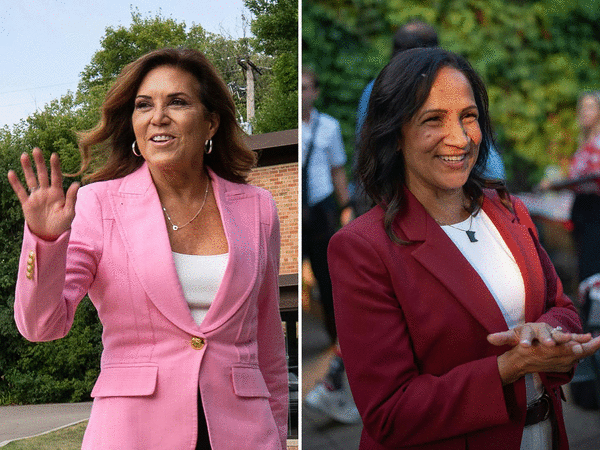
Hours earlier, Republican candidate for governor Lisa Demuth had offered a very different message. At a brewery a few miles from Eden Prairie High School, she was asked what she would say to Minnesota’s Somali community after a reportedly gang-related shooting outside the school’s homecoming football game injured two people.
“Everyone deserves safe communities,” Demuth replied.
By Friday, Demuth had put more distance between herself and the president’s post, which some groups called an incitement to violence.
“President Trump doesn’t speak for my campaign, and it’s not language I would have used,” she said in a statement to the Minnesota Star Tribune.
Republican U.S. Senate nominee Michele Tafoya also pushed back: “No, I do not think President Trump’s post was helpful or appropriate.”
Their responses come as Minnesota Republicans try to make public safety a defining issue in the campaign’s final weeks. Demuth said Thursday that recent violence had brought it “to the top of all Minnesotans’ minds,” arguing that tougher prosecution and sentencing would make communities safer.
Tafoya has also cited the Eden Prairie shooting while criticizing Democratic candidate Lt. Gov. Peggy Flanagan’s record on policing.
Republicans see a chance to regain ground in suburbs shaken by the shootings after more than a decade of Democratic gains. And though some GOP strategists say Trump’s messaging keeps attention on an issue that could energize voters who might otherwise stay home, it also raises a harder question for many of their candidates: What happens when the president takes that argument further than they do?
Republican state Sen. Jim Abeler, whose north-metro district is one of the top targets for both parties in the fight to control the Legislature, said after the president’s post that he hoped Trump would leave the response to Minnesota officials.
“Minnesota and its police, sheriffs, communities are more than capable to handle this,” he said. “This is something for the states. Let us resolve it and we will.”
Trump’s message, candidates’ pivot
Trump’s recent comments reprise an attack he made just before launching Operation Metro Surge. In December, he called Somali immigrants “garbage” and said he did not want them in the United States.
In her response to his most recent post, Demuth said she planned to “continue talking to Minnesotans about my plans to stop fraud and directly confront the rising gang violence that we’ve seen over the past several weeks.”
She also turned the issue back on her opponent, Sen. Amy Klobuchar, saying the Democrat has “said nothing while these problems have spiraled out of control” under Gov. Tim Walz and Hennepin County Attorney Mary Moriarty.
Klobuchar made her own public safety case Friday at Century College in White Bear Lake, flanked by current and former law enforcement officials. She pointed to her record as Hennepin County Attorney and proposed a regional gang violence task force, more help for police departments hiring officers and new gun safety measures.
Asked about Trump’s post, she said the problems required more than rhetoric: “It is not the time for tweeting or ‘truthing,’ it’s the time for action.”
Demuth’s more measured approach does not mean Somali Minnesotans have been absent from attacks surrounding her campaign.
Restore Sanity, an independent outside spending group backing her campaign, released an ad before the primary portraying her as a superhero, with Somali men behind her, promising to send “fraudsters to the slammer.” The group has also run an ad linking Klobuchar work on money transfers to Somalia to the state’s fraud scandals.
Tafoya also aimed her response at Flanagan, saying she “refuses to admit and accept that Somali gang violence is a specific problem that needs solutions. She will not even name the problem, let alone solve it.”
The Star Tribune has reached out to the Flanagan campaign for comment.
The suburban test
Public safety is familiar campaign ground for Republicans nationally and in Minnesota. They criticized Democrats’ response to the destruction in Minneapolis after George Floyd’s murder in 2020, and Scott Jensen made crime a central issue in his 2022 race against Gov. Tim Walz.
Asked Thursday whether the violence could make formerly Republican suburbs such as Eden Prairie, Edina and Bloomington competitive again, Demuth said: “I think every seat in the House, every seat in the Senate - definitely the governor and all the constitutional officers - I think every single seat is in play right now.”
But in recent surveys, voters have ranked issues such as affordability and fraud above public safety. And the suburbs Republicans hope to win back have changed along with their politics. In Eden Prairie, residents of color made up 20% of the population in 2010. A decade later, it’s grown to 30%.
After the shooting, Eden Prairie Schools Superintendent Josh Swanson reminded families that Somali students and neighbors were “just as outraged by what happened as everyone else.”
Preya Samsundar, a Republican political operative, said the GOP is right to be talking about the issue of gang violence and crime in the suburbs. She said what happened at Eden Prairie’s football game “shatters the notion” for suburban residents that “they’re untouchable” from crime they may view as limited to Minneapolis and St. Paul.
Samsundar said Trump stamping in may not hurt the GOP, either. She said voters believe Republicans excel on crime and policing and Democrats struggle, so it’s a better topic for him to highlight than others. Trump’s message will also fire up a GOP base that may be less enthusiastic in a tough political environment for Republicans, she said.
“I think this is an issue that’s in [Trump’s] wheelhouse,” said Amy Frederiksen, a GOP strategist and former Republican Senate Majority Leader.
Still, Frederiksen said Trump “always complicates” things and that he could take things too far with an issue that would otherwise win over voters. He did that with Operation Metro Surge, she said, failing on his promise to only go after the “worst of the worst.”
“What that was, was not anything close to that,” Frederiksen said.
_____
Ryan Faircloth of the Minnesota Star Tribune contributed to this story.
_____
©2026 The Minnesota Star Tribune. Visit startribune.com. Distributed by Tribune Content Agency, LLC


































Comments