Klobuchar and Demuth spar over taxes, costs and regulation at business forum
Published in Political News
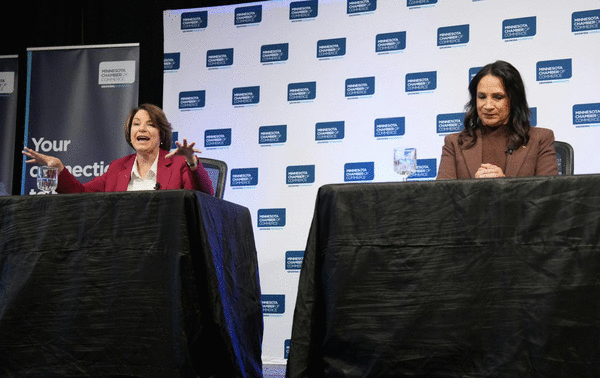
MINNEAPOLIS — Amy Klobuchar and Lisa Demuth offered competing visions for Minnesota’s economy on Monday, debating how to lower costs, stop fraud, attract businesses and regulate the fast-growing artificial intelligence industry.
Demuth, the Republican speaker of the Minnesota House, tried to tie rising costs to Democratic policies and Gov. Tim Walz’s administration. She said she’d lead the way with regulatory reform and reducing taxes if elected governor.
Klobuchar, a Democratic U.S. senator, repeatedly pointed to how federal decisions, such as the war in Iran, have driven up gasoline prices and other costs. She laid out her plan to lower health care costs and said she would oppose new tax hikes.
The Minnesota Chamber of Commerce forum was the first of two events this week where Klobuchar and Demuth are sharing the stage. They will square off again Wednesday night in a televised debate on Fox9.
Here are the highlights of Monday’s forum.
Tax hikes
Both Demuth and Klobuchar said they would not support tax increases.
Their pledges come three years after Democrats in the Legislature approved higher vehicle registration taxes, inflation-linked gas tax increases, a metro-area sales tax for transportation and a 50-cent fee on qualifying retail deliveries. DFLers also added a 1% tax on net investment income above $1 million that year.
Demuth said Walz added thousands of new state employees, and as governor Demuth said she would “right-size” the government and allow taxpayers to keep more of their money.
“We have seen our state be overtaxed year after year under the current administration,” she said.
Klobuchar said she has been willing to fight her own party over taxes in the past. Her opposition to tax hikes puts her at odds with more progressive legislators at the Minnesota Capitol, who have expressed support for taxing the wealthy.
“I have made clear I’m not going to increase taxes, and I would actually like to lower taxes,” Klobuchar said.
Both candidates said they also would root out fraud in social services programs that has cost the state money.
Health care
Klobuchar proposed a multi-step approach to dealing with rising health care costs, including expanding the state’s bulk purchasing of prescription drugs and creating a new tax credit to offset the expiration of federal Affordable Care Act subsidies. The lapse of those subsidies has driven up premium costs for millions of Americans.
The proposed state tax credit would be delivered through MNsure and targeted at small business owners, self-employed workers and farmers. Klobuchar has said the credit would cost up to $180 million.
“I’m going to do it in Minnesota if he won’t do it in Washington,” Klobuchar said, referring to Trump’s refusal to extend the federal subsidies.
Demuth said, as a legislator, she supported the state’s reinsurance program, which reimburses health insurers for high-cost medical claims as a way to help lower costs.
The Republican said she would seek to bring down costs and create more jobs to help people obtain and afford coverage through the private market.
Data centers and artificial intelligence
Both candidates for governor said local communities should have the power to approve or stop data centers in their hometowns. Klobuchar and Demuth have similar positions on the issue, generally supporting the construction of these large projects and opposing substantial new state regulations.
Demuth noted that the Legislature in 2025 passed a bill when she was House speaker — led initially by DFLers — aimed at protecting the state’s climate goals and preventing energy bills from rising because of the cost of data centers.
Klobuchar said she would support further restrictions on the use of nondisclosure agreements by data center companies. A bill to ban those NDAs was voted down by Republicans in a House committee last year, and Klobuchar blamed Demuth for the measure not advancing. Since that vote, on the campaign trail, Demuth has also called for a ban on NDAs for data centers.
Demuth called for “guardrails” on artificial intelligence as the technology improves but said it can also help Minnesota businesses and even detect fraud. Klobuchar said Minnesota has to “develop AI responsibly,” and noted she has worked on regulations for AI along with Republicans like Sen. Ted Cruz.
Paid family and medical leave
Minnesota’s new paid family and medical leave program, which is funded by a new payroll tax, has posed challenges for small and midsize companies.
Demuth criticized the law passed by Democrats in 2023, saying concerns raised by Republicans and businesses have since materialized.
She said that includes “shortening the workforce” and making things unpredictable for businesses. She said people are abusing sick and safe time protections passed by the DFL and said mandates or taxes for programs like these make things more difficult.
“As your next governor, I will make sure guardrails are put in place so there can’t be any fraud or waste,” Demuth said.
Klobuchar said Minnesota should continue to review the new program to see if it can be improved. She told business leaders she would have an “open door” and is willing to listen to their ideas.
The Democrat said the program must be fiscally responsible and that the state must strengthen its workforce pipeline to ensure businesses have enough employees to cover for people who go on leave.
Workforce development
To strengthen the state’s workforce, Klobuchar said she would seek to improve achievement in K-12 schools and expand opportunities for higher education.
She said she wants to limit screentime in classrooms, noting that Minnesota is among roughly a dozen states that do not ban cellphones.
“I think we can do a better job … of making sure our kids are focused on learning with evidence-based curriculum,” Klobuchar said.
Klobuchar also pledged to add 10,000 new apprenticeships and work with colleges such as the University of Minnesota to expand new accelerated three-year bachelor’s degree programs.
Demuth pointed to a central Minnesota program called Exploring Potential Interests and Careers (EPIC), which has given students an opportunity to learn about different career options through an interactive event. She said the state should offer students more opportunities to explore different careers in immersive settings.
Demuth said the state also must improve its education system, noting that many kids cannot read at grade level.
“That means in Minnesota, we are failing our future workforce,” she said.
Mesabi Metallics
The candidates sparred over what is to blame for Mesabi Metallics proposing a $15 billion steel mill in Iowa even as the company, Essar, opened a new Iron Range mine in September, a rare development in that industry.
Demuth said the Iowa project is “an example of the Walz failed status quo,” and said that permitting should be done in a fair amount of time to give more certainty to business. She also said these projects shouldn’t rely on the “whims” of DFL leadership, a nod, perhaps, to the long saga for Mesabi.
Walz attempted to block the mine’s corporate owner from doing business in Minnesota after years of halted construction and bankruptcy. State officials also revoked mineral leases in 2021 after Essar missed a deadline. But Essar restarted construction in 2024 on private mineral leases, overcoming skepticism that the company could ever get going.
Essar had long promised a steel mill in Minnesota, but it fell by the wayside after the company’s multiple failures to fully finance and complete its mine.
Klobuchar said Iowa has put $1.4 billion of taxpayer money toward the steel mill, a subsidy that has been controversial in that state. While Klobuchar said she supported the Nashwauk mine opening and has been endorsed by the steelworkers union, she urged Minnesota to be aware of its fiscal situation.
“That is … $800,000 per job,” Klobuchar said of the Iowa subsidy. “So I want to look at what makes sense for Minnesota fiscally when we look at what these incentives are.”
A dust-up over insulin affordability
As part of her health care agenda, Demuth noted she voted for a bill that created a source for low-cost emergency insulin in 2020. But Demuth quickly got blowback from advocates of that measure who said she voted against earlier versions of the policy that would have capped the cost of insulin.
Legislators that year agreed to a compromise on how to operate and fund that program, overcoming initial resistance from the GOP and drugmakers.
Nicole Smith-Holt led the charge at the Capitol after her son Alec died in 2017 from rationing his insulin.
“I was a yes vote” on the final bill, Demuth said during the debate Monday. Not every Republican joined Demuth in supporting the compromise.
At a pro-Klobuchar news conference, Smith-Holt and others said Demuth favored what they considered to be a watered-down policy. Demuth also later voted against a 2023 measure limiting co-pays for certain drugs including insulin, at $25 per month.
“My opponent did not help when it comes to capping insulin,” Klobuchar said during the debate. “So let’s not throw that name around without being honest.”
_____
Briana Bierschbach, Jessie Van Berkel and Mike Hughlett of the Minnesota Star Tribune contributed to this story.
_____
©2026 The Minnesota Star Tribune. Visit at startribune.com. Distributed by Tribune Content Agency, LLC.















Comments