Feds say Supreme Court should deny Illinois ex-Speaker Madigan's petition to review corruption conviction
Published in Political News
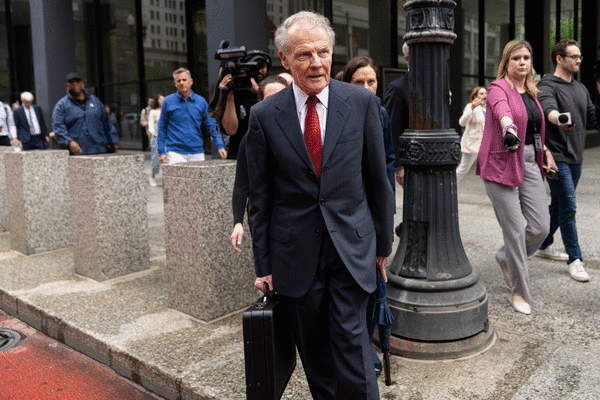
Lawyers for the federal government told the Supreme Court in a brief this week that former Illinois House Speaker Michael Madigan’s corruption conviction was on solid ground, saying he was “not a low-level or novice official” and noting he testified himself that it was illegal to exchange benefits for official action.
Madigan, who turns 85 in April, is asking the high court to take up his case in what is his last hope to overturn his 2025 conviction and 7 1/2-year sentence. He’s been in prison for more than a year and currently is not set for release until October 2031, when he would be 89, prison records show.
In their petition filed in June, Madigan’s attorneys asked the Supreme Court to confront several questions surrounding the legality of the case, including a closer examination of what constitutes a public official acting “corruptly” and whether an “alleged promise to make a job recommendation” or vague support of ComEd’s legislation qualifies as an “official act.”
“The novel bribery theories the government zealously pursued against Speaker Madigan stretch federal bribery law in ways that threaten to criminalize and chill lawful interactions between state and local officials and their constituents,” Madigan’s lawyers argued.
In a response filed Wednesday, however, the Solicitor General’s office said the case would be a “poor vehicle” for the high court to weigh in on those issues, given the mountain of evidence presented by prosecutors and the carefully constructed jury instructions at trial. The response also cited Madigan’s own testimony.
“(Madigan) was a lawyer and Speaker of the Illinois House of Representatives for three decades, not a low-level or novice official,” the government response read. “When he testified at trial, he affirmed that he had known that accepting a thing of value in return for official action was unlawful, not just wrong.”
The response argued the evidence also showed Madigan’s corrupt scheme was “not politics as usual or ordinary lobbying,” but a quid pro quo with ComEd that leaves “no doubt that the jury would have reached the same verdict” even if the instructions on the word “corruptly” had been different.
Madigan’s arguments also fall flat when it comes to issues of what constitutes an “official act,” the 25-page response stated. The evidence clearly showed that ComEd needed Madigan’s support to reach its legislative goals, even if no particular bill had been introduced at the time Madigan agreed to support ComEd’s legislative efforts, the response argued.
“The definition of ‘official act’ encompasses matters that ‘may by law be brought before any public official, in such official’s official capacity,'” the response said.
The same argument also fails when it comes to another scheme in the indictment: a state board appointment for former Chicago Ald. Daniel Solis, who was cooperating undercover with the feds, the response stated. Even though the appointment never actually occurred, the jury could find that Madigan’s agreement to advise then-Gov.-elect JB Pritzker to appoint Solis constituted the solicitation of an official act.
Now that both sides have filed their briefs, the Supreme Court will likely decide whether to take up Madigan’s case in the next several months. It’s certainly a long shot for the former speaker, given that the high court typically receives about 7,000 to 8,000 petitions a year and agrees to hear only about 80 — or about 1%.
Madigan, once the state’s most powerful Democratic elected official, was convicted in February 2025 of bribery conspiracy and other corruption charges, including a multipronged scheme to accept and solicit payments from utility giant ComEd to Madigan associates for do-nothing subcontracts.
Madigan was also convicted on six of seven counts — including wire fraud and Travel Act violations — regarding a plan to get Solis appointed to a state board in exchange for Solis bringing Madigan business for his private law firm.
In April, an appeals court in Chicago sustained Madigan’s conviction, finding the evidence of wrongdoing was “overwhelming.”
____
©2026 Chicago Tribune. Visit at chicagotribune.com. Distributed by Tribune Content Agency, LLC.




























Comments