Democrats notch early victories in quest to control Congress
Published in Political News
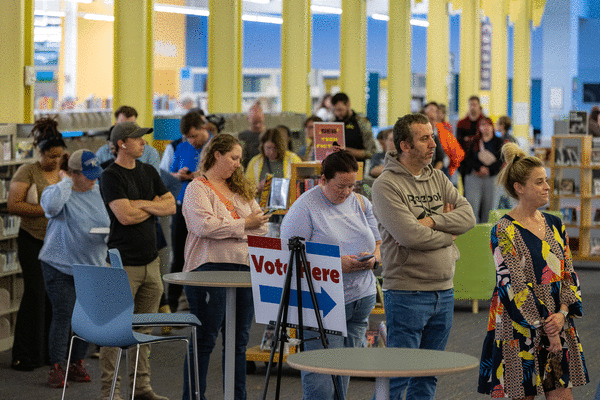
WASHINGTON — Democrats flipped a Senate seat in North Carolina from red to blue Tuesday night, signaling early momentum in a push to win majorities in the Congress two years after President Donald Trump ushered in Republican control of Washington.
Roy Cooper, the Democratic former governor of North Carolina, prevailed over Republican Michael Whatley in the Senate race, the Associated Press and NBC News projected. The seat was left open after GOP Senator Thom Tillis, who faced withering attacks from Trump, declined to seek reelection.
The initial results offered clues on the outcome of the midterm elections, which have been dominated by voter frustration over the high cost of living, including fuel prices that surged after the U.S. and Israel launched a war against Iran.
Earlier in the night, Senator Jon Ossoff, whose speeches attacking Trump over leveraging his office for personal gain have launched him into Democratic stardom, was projected to win his race, according to the AP and other news organizations.
Democrat Chris Pappas was also projected by Decision Desk HQ to win in New Hampshire, a state where Republicans had at one point signaled some optimism about a win. Democrat Jamie Ager flipped a Republican-held House seat in North Carolina as well, DDHQ projected.
As early results came in, the uncertainty cast by the prospect of a politically divided Washington caused global investors to pull back from riskier assets. Stock indexes slid in Asia, Nasdaq 100 Index futures plunged 2% and U.S. Treasuries rallied as investors shifted into havens.
In Florida, DDHQ projected that Republican Senator Ashley Moody would hold her seat, but Democrat Angie Nixon came close, also suggesting Democratic enthusiasm in a state that has leaned conservative over the last decade.
Two Democratic House incumbents in Florida — Jared Moskowitz and Kathy Castor — were expected to survive Republican redraws of their districts, while Republican Anna Paulina Luna was projected to hold onto her seat, according to DDHQ projections.
By 9 p.m. New York time, states that had fully or partially closed polls included Georgia, South Carolina, North Carolina, Ohio, Florida, Michigan, Texas, Kansas, Maine, Iowa, Nebraska, New York and Wisconsin.
Trump, his cabinet officials and political advisers assembled in the White House East Room for a reception to watch the election results, according to a White House official.
Both polling and historical trends favor Democrats to take a majority in the House, while their prospects for Senate control remain more uncertain. Elections have become harder to predict in the decade since Trump’s 2016 victory, when he defied polls to win the presidency.
Still, Democrats have grown increasingly bullish as opinion polls show them holding an advantage. Republicans have been forced to spend time and money defending seats in typically red states including Kansas, Texas, Alaska and South Carolina.
Voters reported grievances with the president’s leadership, according to The Voter Poll, a comprehensive survey conducted by the Associated Press and SSRS. About three-quarters of midterm voters said they felt “angry” or “dissatisfied” with the direction of the country under Trump. About six in 10 attributed high prices “more to Trump’s policies” than factors outside his control.
Ahead of any results, Trump appeared to steel himself for a sea change in Washington, telling CBS News in an interview that he will be a “Mr. Veto” with Democrats if they win a majority in the House or Senate. He also claimed he was optimistic about his party’s chances and his ability to continue advancing his agenda by using his executive power.
If Democrats take even one chamber, it would mark a clear rebuke to the president and his party just two years after his dominant White House comeback. Trump pledged during the 2024 campaign to tackle inflation and keep the U.S. out of overseas conflicts, and surveys show many of those who supported him in the last election have buyer’s remorse.
To take control of the House, Democrats need a net gain of just three seats. The nonpartisan Cook Political Report has projected a Democratic increase of between 15 and 25 House members.
In the Senate, Democrats would need to flip four Republican-held seats to win. It could take weeks to know the final result, given individual states’ rules around counting mail-in votes and longer tabulation times in states that use ranked-choice ballots.
A Republican loss would have tangible consequences for Trump’s final two years in the White House. The president has thus far enjoyed a supine Congress, which has confirmed his controversial cabinet nominees, passed his signature tax-cut legislation and largely refrained from curbing his tariff powers or military operations against Iran.
Should they return to power in Washington, Democrats have indicated they will investigate Trump and his allies, a possibility the president has railed against for months.
The president and Democrats would also be forced to work together on consequential fiscal matters, including government funding and lifting the debt ceiling.
If Republicans are still able to overperform, it could provide a political boost to Trump, similar to how then-President Joe Biden seized on Democrats’ better-than-expected results in the 2022 midterms to claim validation of his leadership. At the time, Democrats gained a Senate seat and lost fewer House seats than projected.
In the month before Election Day, Trump held more than a dozen rallies, mostly in Republican strongholds, pressing supporters to vote as if he were on the ballot.
But with his approval rating at rock bottom, those appeals were seen as a mixed blessing to many candidates. Several Republicans expressed discomfort with Trump’s unusual closing message, which included riffs on his Washington renovation projects and Ohio Senator Jon Husted’s physique.
There are already legal challenges and more court fights are expected if the results of key races are close. The Justice Department has appealed a federal judge’s decision to throw out a lawsuit to preemptively stop Alaska from certifying the results of its Senate race if the Republican candidate loses narrowly.
The Supreme Court rejected the Trump administration’s bid to force thousands of California ballots to be set aside over unproven claims they were cast by non-citizens. In a separate case, a U.S. appeals court lifted a ruling barring the Justice Department from threatening state and local election officials with prosecution if they count disputed ballots.
_____
With assistance from Ted Mann, Sid Verma, Hadriana Lowenkron and William Selway.
_____
©2026 Bloomberg L.P. Visit bloomberg.com. Distributed by Tribune Content Agency, LLC.
















































Comments