How 4 states voted on election-related ballot measures
Published in Political News
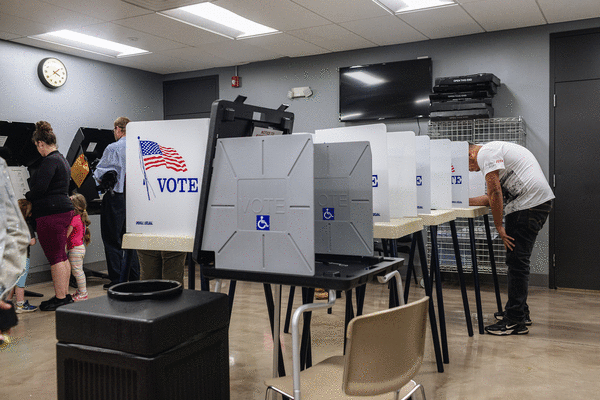
WASHINGTON — More than 100 statewide ballot measures went before voters this week, including a handful that could shape future elections in their states.
Here’s a look at how those measures fared, including one in Alaska that hasn’t been called as yet:
Maryland
Voters in Maryland on Tuesday approved an amendment to the state’s constitution that will make it easier for the state’s Democrat-controlled legislature to redraw the congressional map for the 2028 elections.
The outcome was a victory for Democrats, who could potentially eliminate the state’s lone Republican-held seat – the 1st District on Maryland’s Eastern Shore, represented by Rep. Andy Harris, the chair of hard-line conservative House Freedom Caucus.
The Old Line State emerged as a bright spot in Democrats’ plan to counter the redistricting wars initiated by President Donald Trump and turbocharged by the spring Supreme Court ruling that diluted Section 2 of the Voting Rights Act and set off a slew of Republican-led map-remaking across the South.
But those GOP-led redistricting efforts appeared to backfire this week, with Democrats holding many of the redrawn seats in states such as Texas, Florida, Alabama and North Carolina.
Still, Maryland Gov. Wes Moore told reporters Wednesday that he was “ready to engage” with the legislature on a new map, citing the threat of further redistricting in Republican states.
“Donald Trump is not done. He has already been very clear about his intention to go after additional states, to go after places like Mississippi and South Carolina and Indiana,” Moore said, according to video posted by WBAL-TV 11 News.
Following an unsuccessful attempt to redraw the Maryland map in February, Moore called a special August legislative session during which state lawmakers voted to put the redistricting amendment, known as Question 3, on the November ballot.
The move faced immediate legal challenges from Republicans. Two Maryland courts ruled to block the measure from appearing on the ballot, finding that lawmakers had missed the legally imposed deadline to refer the ballot measure. The state’s Supreme Court, though, allowed the redistricting amendment to go before the voters, with changes to the ballot text.
State and national Democrats campaigned heavily for Question 3 as some public polling pointed to skepticism among voters. Former President Barack Obama even appeared in an ad urging voters to approve it.
Missouri
Voters in the Show-Me State overwhelmingly rejected a Republican-drawn congressional map that sought to dismantle a safely Democratic seat in the Kansas City area.
Missouri Republicans enacted the new lines in 2025, aiming to give them an advantage in seven of the state’s eight House districts, including the 5th District held by Democrat Emanuel Cleaver II.
A protracted legal and political tussle over the map ensued.
The group People Not Politicians Missouri started a citizen petition to put the adoption of the map to a statewide vote. While the petition effort was pending, the state held its August primaries under the new lines. But in September, the state Supreme Court ruled that the 2025 map could not be used in the general election because of the pending ballot measure and ordered state officials to hold November’s election under the previous boundaries, first enacted in 2022.
Attempts to challenge the ruling in federal court ultimately proved unsuccessful, with the U.S. Supreme Court issuing an order that reinstated the 2022 map.
Groups on both sides of the ballot measure, known as Proposition A, reportedly spent millions to persuade voters. But St. Louis Public Radio reported last week that while opponents of the 2025 map were actively campaigning against it, organized efforts in favor of Proposition A appeared “nearly nonexistent.”
Republican efforts to try again and enact a new congressional map for 2028 could be complicated by a constitutional amendment, approved by voters Tuesday, that curtails the power of state legislators to override the result of a voter-approved initiative.
Massachusetts
Voters in Massachusetts opted this week not to join states such as California and Washington and adopt a nonpartisan primary system.
The ballot initiative, known as Question 3, would have replaced the state’s partisan primaries with an open primary under which all candidates would appear on the same ballot, with the top two vote-getters, regardless of party, advancing to the general election.
The outcome was a victory for the chorus of labor unions and progressive groups, including the Working Families Party, that opposed the measure. Holding so-called jungle primaries, the groups argued, could make it harder for candidates without financial resources or high name recognition to run for office.
A bipartisan coalition that included the NAACP of New England and Republican former Gov. Charlie Baker supported the measure, arguing that open primaries would give voters more choice and create more competitive elections in a state dominated by Democrats.
Alaska
Alaskans weighed in this year for the second time as many cycles on a ballot measure to revert to partisan primaries and repeal the state’s top-four ranked choice voting system.
With over 70% of the vote in, The Associated Press had yet to call the ballot initiative, known as Measure 2, which would also roll back certain campaign finance disclosure requirements. As of Thursday evening, the “no” side, which supports keeping the current election system, was narrowly ahead. The state has until Nov. 18 to finish counting outstanding ballots.
Under Alaska’s voting system, all candidates ran on the same ballot during the primary. Then the top four candidates, regardless of party, advance to the general election, which is decided by ranked choice voting if no one takes a majority of the vote.
In 2024, Alaska voters narrowly voted to keep the current system in place.
National Republicans, though, have largely opposed ranked choice voting, including President Donald Trump, who has characterized Alaska’s voting system as a “scam.”
The state’s use of open primaries and the top-four ranked choice system has drawn fresh scrutiny this year. Outside groups spent big sums trying to boost underdog candidates during the Senate primary in an effort to hurt the front-runners. And several candidates in the Senate, House and governor’s races dropped out before the deadline to finalize the general election ballot, again trying to prevent splitting votes with their party front-runners.
Then last week, the Senate race was upended by a New York Times investigation that revealed operatives aligned with the Senate campaign of Democratic Mary Peltola helped recruit a candidate with a similar name to her opponent, Republican Sen. Dan Sullivan in an attempt to stack the four-candidate ballot with two Republicans with the same first and last names. The revelations have fueled an ongoing debate there about whether ranked choice voting encourages this kind of campaign chicanery.
“We would not be having this conversation at all if we didn’t have a thing in place called ranked choice voting,” Mike Dunleavy, Alaska’s outgoing Republican governor, told Fox News last week.
Dunleavy has ordered an investigation into the revelations, as has the Justice Department. The DOJ also sought to block the certification of the state’s Senate results if the incumbent Sullivan loses. Last weekend, a federal court dismissed the lawsuit.
Alaska and Maine are the only two states that currently use ranked choice voting in regular federal elections, along with the District of Columbia.
—Michael Macagnone contributed to this report.
©2026 CQ-Roll Call, Inc., All Rights Reserved. Visit cqrollcall.com. Distributed by Tribune Content Agency, LLC.



































Comments