There was a 'pathway' to expand abortion access in Idaho. Why did Prop 1 fail?
Published in Political News

BOISE, Idaho — In a survey last year, Boise State researchers found a “wide range” of opinions on abortion. Twenty percent of Idahoans wanted abortion completely banned, while 25% wanted no restrictions on abortion at all.
More common, researchers found, were Idahoans who wanted some abortion access — at least through the first trimester of pregnancy — but with restrictions.
The results suggested that Idahoans were not universally bought in on the state’s strict abortion ban — and that “there was potentially a pathway” for expanding abortion access, albeit with restrictions, in the state, said Jaclyn Kettler, a political science professor at Boise State University.
To make such a change through the initiative process, the proposal would need to garner at least 50% of the vote. That would require it to appeal to those who wanted some restrictions on abortion, as well as some of the people who told the researchers they were “not sure” how many restrictions the state should place on the procedure, Kettler told the Idaho Statesman.
Supporters of Proposition 1, a ballot initiative this year to expand abortion access in Idaho, pitched their proposal as just that: a middle-of-the-road policy that could moderate Idaho’s strict abortion laws without alienating the deep-red state’s largely conservative and pro-life voters. The initiative aimed to legalize abortion before fetal viability, and after that point in medical emergencies.
Some national progressive groups, including the American Civil Liberties Union, actually declined to support Prop 1 because they thought it was “not ambitious enough,” said Melanie Folwell, the executive director of Idahoans United for Women and Families, the organization that got Prop 1 on the ballot. Those groups were concerned about language in the initiative that would have limited abortion access after fetal viability and precluded public funding for the procedure, she previously told the Idaho Statesman.
“This was, in the scheme of things … a more modest policy change,” said Charles Hunt, another political science professor at Boise State.
But on Election Day, Prop 1 failed, with only 44% of the vote.
What happened?
Opponents argued Prop 1 was ‘too extreme’
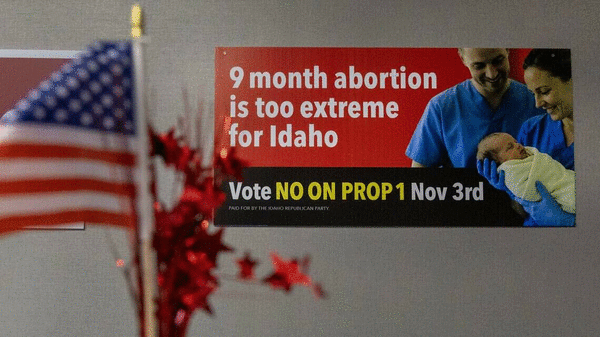
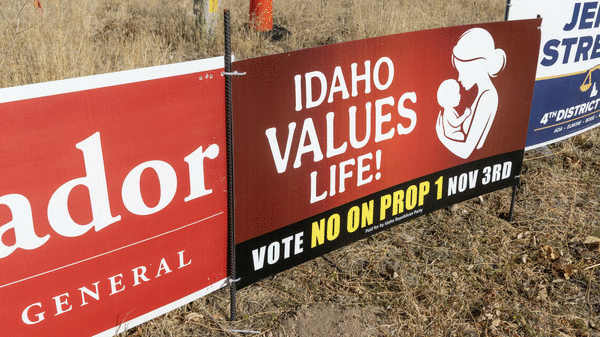
After Prop 1 in July qualified for the November ballot, securing over 110,000 signatures from Idahoans across the state, a committee called Too Extreme For Idaho got to work opposing it.
The campaign against the initiative called it a “bait and switch” that, despite sponsors’ claims that it was moderate, would allow “late-term abortion on demand,” allow non-physicians to perform abortions, and let minors get abortions without their parents’ approval.
Opponents seized on ambiguity in the initiative to make their case. Prop 1 defined “fetal viability,” for example, as the point in a pregnancy when the fetus “has a significant likelihood of sustained survival outside of the uterus without extraordinary medical measures” — but did not define what kinds of measures those were.
In that vacuum, opponents decided on their own definition. “Extraordinary medical measures,” they said, meant the assistance of oxygen or nutrition, time in the neonatal intensive care unit, or the use of a ventilator — measures that many premature babies require.
Based on that understanding, opponents argued that Prop 1 would view a fetus as non-viable until very late in a pregnancy, when it could survive outside the womb without those routine measures.
“Prop 1 would create a new right to abortion until fetal viability, which is so vaguely defined that it could potentially allow abortion on demand, without question, until very late stages of pregnancy,” the Idaho Republican Party wrote in a September news release.
In fact, the Oxford Medical Dictionary defines “extraordinary medical measures” as “life-prolonging treatments that are not regarded as beneficial” — that is, they “do nothing to promote recovery or relieve suffering” and are not “clinically effective.”
All of the Idaho Hospital Association’s providers adhere to this interpretation, Serena Dazzio, a spokesperson for the association, told the Statesman. By this definition, fetal viability moves much earlier in a pregnancy.
(The American College of Obstetricians and Gynecologists defines fetal viability as the period from week 20 to nearly 26 weeks of gestation, though it notes that viability depends on many complex factors.)
Opponents similarly seized on a broad statement toward the end of Prop 1, which said that the provisions of the act “are intended to control over any other section of Idaho Code.” They argued that this would include parts of Idaho law that require health care providers to get parental consent before treating a minor — and would, in effect, allow women under 18 to get abortions without their parents’ knowledge.
Folwell, of Idahoans United for Women and Families, disagreed with that interpretation.
“I’ll tell you where Prop 1 stands on that (issue), and that is completely silent,” she previously told the Statesman. The initiative “is silent on many things. That does not mean it’s seeking to alter them,” she said.
The language in question, she said, was intended to apply only to the nearly two dozen Idaho laws that deal with abortion.
Ambiguity left Prop 1 vulnerable to opposition arguments
The length and complexity of Prop 1 made it vulnerable to such uncertainty, David Leroy, a former Idaho attorney general, previously told the Statesman.
“For something that runs many pages or something that interrelates on complicated topics, the initiative process is poorly designed,” Leroy said. It can be a challenge in those cases to “inform the voter of all the ramifications that are contained in the language” and to assess how such a change would affect existing laws on the topic, he said.
Prop 1 “suffers from both curses,” he said.
When voters are uncertain about what a law would do, studies have shown they are more likely to support the status quo, said Kettler, the Boise State political science professor.
Katie Ball, a law professor at the University of Idaho, said ambiguity in legal language is common. When laws are challenged in those cases, courts routinely use their understanding of plain language — and a record of sponsors’ intent — to interpret unclear terms, Ball told the Statesman.
“The courts are experts” at this, she said.
She noted, too, that pinning down specific “one-size-fits-all” definitions may not be possible, especially in the context of medical terminology. Fetal viability, for one, has been a moving target over the years as medical knowledge and technology have increased fetuses’ viability earlier and earlier in pregnancy.
Likely for that reason, Ball assessed, Prop 1 defined the term as something assessed with “a physician’s good-faith medical judgment.”
Folwell, for her part, said opponents of the initiative were deliberately misrepresenting its actual language to mislead voters — and would have done so no matter the language used.
“They are bad-faith actors,” she said. “They will say anything to defeat any reform. They want the ban we have, and there is no version of Proposition 1 that they would have been OK with.”
Tom Luna, a board member of the campaign against Prop 1, did not directly respond to a question about whether his organization would have been open to alternate language in Prop 1. But in emailed comments Monday, he seemed to suggest that his campaign wanted to uphold Idaho’s abortion ban as-is.
“The language on the ballot could not have been more clear,” he said. “ ‘A NO vote would support making NO change to Idaho’s current law.’ “
A ‘Wild West’ campaign environment
The campaigns for and against Prop 1 were fierce — and, by Election Day, exceptionally well-funded. Both sides wound up receiving nearly $5 million in donations, according to the Idaho Secretary of State’s campaign finance transparency website.
Prop 1’s opponents were bolstered by massive donations in October from The Church of Jesus Christ of Latter-Day Saints and the Roman Catholic Diocese of Boise, which came about a month after Idaho Attorney General Raúl Labrador issued an official opinion that a church that spent more than $1,000 on a ballot initiative as an exercise of its religious beliefs did not have to disclose its donors’ identity.
That decision “was basically the green light for undisclosed money to flow in” from religious institutions that opposed the initiative, Folwell told the Statesman in October. Given those institutions’ “massive” operating budgets, she said, “we are disproportionately, wildly outflanked.”
“The opposition from the two wealthiest religions in the world — that is a pretty staggering thing to be up against as a citizens’ grassroots campaign,” she said. Opponents spent money on ads that mirrored ads opposing a “completely different” constitutional amendment in Florida, she said.
Her campaign struggled, she said, against an opposition that frequently broke campaign finance rules by disseminating materials opposed to the initiative that didn’t say who paid for them.
“The environment is completely out of compliance,” she said. “It’s kind of a Wild West environment right now.”
Idaho Secretary of State Phil McGrane confirmed that he’d seen several campaign violations this election season, mostly from those opposed to Prop 1. Prop 1’s opponents tended to be less organized than its supporters — and as churches joined the fight against Prop 1, they activated many “mom and pop” advocates who didn’t know the rules, he told the Statesman.
In September, Folwell expressed frustration to the Statesman that Idaho media outlets were doing little to fact-check opponents’ claims. She did not respond to a post-election request to discuss what went wrong for Prop 1, though she told the Statesman by text that the media’s approach to covering the initiative — including disseminating images of opponents’ campaign materials without sufficient context — had likely contributed to the initiative’s failure.
Boise State prof calls Prop 1 loss ‘inevitable’
To some observers, getting an initiative like Prop 1 passed always seemed like too steep a hill to climb, given Idaho’s deeply conservative voting base.
“I think a modest loss is, frankly, the outcome I roughly expected,” said Hunt, the Boise State professor. “This outcome (was) more or less inevitable.”
Opponents’ criticisms of Prop 1 were likely a given, too, he said.
“Any campaign about this issue, I think, was bound to end up becoming polarized in this way, where the campaign against it was going to frame anything like Prop 1 as a pro-choice effort — which is just not a majority issue in Idaho,” he said.
In an election year when many Republicans were feeling disaffected, Hunt said, Prop 1 may actually have been the driving force to get party members to the polls. And he wasn’t hugely optimistic about the initiative getting another shot.
“If it’s not going to pass in an environment like this, it’s not like this is going to stand a better chance of passing in 2028, when you have a presidential electorate and even more Republicans coming out,” he said. “I can’t really imagine a more left-leaning Democratic environment than this one currently.”
©2026 Idaho Statesman. Visit at idahostatesman.com. Distributed by Tribune Content Agency, LLC.

































Comments