Commentary: Our 'E pluribus unum' election makes me grateful
Published in Political News
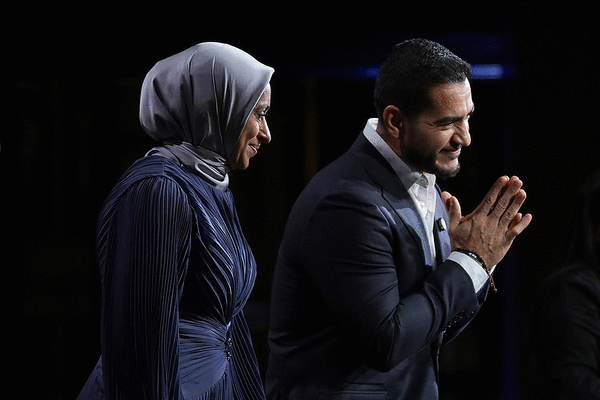
As I prepare to tuck into my Thanksgiving meal and enjoy the company of my extended family this week, I am grateful for a nation where people of one identity celebrate the political victories of people of other identities. For centuries, political philosophers thought this literally was impossible — which is why they believed diverse democracy was an oxymoron. But the American experiment proved them wrong.
That was never more evident to me than on election night this month.
As is tradition on election night, I exchanged texts with friends and colleagues while the results trickled in. Full disclosure: Most of the people in my life were not disappointed to see what they viewed as a repudiation of the administration’s cruelty. Neither was I.
In each of the races that mattered to my friends, they celebrated the victory of a candidate who did not share their racial, religious or ethnic identities. In some cases, they disagreed with the candidates on issues near and dear to them, but celebrated their victories nonetheless.
To me, this is a powerful indicator of pluralism at work, ingrained in the way we understand our nation. What we saw on election night was an American people — not defined by a single ethnicity, religion or language — say they are comfortable with many-ness, that we love the diverse people around us. That is what it means to be a people, and every once in a while, the sense of decency of a people shows.
Consider the election of Abdul El-Sayed to the United States Senate from Michigan, the first Muslim elected to that body. In his victory speech, he pronounced his full name, “Abdulrahman Mohamed El-Sayed,” the way his grandmother would have whispered it in his ear when he was born, in the guttural Arabic of his family’s heritage.
A melting-pot America would ask him to leave that part of himself behind. But if we see our country as a potluck nation, we understand our distinctive identities have value, like the unique dishes brought to the common table of a potluck. Where we’re from, the traditions we grew up with at home, even how our names are pronounced — these are contributions to the greater whole. Most Michigan voters do not share El-Sayed’s identity, but they chose him to represent them.
Moments like these fill my soul. I’m reminded of the concession speech of the late Sen. John McCain in 2008, when he said Barack Obama deserved his respect for winning “by inspiring the hopes of so many millions of Americans, who had once wrongly believed that they had little at stake or little influence in the election of an American president.” He went on to acknowledge the “special significance it has for African Americans and for the special pride that must be theirs tonight.”
Here was a white man with an awe-inspiring resume with half a century of service to the country, who dreamed of sitting in the Oval Office for years able to see the beauty of what his opponent’s victory meant for the next chapter of the American story and for Black Americans who lived to see that day. There is decency, and a nobility, in how we carry ourselves in victory, but especially in defeat.
While these displays of decency may be uncommon on election nights, we see it all the time in sports. Pope Leo XIV, a Chicagoan and a beacon of decency himself, recently elevated a profound truth about athletic competition that has just as much to teach us about American civic life, especially our politics.
Welcoming the basketball teams from Notre Dame and Villanova to Rome ahead of their Eternal City Tip-Off, the pope reminded the players: “In any competition, the members of two teams, even when they have a competitive rivalry, are certainly not enemies.”
To me, the handshake or hug between competitors after a hard-fought game is one of the most beautiful things in all of life. Each side fights with everything they have to win, but when the game ends, the competitors embrace. The stakes in politics are different, of course, but the principle is no less important. We can fight fiercely for what we believe without losing sight of the dignity of those on the other side. Adversaries, not enemies.
The American experiment began with a collection of people with profoundly different religious beliefs and political convictions and an attempt to answer the question: Could people who disagreed on matters of ultimate importance come together and cooperate to build a nation?
Two hundred and fifty years later, our diversity has grown far beyond what the European founders could have imagined. The beauty of the American project today lies not simply in that many-ness, but in the healthy pluralism that allows us to embrace it, to take pride in one another’s identity achievements and to show grace even in defeat.
For that, I’m grateful.
____
Eboo Patel is founder and president of Interfaith America.
___
©2026 Chicago Tribune. Visit at chicagotribune.com. Distributed by Tribune Content Agency, LLC.









Comments