John Romano: Gotta love that Rays stadium plan! Also, gotta know what it'll cost.
Published in Baseball
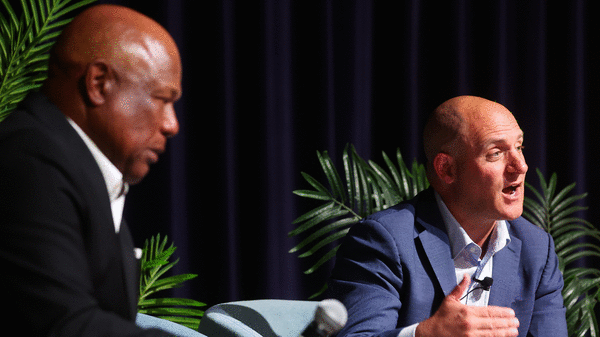
On the first night of the Rays’ community engagement tour, there was something for everyone.
For the diehard fan who has been waiting a generation for a better stadium experience, there was a slick AI video, slides and promises of a self-contained village of restaurants, shops, hotels and family-friendly memories.
For Hillsborough College students and faculty concerned about the disruption to their campus, there were assurances that interim plans are in place and the school will emerge a better place on the other side of construction.
And for skeptics wary of the stadium’s cost to taxpayers, there were enough unanswered questions to validate their fears.
Did you expect anything different?
While the forums give residents a chance to ask questions and offer feedback, they are mostly designed to convince everyone that building a mixed-use development around a $2.3 billion stadium will be a boon for the team, the college and Tampa Bay’s quality of life.
And it’s possible that’s entirely true.
Even though economists justifiably dispute rosy projections of economic impact around sports stadiums, the success of Truist Park and the surrounding Battery development near Atlanta suggests the right type of plan could turn out to be a win-win scenario.
And while that’s encouraging, it’s not a guarantee.
Once upon a time, a public-private partnership to build a baseball stadium in Miami seemed like a good idea. Until it turned out a tad heavy on the public side of the ledger. And years after opening, the NFL stadium in Cincinnati was still eating up an obscene portion of Hamilton County’s budget.
So, it’s not enough to point at Atlanta and ask, “Can we have one of those?”
At some point, the details matter. And, in this case, we still haven’t seen enough of the fine print.
Look, we all get the basic premise of this project. It’s somewhat similar to what the previous ownership group was proposing on the Tropicana Field site, where revenues from the surrounding development would have helped the Rays pay for their portion of the stadium’s construction. And St. Petersburg’s investment would have been recouped — theoretically — with taxes from rising property values.
The same basic principle was used by the Braves in Cobb County, although they arrived at the deal in a different way. The public’s portion of the debt service was paid, in part, with hotel and rental car taxes and taxable properties built around the stadium. While economists initially said Cobb County was losing millions in the first few years of the deal, the county now says taxes from the development surpassed debt payments beginning in 2022.
If the Rays deal in Tampa followed a similar trajectory, it would be a major victory.
And the Rays broke out a slide presentation Tuesday night that suggested the redevelopment would generate new tax revenues of $2.32 billion for the state and $3.3 billion for Tampa/Hillsborough County over the first 30 years. Considering the Rays are looking for $1 billion-plus in public funds, that sounds like a no-brainer of a deal.
Except, we don’t know how they arrived at those numbers — other than paying consultants to conduct a presumably team-friendly study. And, while they’re quite specific about how much money could be made in new taxes, they’re more vague on who is paying for what in up-front costs. As well as how much they stand to profit in building out this major parcel of public land.
Also, there has been no talk of what happens if the redevelopment doesn’t attract as many visitors as hoped. Or if a recession eats into tax revenues.
Am I just spit-balling here? Yeah, I am. I’m no economist. I’m sure there are a ton of questions that I haven’t even considered.
The bottom line is this could be a transformational project. It could ensure Major League Baseball remains in the community for decades to come. It could provide a valuable destination point in mid-Tampa Bay. It could increase the market’s visibility, and it may even attract a greater corporate base to the bay area.
But it’s wrong to suggest this is a risk-free venture. And it would be helpful if the colorful photos were accompanied by real numbers.
I understand that big projects do not get green-lit by obsessing over the price rather than the benefits. But if you truly believe this is a partnership between the franchise and the community, then providing more economic clarity to your partners seems like a pretty basic idea.
The Rays have been big on the live, work, play and learn description of this proposal.
Eventually, they’ll need to reveal the finer points of the cost, too.
____
©2026 Tampa Bay Times. Visit tampabay.com. Distributed by Tribune Content Agency, LLC.






Comments