Mets and Dodgers celebrate Jackie Robinson Day: 'It's special to wear his jersey here'
Published in Baseball
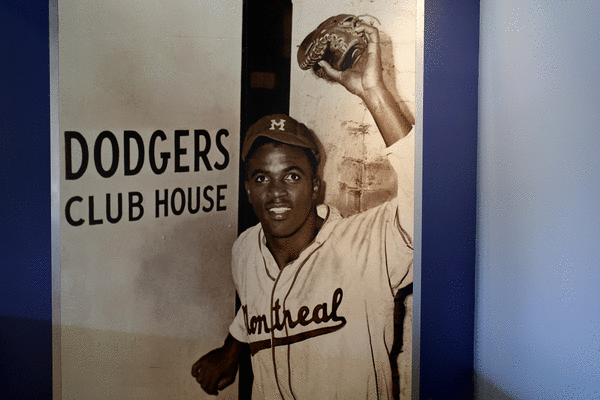
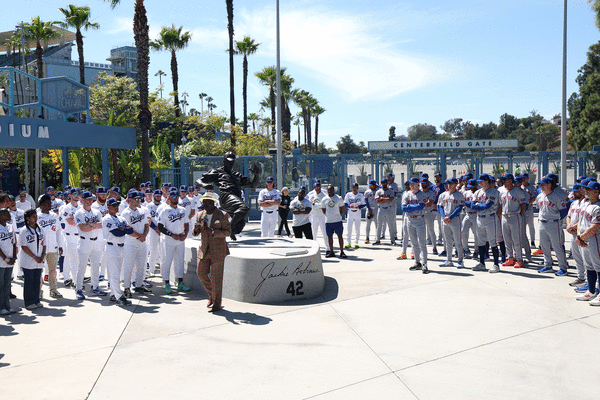

LOS ANGELES — Jackie Robinson may not have played at Dodger Stadium, but make no mistake, his influence is as much a part of one of baseball’s most storied ballparks as the World Series trophies and the sweeping views of the Sierra Madre mountain range.
His influence extends for miles all over the Los Angeles area, stretching from Pasadena, where he grew up, to Westwood, where he lettered in baseball, basketball, football and track at UCLA. His boyhood home on Pepper Street has been preserved by the Pasadena Historical Society. There are monuments dedicated to him in Pasadena and beyond, and numerous fields named for one of baseball’s most impactful heroes.
Where the Bruins play, there is both — a bronze statue of Jackie Robinson that sits near the entrance of Jackie Robinson Field, adjacent to the UCLA campus.
There is extra meaning for some when it comes to playing in Los Angeles on Wednesday, when the league celebrates Jackie Robinson Day.
“It’s special to wear his jersey here,” Mets second baseman Marcus Semien told the New York Daily News this week. “Jackie is from this area, Jackie is an L.A. guy. I get to play a position he played a little bit of.”
These things exist all year round, yet they get all shined up for the one day a year when baseball recognizes the anniversary of the historic day in 1947 when Robinson broke the sport’s color barrier. April 15 is celebrated every year to ensure his legacy lasts and that inclusivity in sports continues.
“It’s about helping the next generation,” Semien said. “I think about the youth in the game, players who maybe look like me. I hope to inspire them to play this game because it’s changed my life and it’s opened a lot of doors for me as a Black player.”
We all know his story, though we’ll never truly understand his burden.
Some of his own teammates in Brooklyn threatened to sit out. The St. Louis Cardinals threatened to strike and plan a league-wide lockout. He was derided by fans and became the target of hard slides and cheap shots from opponents.
Branch Rickey and Leo Durocher, the Dodgers’ general manager and manager, took great pains to protect Robinson, but protecting him from all of the vitriol was an impossibility. Still, Robinson became one of the best players of his generation, possibly of all time, showing tremendous mental fortitude to go along with his elite athleticism.
“Some things none of us will ever understand,” Semien said. “The only thing we can do is appreciate it to make things a lot smaller for us. I always looked at the level of play that he actually played on the field as an MVP. People talk about him being the first player, but he was an MVP, and he was such a quality player. Just a special, special talent.”
Even Latinos were separated by skin color before 1947. Cuban-born Adolfo Luque was light-skinned enough to play in the National League in the early 1900s. But a decade after he left the game, Cuban-born Minnie Miñoso was playing in the Negro Leagues. Miñoso, like many other Afro-Latino players of that era, went to the major leagues after the color barrier fell.
“It means a lot, especially for me as a Latino because I wouldn’t be here if it wasn’t for him,” said Mets manager Carlos Mendoza. “We talk about dealing with pressure at this level, but imagine what he dealt with, or the pressure that he dealt with back in the day.”
Robinson’s relationship with MLB and the Dodgers became fraught later in his life, in part because of what he felt was a lack of support for Black managers and coaches. He made it so that Black players and Afro-Latino players could succeed at all levels of the game, but he wasn’t seeing them ascend to the highest personnel levels after they stopped playing.
Just nine days before his death at age 53, he made his final public appearance in baseball, throwing out the first pitch at Cincinnati’s Riverfront Stadium before Game 2 of the 1972 World Series. He told the world what he wanted to see.
“I’m extremely proud and pleased to be here this afternoon, but I must admit I’m going to be tremendously more pleased and more proud when I look at that third base coaching line one day and see a Black face managing in baseball,” he said.
Wednesday night, those who watch the game on ESPN will see diversity just about everywhere. They’ll see Mendoza in the Mets dugout, a Venezuelan manager and one of only three skippers born in Latin American countries or territories. In the Dodgers’ dugout, they’ll see manager Dave Roberts, who is African-American and Japanese. The game’s biggest star, Shohei Ohtani, is Japanese.
Representation matters, whether it’s in Los Angeles, New York, Cincinnati or anywhere else in the world where kids want to play baseball. It’s what Robinson spent his life fighting for, and what baseball is responsible for carrying forward.
“There will never be another like him. We will never go through what he went through,” said Mets shortstop Francisco Lindor. “It’s gratitude. A lot of gratitude.”
©2026 New York Daily News. Visit nydailynews.com. Distributed by Tribune Content Agency, LLC.





Comments