Jim Alexander: Pat Riley statue captures his Lakers coaching personality
Published in Basketball
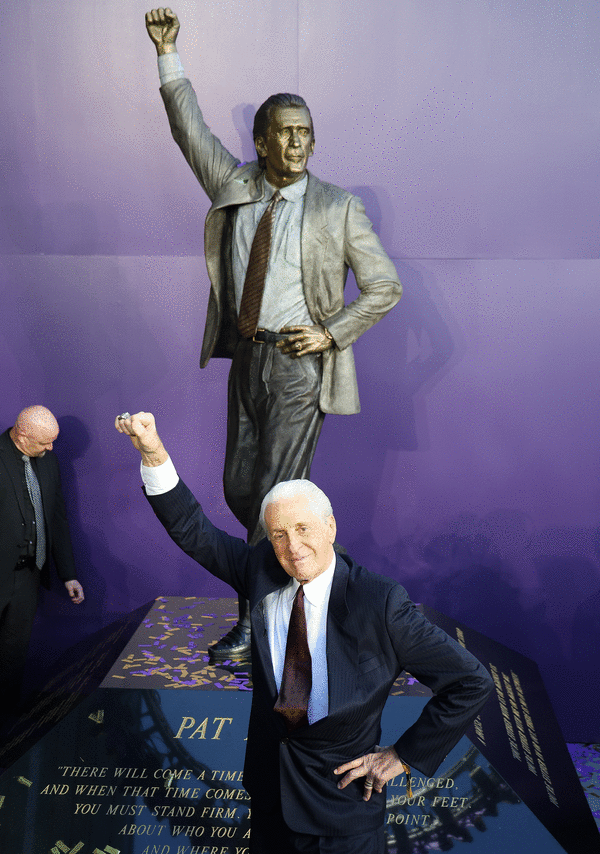
LOS ANGELES – Yes, Pat Riley is the current president of the Miami Heat, and he has his fingerprints all over what is advertised – presumably at his urging – as “Heat Culture.”
But I suspect anyone who lived through the Showtime era of the ’80s – or, for that matter, watched how the roots of Laker Exceptionalism were formed before that – knows the true roots of that culture.
And the statue that was unveiled early Sunday afternoon in the Star Plaza is the perfect characterization of the ethos that propelled that era of championship basketball: Riley, impeccably dressed, hair slicked back, thrusting a fist in the air.
The significance of that particular gesture? It might as well have been the international symbol for “Get the ball to the Big Fella.” Those Lakers teams, with Magic Johnson bringing the ball up the floor, were oh, so skilled at running their opponents ragged. But sometimes the best option was to just throw the ball into Kareem Abdul-Jabbar in the post.
“Whenever we needed a bucket, I might look calm, cool and collected,” as the statue depicted, Riley said in his speech leading up to the unveiling. “But there was a lot of desperation in me as I was walking up and down the sidelines. I just threw a fist in the air, and Buck (Johnson) would nod and we went after it.”
Yet there has been, is and probably always will be more to Lakers’ success than just the right personnel or the right strategy.
(Or, for that matter, the right wardrobe. For the record, Riley said during a session with the media following the unveiling that he wishes coaches would go back to wearing suits on the sideline rather than today’s sweatsuits, adding: “I think an audience wants to see somebody on the sidelines who looks like the leader, dresses like the leader, acts like the leader.”)
The seeds of a championship attitude might have been planted years before Riley was thrust into coaching early in the 1979-80 season, when he moved from the color analyst’s role on radio and TV to assist Paul Westhead after original head coach Jack McKinney was seriously injured in a bicycle accident.
Go back further, in fact, to the 1971-72 season, the year that the Lakers finally won their first championship in L.A. after six finals losses in the ’60s to the Bill Russell Celtics and another in 1970 to New York. That was a team of veterans: Jerry West, Wilt Chamberlain, Happy Hairston, Gail Goodrich, with rookie forward Jim McMillian stepping into the starting lineup at the start of November and Elgin Baylor announcing his retirement, right before a 33-game winning streak that remains a professional sports record.
Riley, along with Flynn Robinson and LeRoy Ellis, was the key reserve on that team.
“We had a great team and we were able to sustain it, and that did set the tone, I think, for the rest of that decade,” Riley recalled. “When we got Kareem (in a trade with Milwaukee in 1975), that was the first piece we needed to dominance. And then they started to add in players to that in the late 70s and then we drafted (Johnson in 1979) and that changed everything.”
Along the way, an expectation of excellence took root. It fueled the five championships in the ’80s, and created an atmosphere that led to five more Lakers titles in the 2000s and the 2020 bubble title, which in turn were propelled by the acquisitions of superstars, themselves part of a Lakers tradition: Shaquille O’Neal, Kobe Bryant, Pau Gasol, LeBron James, Luka Doncic.
When Riley left L.A. after the 1989-90 season, stepping away after a second-round playoff loss to Phoenix – just days after being named Coach of the Year for the first time – he took those expectations and those standards with him. After a year of TV work, he coached the Knicks for four seasons, with a 60-win season in 1992-93 and a trip to the NBA Finals the next season.
Riley then moved to Miami and coached the Heat 11 seasons, with a year’s hiatus in 2004-05 followed by an NBA championship in 2005-06. He’s also been an Executive of the Year in 2010-11.
All of that “Heat Culture” signage? That’s an outgrowth of the way the Lakers were doing things all those years ago.
“Mentally tough,” Johnson said, describing what Riley looked for in a player. “Physically tough. High basketball IQ. You have to have some grit and toughness. Discipline. You have to be about winning. You have to love the game, passionate about the game, or you couldn’t play for Pat Riley.
“Every time we went to war, to battle, we were prepared. Pat Riley was the best X and O guy in the business and the one thing he never got credit for he was the greatest in-game adjustment coach we’ve ever seen. See, it’s one thing to have a strategy, and then that team does something that you now have to make an adjustment. This man, on the run, on the fly, could always make adjustments and put us in a position to win.”
And it’s worth noting that among those in attendance for Sunday’s unveiling was Dwyane Wade, who never played a second as a Laker but is a Hall of Famer, a 13-time All-Star and three-time champion largely because of those lessons he learned under Riley’s tutelage in Miami.
“Dwyane was special, and he would have absorbed anything,” Riley said. “But what I taught him, a lot of it came from L.A. It just did.
“You are a product of your education, your experiences, your environment. You know, the players that you coach, the coaches that you coach with, your assistant coaches (like) Bill Bertka, Randy Pfund, Dave Wohl at the time. You know all of those people. Pete Newell, in the beginning, was the general manager. And then Bill Sharman, then Jerry West.
“I mean, there was a lot of people. Chick Hearn. You know, sitting next to Chick every night, having a drink after a game in the family room, it was just like, he was like an almanac.”
That statue outside the arena is evidence that after absorbing all of that wisdom, Riley more than paid it forward.
____
©2023 MediaNews Group, Inc. Visit ocregister.com. Distributed by Tribune Content Agency, LLC.




Comments