C.J. Holmes: A generational tank-off has the NBA reaching for fixes, and fans hate the fine print
Published in Basketball
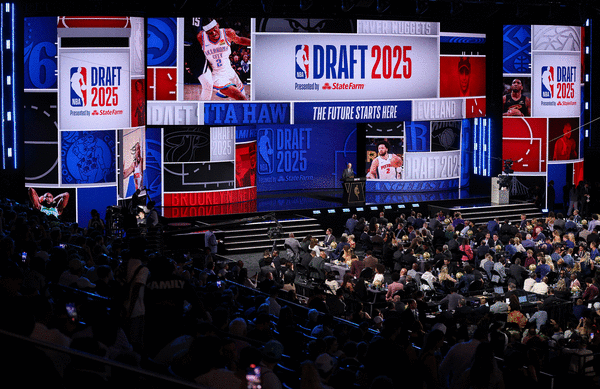
The last 10 games have essentially turned into a tanking leaderboard, and the race to the bottom is brutally tight.
Entering Friday, the Nets are 1-9. The Indiana Pacers are 1-9. The Washington Wizards are 1-9. The Memphis Grizzlies are 1-9. The Utah Jazz are 2-8. It’s a sprint for lottery position, and it’s exactly the type of late-season stretch that has the NBA’s Board of Governors staring at the draft lottery and asking, again, how to make it look less like an open secret.
On Wednesday, the league presented three broad anti-tanking concepts to team owners, with tweaks expected and a formal vote targeted for May, according to ESPN’s Shams Charania. The ideas vary, but they share the same theme, widen the lottery pool, flatten odds and try to make losing feel less profitable.
So, why are people taking issue with them? Because each proposal doesn’t eliminate tanking so much as move it around, and in some versions, widen it.
The first concept expands the lottery to 18 teams and flattens odds heavily, with the bottom 10 teams each sitting at 8% to land the top pick and the remaining 20% distributed among the next eight teams, plus a drawing for all 18 picks.
The pushback there is simple. If more teams have lottery access and the worst teams don’t gain much by being the worst, then more franchises can justify late-season losing as a rational move. Instead of five teams “being honest” about their direction, you could end up with a larger middle class of teams doing the same calculation.
The second concept goes even further, a 22-team lottery that brings in the four teams eliminated in the first round of the playoffs. It also uses a two-year record component and a minimum win threshold concept, like 25 wins, to discourage extreme tanks.
This is the one that makes the biggest chunk of people uneasy because it introduces the most subjectivity and the most edge cases. A two-year formula can punish teams that crater for reasons that have nothing to do with intentional losing, and a win floor can feel like the league retroactively assigning results to smooth out the standings.
Critics also worry it could warp incentives for teams hovering around the play-in and the playoffs, where the “best” outcome might become losing at the right time to get into the right bucket.
The third concept is the “5 by 5” model, which gives the bottom five teams equal odds for picks 1 through 5, then uses a second drawing for the next set of picks with a safety net so bottom-five teams can’t fall below 10. The league’s logic is clear, stop the sprint to be the single worst team. But the fear is it simply shifts the sprint into a new lane, the fight to finish bottom five. Equal odds can reduce the benefit of being historically bad, but it can also raise the value of just getting into that bottom-five group, and once you’re there, the temptation is to stay there.
Across all three, there’s also a very real fan-facing complaint. The current lottery is complicated enough. Expanding the pool, layering two-year records, adding floors and running multiple drawings can make the process harder to explain and easier to distrust, even if the league’s intent is clean.
And maybe the biggest reason these proposals rub people the wrong way is timing. The league is reacting to a season where tanking has become the story, and that can read as overcorrection. When five teams are all 1-9 over their last 10 and everyone can see what’s happening, the instinct is to swing the hammer. The concern is that the hammer lands on teams that are just bad, injured or rebuilding normally, while the truly motivated tankers simply learn the new angles.
That’s the tension underneath all of this. The NBA can tweak the odds, widen the pool and add guardrails, but as long as the draft is still the straightest path to elite talent, teams will keep hunting for the most defensible way to lose.
_____
©2026 New York Daily News. Visit at nydailynews.com. Distributed by Tribune Content Agency, LLC.






Comments