Paul Sullivan: To freeze or not to freeze? That's the question facing Bears fans when pondering new stadium.
Published in Football
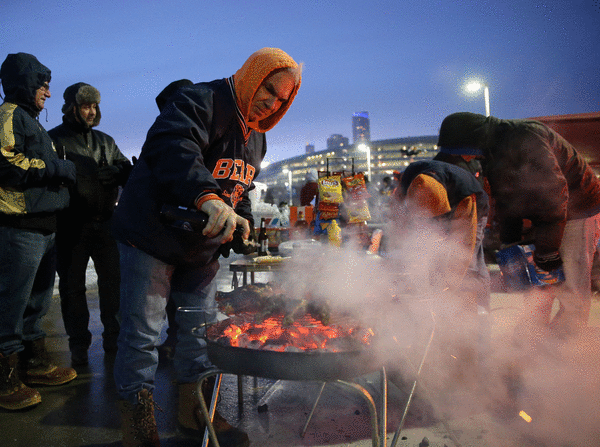
CHICAGO — If you haven’t heard, it was a little chilly Sunday when the Chicago Bears defeated the Cleveland Browns 31-3 at Soldier Field, with temperatures that dipped into the single digits and a wind chill well below zero.
It may have been one of the coldest days in Bears history, which of course is full of mostly forgettable freezefests because the Bears play their home games in the winter at an old stadium located next to a large lake.
Everyone seems to love the idea of watching players endure frigid conditions, much more so than watching those same players sweat their tails off in the heat of early September. We all remember the NFL Films highlights of linebackers breathing in slow motion on frigid days, showing the tiny droplets of water turning into a misty haze. And if your favorite team is winning games when it’s freezing, it’s often looked upon as a sign they’re built for the cold and are playoff-ready, even if that’s a mirage.
Bears and Browns players were asked about it all week, and most gave the usual replies that suggested they embraced the brutal weather conditions.
“It’s just Soldier Field,” Bears offensive lineman Theo Benedet said. “No one knows the weather, the wind there, better than us, so I’m excited.”
Bears fans were layered up, of course, and some no doubt were liquored up as well. Visions of Bears fans pulling a Ben Johnson and removing their shirts for the TV cameras came to life. Unlike the Bears coach, they didn't need the lure of free hot dogs to become exhibitionists for a day.
The oft-told story that cold weather brings out the best in Bears fans is a myth that dates to the Super Bowl-winning team of 1985, ignoring the fact that some of the biggest losses came in ice-cold playoff games. Winning brings out the best in fans, not freezing in unison.
Nevertheless, we enjoy the reputation. The scene of hardy Bears fans shrugging off the elements at Soldier Field is an image we’ve seen repeatedly over the years. Having tough guys such as Dick Butkus, Mike Ditka and Steve McMichael as our role models makes us feel as if we’re kindred spirits, even if we’re watching from our living-room couches and not impersonating an ice cube in the stands.
It’s what the experts call “Bears osmosis” — that feeling their toughness somehow rubbed off on us.
If the Bears owners have their way, days like Sunday will soon be a thing of the past. A fixed roof stadium is coming at some point, potentially turning us into softer-than-marshmallow Lions or Vikings fans in our own climate-controlled environment. Green Bay Packers fans will be laughing at us and clinging to their lofty reputation forged by games at Lambeau Field, the original frozen tundra.
Truthfully, if the McCaskeys wanted to sell the idea of a domed stadium to Bears fans, Sunday was the perfect time to do so. A single rendering of fans relaxing in their new, 72-degree, fixed-roof stadium in Arlington Heights would be a great juxtaposition with the reality of the Browns game — fans bundled up to the hilt, waiting in long lines on the concourse to get into a cramped, heated rest room and trying to avoid frostbite at Soldier Field or on the long, postgame walk to the Roosevelt Street “L” station.
Instead, the Bears made their big pivot at the start of the 2025 season, refocusing on the team-owned site in Arlington Heights back in August when the weather was warm and no one was thinking about wind chill factors or the possibility of having a 10-4 team heading into the final three games of the regular season.
Timing is everything, and five months later, the Bears are still at square one, waiting for the state legislature to approve of a property-tax relief bill that would get the ball rolling on their stadium complex proposal. Maybe next year.
Surveys have shown that Chicagoans want the Bears to stay in Chicago, but don’t want to help subsidize a new stadium. A recent by the University of Chicago’s Mansueto Institute for Urban Innovation found that 65.2% actively oppose using any public funding for a new stadium in Chicago.
That’s no surprise.
They’ve already been burned by the public funding of what’s now called Rate Field — which White Sox Chairman Jerry Reinsdorf and future successor Justin Ishbia want to abandon — and by the Soldier Field renovation that was widely panned. Fool us twice, shame on us.
The Bears, to their credit, are willing to pay a couple of billion dollars to build their new stadium in the northwest suburb but say they need a little help. Eventually I think they’ll get some government support, and the shovels will hit the dirt.
Still, whether Bears fans want a fixed roof — the modern term for a domed stadium — has never really been answered. The U of C poll didn’t even bother to ask, and it’s also not a topic the Bears care to bring up. They already have decided a fixed-roof proposal is the only way to go for year-round concerts and events, and perhaps even a Super Bowl in the distant future.
Since it’s not up for debate, why even bother?
Curiosity, mostly.
The early arrival of a mini polar vortex and the possibility of playoff games in mid-January, when the really cold stuff moves in, make me wonder if most Bears fans are secretly hoping for a dome while pretending to prefer the status quo.
Sure, we like to think days like Sunday build character and embellish the reputation of Chicago as a tough, gritty city that can endure any kind of weather conditions.
But down deep, we still like feeling our toes.
____
©2025 Chicago Tribune. Visit chicagotribune.com. Distributed by Tribune Content Agency, LLC.






Comments