Sam McDowell: Are the Chiefs asking Patrick Mahomes to do too much?
Published in Football
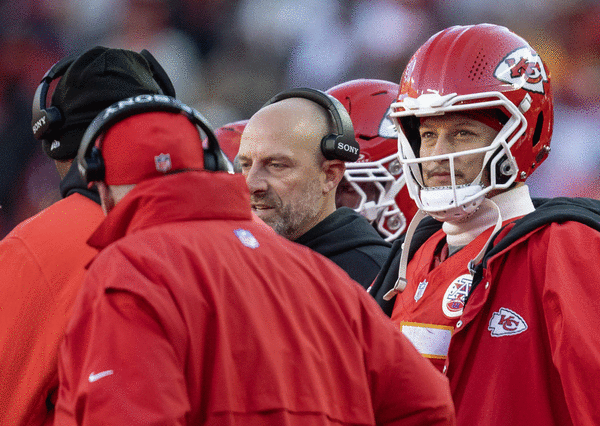
KANSAS CITY, Mo. — The Raiders mobbed kicker Daniel Carlson after his game-winner split the uprights in last Sunday’s season finale in Las Vegas, to the point of knocking him to the ground.
But really? It should have been the team on the other sideline celebrating with him.
The kick won the Raiders a game, but it also booted the Chiefs up two spots in this spring’s NFL draft order — from 11th to ninth — giving them their most valuable draft commodity since Patrick Mahomes.
The result of that game in Las Vegas, in other words, was for the best. In fact, the last three Chiefs results have all been for the best for them — losing in the short-term offers some benefit for the team’s long-term future.
But did they have to look that bad while doing it?
The Chiefs were the worst offensive team in football over the last three games of the 2025 season, as graded by expected points added (EPA) per play, per NFLfastR data. They scored only one touchdown in those three games, and two of those contests came against the three-win Titans and the three-win Raiders.
You might point out the Chiefs, who finished 6-11, were missing a pretty valuable piece of the operation: quarterback Patrick Mahomes.
It’s a valid point.
It’s also precisely my point.
If this is what the offense looks like without Mahomes — and, yes, without a top wide receiver and two starting tackles — it’s a small peek at the bigger picture that ought to drive some decisions this offseason.
Have the Chiefs grown too reliant on Mahomes?
The list of items to study over these next several weeks is lengthy, but nothing is more important for the Chiefs to evaluate that the stress of the job they demand from Mahomes. And there’s never been a more important time for that evaluation than the offseason Mahomes will spend rehabbing from a season-ending knee surgery.
The Chiefs got a three-week head start on their evaluation.
They stunk up the place without him.
Mahomes can sometimes make his job look easy. Gardner Minshew, Chris Oladokun and Shane Buechele proved how difficult the job really is.
Too difficult.
This isn’t to belabor the point of the final three weeks, because the Chiefs didn’t exactly have much of anything to play for. And again, they didn’t have Mahomes, and it’s hard to judge anything about the Chiefs without Mahomes.
Or is it?
The Chiefs averaged 2.99 yards per play over the final three games after Mahomes tore his ACL in Week 15 against the Chargers — the worst three-game stretch for any offense in the NFL all season.
Dead last.
It’s not as though the Chiefs were the only team in football to play short-handed over a three-week stretch. They weren’t the only team to play without a top starting quarterback, either — or a wide receiver, or some offensive linemen.
They were, however, the only team to perform this poorly.
Over that same time frame — Weeks 16 through 18 — there were a combined 21 other starts made by quarterbacks who were in the lineup strictly because an intended starting quarterback was unavailable. Those backup quarterbacks went 9-12. Combined, their offenses averaged 20.3 points per game.
The Chiefs averaged 11.3. And the Chiefs averaged 2.99 yards per play, while other teams were at 4.82.
How can that be? All of those teams were also without their starting quarterback. So what did they have that the Chiefs did not?
Other options.
They weren’t solely dependent on the quarterback working his magic.
So without the quarterback, they relied on Plan B. The Chiefs just navigated an entire season without a secondary option. It’s all Mahomes.
It’s why I’ve talked extensively about the running game this season — what offensive coordinator Matt Nagy referred to as the proverbial quarterback’s best friend.
Mahomes’ BFF was M.I.A.
Teams dared the Chiefs to run the football, and I’ve used plenty of data to illustrate how inept they were with it anyway, and how that affected the passing game. Coach Andy Reid brought up another effect this week when I asked him about the relationship between the run and pass.
Play-action.
It’s his barometer, of sorts, for what everyone else thinks of his run game. How is the defense reacting when you play-fake?
Reid’s conclusion:
“We’re not getting enough reaction out of them,” he said. “So however you take that — that could be because of the run game (or) that could be because of the action we’re showing — there wasn’t enough respect there than needs to be given.”
(It’s because of the run game.)
The Chiefs have to be careful not to devote all of their attention to the running game — not to consider it a catch-all solution — but they should be far more careful not to ignore just how much it affected the entire operation.
They have already invested heavily in their offensive line to better protect Mahomes. They’ll need to once more address the weapons around him to offer him better options.
But nothing could ease the stress off him more quickly than a running game that invokes fear — any fear, just something that causes a team to actually react to play-action.
That’s the easy button for other NFL teams. But the Chiefs were 30th in passing yards on play-action throws, 30th in first downs generated from them, 26th in completion percentage and 21st in EPA per dropback. They threw just one play-action touchdown all season. Every other team had at least two.
The Rams had 19 touchdowns from play-action.
Nineteen to one.
How do the Chiefs fall behind that badly in any passing statistic when Patrick Mahomes is the quarterback throwing the football?
When it requires the run game to help him out.
And that’s the heart of it, isn’t it?
He didn’t have enough help.
©2026 The Kansas City Star. Visit kansascity.com. Distributed by Tribune Content Agency, LLC.

Comments