Fish species native to Connecticut getting statewide protections for first time since 1953
Published in Outdoors
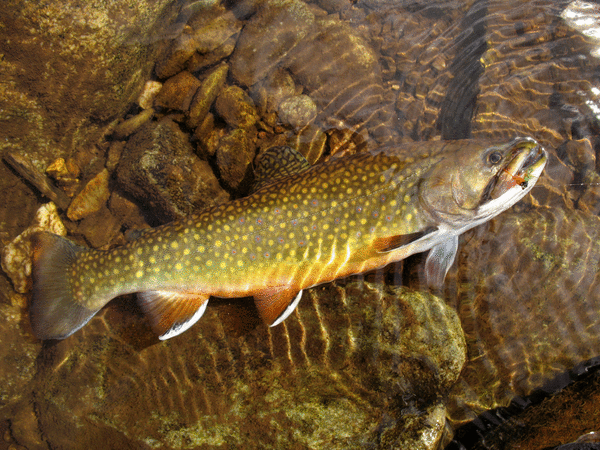
HARTFORD, Conn. — The brook trout, the only species of trout native to Connecticut, will soon be getting a minimum size limit to harvest for the first time in over 70 years.
Officials with the state’s Department of Energy and Environmental Protection are placing more protections on the fish after monitoring revealed a declining population. State biologists said they have been monitoring the fish for a years.
Brook trout require cold water to survive and flourish, meaning that they are particularly susceptible to the impacts of climate change, according to DEEP.
“The brook trout is an iconic New England fish that is losing ground here in Connecticut,” said DEEP commissioner Katie Dykes. “DEEP is pleased that our state’s fishing community broadly supported new fishing rules that will provide additional protections for this special fish. We all have a role to play in ensuring that future generations of Connecticut residents and visitors will have access to healthy streams and fish populations.”
Beginning on Jan. 1, 2026, officials say only trout nine inches or longer can be harvested statewide except in places where more restrictive length limits are already in place. Since 1953, there has not been a default statewide minimum length limit for brook trout, according to officials.
The new nine-inch minimum length limit for trout seeks to help protect wild brook trout in streams, as most are less than nine inches in length, according to officials. DEEP stocks hatchery-raised brook trout that are greater than nine inches in length, still allowing for harvest opportunities.
“DEEP’s new trout regulations will provide enhanced protections for wild brook trout while also simplifying statewide trout fishing regulations,” said Pete Aarrestad, director of the DEEP Fisheries Division. “These changes reflect DEEP’s commitment to managing our state’s natural resources for resilience to climate change and providing high quality and accessible outdoor recreation opportunities.”
In addition, 22 waters throughout the state are now designated as wild trout management areas. Wild brook trout populations in these areas now will be protected by year-round, catch-and-release-only regulations and a requirement that anglers use only artificial lures or flies with a single barbless hook. No harvesting is allowed in wild trout management areas.
These newly designated trout management areas include Beaver Brook in Barkhamsted, Belden Brook in Granby, Bonemill Brook in Tolland and Ellington, Cold Brook and tributaries in Glastonbury, Green Falls River in North Stonington, Gulf Stream and tributaries in Somers, Hall Meadow Brook in Norfolk, Thorne Brook and tributaries in Hartland, Hurricane Brook in Hartland, Indian Hole Brook in Shelton, Jericho Brook in Thomaston, Lowden Brook in Voluntown, Mohawk Pond Outflow in Goshen, Morgan Brook in Barkhamsted, Pease Brook in Bozrah, Railroad Brook in Vernon, Sages Ravine Brook in Salisbury, Spruce Brook and tributaries in Litchfield, Stony Brook in Montville, Stratton Brook in Simsbury, West Branch Salmon Brook and tributaries in Hartland, Willow Brook and tributaries in Hamden and Cheshire.
In addition, the state will establish a protective thermal refuge in Highland Lake in Winchester at the mouth of Taylor Brook. Officials say there will be no fishing allowed there from July 1 through Oct. 15.
More information on the new regulations can be found on DEEP’s website. The new regulations will be reflected in the 2026 Online Freshwater Fishing Guide and the 2026 printed Inland Fishing Regulations booklets available at DEEP offices, town clerk offices and fishing license vendors. Questions can be directed to the Fisheries Division by email at deep.inland.fisheries@ct.gov or by phone at 860-424-FISH (3474).
____
©2025 Hartford Courant. Visit courant.com. Distributed by Tribune Content Agency, LLC.






Comments