The Fed didn't cut interest rates. Here are 5 things to watch next
Published in Business News
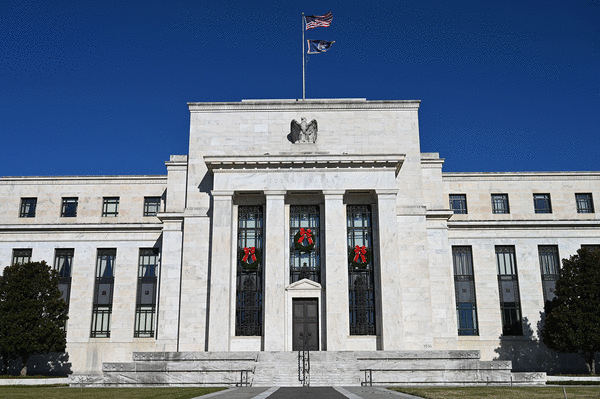
The Federal Reserve left interest rates alone at its first meeting of the year, keeping borrowing costs at a multiyear high for Americans as policymakers grow more cautious.
The decision means Fed policymakers will keep their benchmark rate in a target range of 3.5-3.75%, pausing a recent string of three rate cuts that began in September 2025. While borrowing costs are down sharply from their July 2023 peak of 5.25-5.5%, they remain higher than they were in the decade leading up to the pandemic.
The big question now: What will it take to get the Fed moving again? Inflation has shown little improvement over the past 18 months and remains above the Fed’s 2% target, while the unemployment rate has edged lower.
Before restarting rate cuts, policymakers will likely want to see convincing evidence that either inflation is retreating back to 2% or that the labor market is starting to lose more steam, according to Former Cleveland Fed President Loretta Mester.
“The Fed is in a very good position to hold for a while and see how the economy actually evolves,” says Mester, who is now an adjunct professor at the Wharton School of the University of Pennsylvania. “The labor market has stabilized, and they need to keep policy a bit restrictive to help inflation move back down to 2%. It’s a good time to wait.”
Policymakers may not see rate cuts as urgent, but Americans aren’t feeling much better about their own economic prospects. The job market is not as robust as it was a few years ago — and feels much worse than it looks on paper. Hiring is at its weakest since 2013, when the unemployment rate was above 7%, according to Labor Department data. By comparison, joblessness currently sits at 4.4%. At the same time, prices are rising again for many of the essential items households can’t cut out, such as groceries, electricity and heating costs.
Another open question is how much the Fed could cut rates. The Fed is holding interest rates steady amid unprecedented political pressure from President Donald Trump, who is expected to soon name his pick for the next Fed chair — another layer that complicates how clearly policymakers can signal what comes next.
Bankrate’s annual Interest Rate Forecast estimates another three cuts worth 0.75 percentage points in 2026. Investors are betting that the Fed will cut interest rates twice in 2026, starting in June, according to CME Group’s FedWatch tool, and Fed policymakers see just one cut this year.
Here are five things to know about the Fed’s pause and the steps you should take with the Fed on hold.
Here’s an inside look at all of the shifting forces that could alter how much the Fed lowers interest rates in 2026.
Mortgage rates could fall before the Fed cuts again — but there’s a catch
The Fed doesn’t directly set mortgage rates. Instead, those longer-term borrowing costs tend to move with the 10-year Treasury yield, which rises and falls based on expectations for economic growth and inflation in the years ahead.
That means prospective homebuyers don’t need a Fed rate cut to see relief. Mortgage rates can — and often do — fall before the central bank’s. Case in point: Rates dropped more than 40 basis points over a four-week span in September 2024, even though the Fed hadn’t yet begun cutting borrowing costs, according to Bankrate data.
“Mortgage rates are a focal point for both aspiring and current homeowners, and they are also an area of interest for the White House,” Kates says. “There is little the Federal Reserve can do to push these borrowing rates meaningfully lower.”
But what usually drives those moves is a shift in the outlook. Concerns about a slowing economy can pull long-term rates lower, while expectations of stronger growth or stickier inflation tend to push them higher.
Mortgage rates in 2026 could fluctuate for those reasons. They’re expected to bounce between a low of 5.7% and a high of 6.5% as the landscape shifts, according to Bankrate’s annual forecast.
Not to mention, lower mortgage rates might not be a panacea for Americans’ housing affordability struggles. If lower rates fuel more demand for housing, prices could start to increase in some markets.
“Even if mortgage rates come down a bit, it doesn’t mean the overall price of the house is going to go down,” says Ross Bramwell, CFA, managing director of investment communications at HB Wealth. “Until you have a larger supply of homes, it’s unlikely home prices come down anytime soon.”
For now, Bankrate’s weekly rate survey shows that the average interest rate on a 30-year fixed mortgage is 6.25%. Borrowers with strong credit, however, can often secure even better deals, with the lowest weekly offers tracked by Bankrate currently around 5.6% as of Jan. 28.
Many borrowers don’t have to wait on lower interest rates from the Fed for relief
Make no mistake: Interest rates are still likely headed down at some point. The Fed’s three expected rate cuts this year could push auto loan rates to their lowest level since 2023, according to Bankrate’s annual forecast calls. Home equity loans and home equity lines of credit (HELOCs) could fall to their lowest since 2022.
But borrowers can’t always time the market. If your car breaks down or your home needs an urgent repair, you may have no choice but to take out a loan before rates fall. Not to mention, rates might not offer much relief on certain big-ticket or high-rate purchases, such as cars and credit card borrowing.
With the average price of a new vehicle topping a record $52,000 in December, many borrowers are locked into hefty monthly payments. Nearly 17% of new car payments now exceed $1,000, according to Experian’s quarterly State of the Automotive Finance Market report. And credit card rates have fallen just enough to save the average credit card borrower about $6 a month, according to Bankrate calculations.
The good news: Borrowers still have ways to save on interest rates. Boosting your credit score is among the most effective steps you can take to secure a lower rate, with lenders offering substantial differences to those across the credit spectrum. For those with a credit card balance, a balance transfer card can offer a temporary interest rate as low as 0%.
Savers who keep their cash in a high-yield account will still have the upper hand
The longer the Fed stays on hold, the better the news for savers. Just as lenders lower borrowing costs when the Fed cuts interest rates, banks also tend to reduce how much they pay depositors — if you’re parking your cash in a high-yield online bank, that is. Traditional brick-and-mortar banks have barely adjusted yields at all in the years since the Fed began raising interest rates.
When borrowing costs were at a more-than-two-decade high, the top bank on the market paid savers as much as 5.55% in interest. Today, Bankrate data shows the best savings accounts offer about a 4.2% annual percentage yield (APY).
A Fed on hold may keep those returns from falling as quickly. By the end of the year, the top savings rate is expected to fall closer to 3.7%, while the national average slips to about 0.45%, according to Bankrate’s annual forecast.
The stock market is soaring, but don’t be afraid of volatility
The Fed’s rate cuts and an optimistic outlook for the economy are currently fueling a rally in the stock market. The S&P 500 closed at a record high on Tuesday and is already up about 2% to start the year. Looking ahead, strategists at Goldman Sachs expect the index to climb another 12% in 2026.
That tune, however, can change in an instant. Bankrate’s latest Economic Indicator Survey expects another year of above-trend growth, but the risks of a recession aren’t zero.
For long-term investors, market pullbacks can create meaningful buying opportunities, particularly at a time when stock valuations are expensive by historical standards.
If you’re nervous about a downturn in the market, consider it a prime time to review your asset allocation, maintain a diversified portfolio and speak with a financial adviser. Remember: Volatility in the market is the price Americans pay for inflation-beating returns over time.
“For the most part, if the Fed pauses for three months, six months, a year, it shouldn’t really influence what people are doing,” says Brian Walsh, CFP and head of advice and planning at SoFi. “The biggest thing for everyday people that we talk to right now is just making sure they don’t let uncertainty or potential changes stop them from taking action in their personal finances right now.”
Rate cuts were meant to help job seekers, but workers may have to keep waiting
Joblessness might be low by historical standards, but few workers would describe this job market as strong. U.S. employers added just 584,000 jobs last year, down from 2 million in 2024 and representing the fewest jobs created in any year outside a recession since 2003, according to Labor Department data.
Young workers, recent graduates and people early in their careers are bearing the brunt of that slowdown, as companies pull back on entry-level positions and hire those with more experience.
The job market might not improve much in the near future. Economists expect the unemployment rate to edge up to 4.5% by the end of 2026, with employers adding just 64,500 jobs a month on average over the next year, per Bankrate’s latest Economic Indicator Survey.
Complicating matters further, some of the forces weighing on the labor market — like stricter immigration or tariffs — may be beyond the Fed’s reach, according to Mester.
That uneasy backdrop helps explain why Fed policymakers are divided over what comes next. Rate cuts that could support hiring also risk reigniting price pressures, leaving policymakers caught between their two mandates.
“It’s not as vibrant of a labor market as you’d like, but that’s because of the policies that have been put onto this economy, not anything a Fed tool like the fed funds rate can address,” Mester says. “In an environment this difficult to read, I don’t think it’s very unusual or surprising that you’d have different views. If everyone agreed, I’d be worried they’re not working at things as robustly as they should.”
©2026 Bankrate.com. Distributed by Tribune Content Agency, LLC.









Comments