Developers want rollback of Seattle affordability program as construction stalls
Published in Business News
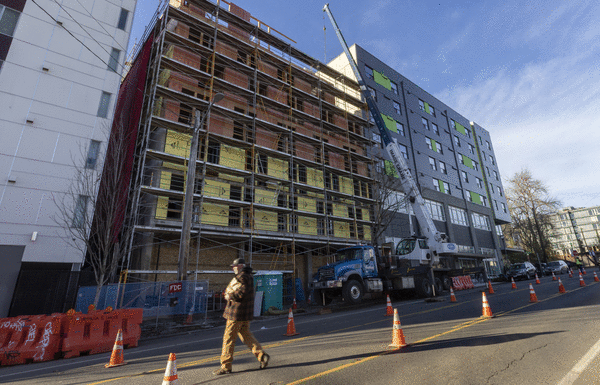
SEATTLE — A push to temporarily roll back Seattle’s defining housing policy of the late 2010s is gaining traction in City Hall as both developers and lawmakers look to plummeting permit applications with growing fear and search for ways to inject new supply into the city’s housing stock.
The Mandatory Housing Affordability program was the result of a 2015 “grand bargain” between the city and developers that allowed larger buildings in exchange for contributions from developers to help add affordable housing, either through on-site subsidies or fees.
Passed in pieces from 2017 to 2019, the policy was cheered within City Hall as a best-of-all-worlds approach to unleashing the private market while also taking advantage of a generationally good environment for development on behalf of the public. Though hardly beloved by all, particularly those who argued it was a tax on housing and destroyed the financial model for town homes, opposing voices were largely drowned out. Through 2023, it raised more than $300 million for affordable housing.
Today, though, the cranes that once dotted Seattle’s skyline have mostly disappeared, and the pipeline suggests that’s not likely to change soon. Last year saw roughly half as many permit applications as 2024 and less than 18% of the city’s 2020 peak. As a result, annual contributions from the program have begun to dry up, from $74 million in 2021 to $22 million last year.
Now, at the urging of developers and affordable housing advocates, some elected officials are weighing options to partially or mostly roll back the fees for up to three years in an effort to grease the skids for new homes in the private market.
“I am open to a temporary reduction,” said Councilmember Eddie Lin, a newly elected progressive who chairs the council’s land use committee. “It needs to be sort of tailored to the right size to get construction going, but not more than we need to.”
Sage Wilson, spokesperson for Mayor Katie Wilson, said the administration is looking for “creative solutions” to the supply slowdown and is working with “both market rate and nonprofit housing developers to identify policy options to build more housing, expand affordability, and ensure Seattle can be a welcoming place to people of all incomes and backgrounds.”
Global forces are a major factor behind the decline in new permit applications, as interest rates jumped along with the cost of materials and labor. Tariffs haven’t helped.
But in such a tight environment, developers say the fee imposed by the housing affordability program is enough to scare off investors, making borderline projects no longer viable. Recent moves by the city to speed up design review and permitting timelines have helped, they say, but the fees — which fall between $8 and $50 per square foot, depending on the type and location of a development — represent the most significant financial barrier.
At the same time, the city is spending more than it ever has on affordable housing, by way of a voter-approved levy and payroll tax on large businesses, making the program a much smaller proportion of the city’s overall investments.
“(Mandatory Housing Affordability) was probably the right tool back in 2017 when Seattle was at the cusp of a major building boom with record-low interest rates and, as a city, we had very few tools that were funding affordable housing,” said Ian Morrison, land use attorney and partner with McCullough Hill, whose founder, Jack McCullough, helped negotiate the original agreement. “But if no new market rate housing is getting built right now, that $22 million (Mandatory Housing Affordability) revenue could be close to zero.”
A group of multifamily housing developers, calling itself the Seattle Housing Roundtable, is proposing scaling back the mandatory fees by between 75% and 90%. That, they argue, would be enough to trigger at least 13 housing projects in the first year that have already gone through the permitting process and just need investor buy-in. By maintaining small fees, that new development alone could offset some of what the city would lose with the reduced fees.
The pitch, at least in principle, is gaining momentum. The Housing Development Consortium, which primarily supports affordable housing developers not subject to the payments who could see a decline in funding if a pause is passed, agrees the city should revisit the program. Lack of market-rate housing will increase pressure on its members, said director Patience Malaba.
“You’ve got projects that were penciling two years ago that are not penciling now,” she said.
Lin said he’s not yet agreed to any proposal, but said he’s motivated to spur new private development and believes the fees are making local developers’ financial equation more difficult.
At the same time, he wants to examine other options to ease financial hardships on developers because he wants to be sure the temporary pause does not become a permanent one.
I do not think there's appetite for that,” he said.
The Mandatory Housing Affordability program was former Mayor Ed Murray’s cornerstone policy proposal born out of monthslong negotiations between developers, lawyers and housing advocates in 2015. Hailed as a “grand bargain,” the city’s developers agreed not to litigate the housing fee so long as they received the right to build denser housing and commercial buildings.
A five-year evaluation of the program found it brought in more than $300 million over that period. At the same time, the study could not prove that the development environment in Seattle had performed much differently than in neighboring cities without the fees.
“We were able to leverage what was a growing housing production overall and show that affordability was a part of that growth,” Malaba said.
Not everyone was so happy. Town homes stopped being profitable overnight because of the program, said Erich Armbruster, pushing his firm to pivot all of its work to accessory dwelling units. The five-year evaluation agreed with his assertion, saying it slowed construction in the city’s low-rise zones because the extra density did not balance out the new cost at that level.
“For a small infill builder, it was flawed from the get-go and I will die on that hill,” Armbruster said.
Regardless of the precise policy prescription, Malaba of the Housing Development Consortium said the slowdown in housing production should "be concerning to all of us. The consequence of no action, she said, will be “the worst housing shortage in our history.”
©2026 The Seattle Times. Visit seattletimes.com. Distributed by Tribune Content Agency, LLC.










Comments