Ex-Venezuelan spy chief alleges Maduro regime runs drugs, gangs, spies in U.S.
Published in News & Features
Hugo Carvajal Barrios, a former three-star Venezuelan general and once one of the most powerful figures within the Caracas socialist regime, has released a letter from a U.S. federal prison making sweeping allegations about the Venezuelan government’s involvement in narcotics trafficking, organized crime and intelligence operations inside the United States.
Carvajal—who voluntarily pleaded guilty in the U.S. to a narco-terrorism conspiracy—addressed the letter to President Donald Trump and “the People of the United States,” saying he hopes to “atone” by providing information that he claims could help U.S. authorities counter threats from Venezuela’s ruling leadership. The letter was initially run by the Dallas Express.
Carvajal previously served as director of Military Intelligence and later as a member of Venezuela’s National Assembly. He defected from the Maduro government in 2017 and fled the country before being extradited to the United States.
Allegations of State-Directed Narcotics Operations
In the letter, Carvajal alleges that the Venezuelan government evolved into a criminal enterprise during the Chávez era and confirms that its top leaders operate the so-called “Cartel of the Suns,” a term used to describe a military-led drug trafficking network embedded within the Venezuelan state. He claims the network coordinates drug routes designed to harm the United States and has collaborated with Colombian guerrilla groups, as well as Cuban operatives and Hezbollah.
Carvajal asserts that the movement of narcotics through “new routes” into U.S. cities was a deliberate state policy—rather than isolated corruption or the work of rogue traffickers. These claims echo long-standing U.S. accusations against senior Maduro officials and underpin its justification for blowing up boats allegedly carrying drugs in the Caribbean Sea, though Caracas has consistently denied the cartel’s existence.
“The purpose of this organization, now known as the Cartel of the Suns, is to weaponize drugs against the United States,” Carvajal wrote. “The drugs that reached your cities through new routes were not accidents of corruption nor just the work of independent traffickers; they were deliberate policies coordinated by the Venezuelan regime.”
According to Carvajal, the strategy to weaponize drug trafficking was suggested to Chávez by the Cuban regime in the mid-2000s and later implemented with support from FARC, ELN, Cuban operatives and Hezbollah. He claims the Venezuelan government has provided weapons, passports and impunity for “these terrorist organizations” to operate freely from Venezuelan territory.
Vast armada
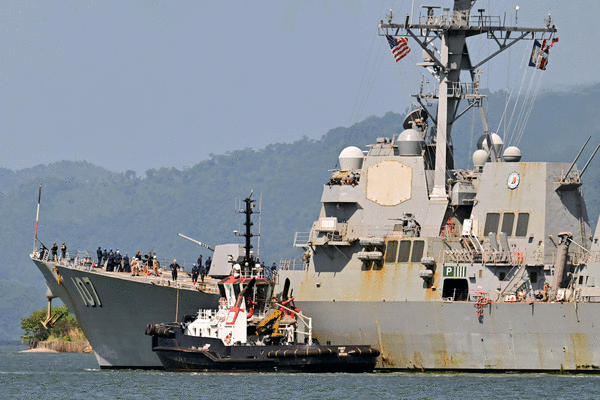
The former spy chief issued the letter at a time the Trump administration has ensembled what officials describe as the Caribbean’s largest military concentration in decades just off Venezuela’s coast to disrupt the operations from Latin American drug cartels, with special emphasis placed on the Cartel de Los Soles. Led by the USS Gerald R. Ford, the world’s largest aircraft carrier, the task force includes 10 additional warships, a nuclear submarine, F-35 fighter jets, amphibious assault vessels and roughly 15,000 U.S. troops.
Since forming in early September, the deployment has been used primarily to shoot down fast boats suspected of trafficking drugs. But last week Trump signaled a shift toward a more aggressive phase targeting the Venezuelan cartel. Operations that started in September have resulted in the destruction of over 20 boats and the deaths of more than 80 suspected drug traffickers — attacks that have led to congressional inquiries.
U.S. authorities have long accused the leadership of the Venezuelan regime of overseeing a cocaine-smuggling network that they estimate has moved between 350 and 500 tons of drugs annually to Europe and the United States.
In 2020, the Justice Department indicted Maduro and more than a dozen senior officials, calling the Venezuelan state a “narco-terrorist enterprise.” This year, the U.S. placed a $50 million reward on Maduro — the largest ever offered for a sitting head of state — and $25 million for ruling-party strongman Diosdado Cabello.
Claims on the Spread of the Tren de Aragua Gang
Carvajal also claims he witnessed decisions by Chávez and Maduro to empower and “weaponize” criminal gangs, including Tren de Aragua, which has recently drawn attention from U.S. law-enforcement agencies. He alleges that Venezuelan security forces facilitated the expansion of gang members beyond Venezuela’s borders, including into the United States.
This allegation forms part of the Trump administration’s argument for deporting hundreds of thousands of Venezuelans who arrived in the U.S. seeking refuge after fleeing the dictatorship.
While law-enforcement agencies have disagreed over claims that Maduro intentionally sent criminals to the United States, an FBI memo prepared at the end of the Biden administration—issued in January—warned Washington of a coordinated strategy to release violent offenders, encourage their migration abroad and employ them as unofficial enforcers across Latin America and increasingly in U.S. cities.
Espionage and Intelligence Allegations
Carvajal further claims that Russian and Cuban intelligence services have conducted joint operations from Venezuelan territory, including a Russian proposal to intercept U.S. communications. He alleges that Venezuelan and Cuban intelligence agencies have placed spies inside the United States “for decades,” including individuals posing as opposition activists.
“I was present when Russian intelligence came to Caracas to propose to Hugo Chávez the tapping of submarine internet cables that connect most of South America and the Caribbean islands with the United States, for the purpose of penetrating United States Government communications,” he wrote. “In 2015, I warned Maduro that allowing Russian intelligence to build and run a secret listening post on La Orchila Island would one day invite American bombs. He ignored me.”
Carvajal says the Venezuelan regime has been sending spies to the United States for at least two decades, some still active and in some cases disguised as members of the Venezuelan opposition. Cuba, he added, runs similar operations.
“Cuban intelligence showed me their networks inside your naval bases on the East Coast. They bragged about having sent thousands of spies over decades, some now career politicians. U.S. diplomats and CIA officers were paid to assist Chávez and Maduro in remaining in power. These Americans acted as spies for Cuba and Venezuela, and some remain active to this day,” he claimed.
Praise for Trump’s Venezuela Policy
Throughout the letter, Carvajal praises President Donald Trump’s approach to the Maduro government, calling it “not only correct, but absolutely necessary” for U.S. national security. He warns that the Venezuelan regime is “at war” with the United States through drugs, gangs, espionage and “even your own democratic processes.”
Carvajal claims Maduro’s inner circle has contingency plans to remain in power “under every extreme scenario,” and says he is prepared to provide additional information to U.S. authorities.
He remains in U.S. custody following his guilty plea and awaits sentencing. Carvajal was charged with participating in a narco-terrorism conspiracy, carrying a mandatory minimum of 20 years and a maximum of life in prison. He was also convicted of conspiring to import cocaine into the United States and using, carrying and possessing machine guns and destructive devices in connection with those conspiracies, charges that could also put Carvajal in prison for life.
Nicknamed El Pollo, Carvajal was once among the most influential figures in Venezuela’s intelligence apparatus. As head of the Military Counterintelligence Directorate, he had access to sensitive state secrets and maintained direct contact with senior officials under both Hugo Chávez and Nicolás Maduro. A staunch Chavista for most of his career, he eventually broke with Maduro and publicly supported opposition leader Juan Guaidó in 2019.
After his defection, Carvajal vanished from public view, evading extradition for years while seeking asylum in Europe. Spanish authorities arrested him in 2019. After protracted legal battles he was extradited to the United States in 2022 to face federal charges related to his alleged role in the “Cartel of the Suns.”
Prosecutors allege that Carvajal helped coordinate large-scale cocaine shipments to the United States, using his official position to protect drug operations and facilitate deals with foreign insurgent groups, most notably Colombia’s FARC.
Carvajal’s letter comes just days after Trump pardoned former Honduras President Juan Orlando Hernández, who was convicted of conspiring to bring 400 tons of cocaine into the United States. Hernández, in a bid to win his freedom, had weeks earlier sent Trump a letter arguing that his conviction and resulting 45-year- sentence was the product of political persecution.
©2025 Miami Herald. Visit at miamiherald.com. Distributed by Tribune Content Agency, LLC.

Comments