Extremely rare 'dinosaur mummy' makes its way to Minnesota for study
Published in News & Features
WINONA, Minn. — It’s hard to overstate how rare and exciting a dinosaur mummy is.
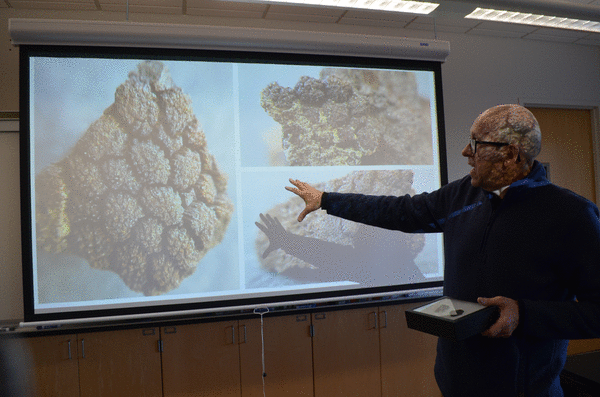
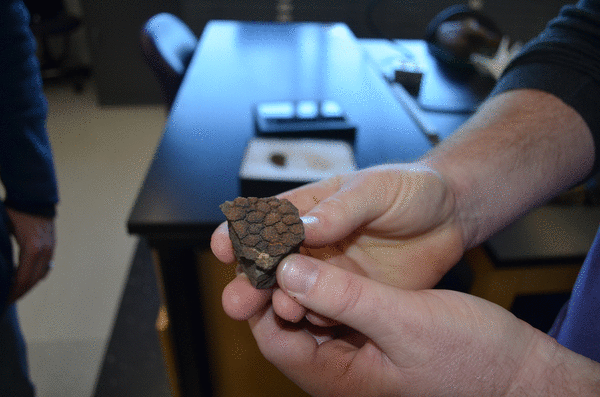
And yes, the fossil called "Medusa” could be a dinosaur mummy — the remains of an Edmontosaurus about 66 million years old that researchers believe contains a significant amount of skin and tendon tissue.
It’s so rare that only about a dozen such fossils exist worldwide — and it’s come to Winona.
“We don’t know exactly what’s going to emerge from the rock when we prepare it,” said Winona State University geoscience professor W. Lee Beatty. “If that’s what happens, then this is going to be a really rare thing.”
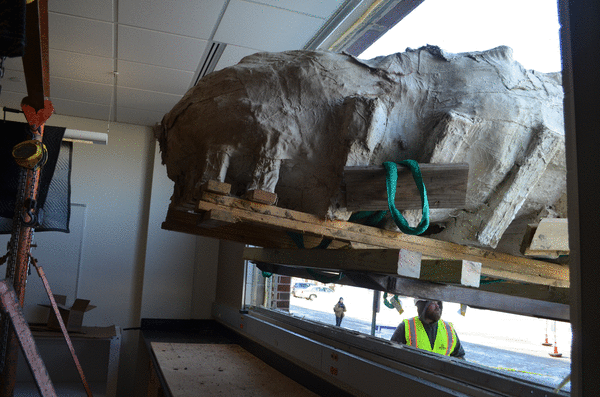
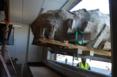
Workers spent much of Thursday in the frigid weather transporting Medusa into Winona State’s science department, taking out two windows to push the 14,000-pound, rock-encased fossil inside.
It’s the culmination of more than a year’s worth of work cutting the fossil out of the Hell Creek Formation archaeological site in the badlands of North Dakota and readying it for travel.
A team led by Winona State graduate Adam Schroeder found it in Hell Creek in July 2024. Schroeder said he didn’t think much of the fossil when a colleague started working on it, but he started to realize how significant Medusa was once he started walking around and saw evidence of tendons on dorsal bones sticking out of the rock.
“I’ve been out at Hell Creek every year since before I graduated, and this is the first specimen that I was like, ‘We have to get this to the university,’” he said.
It took months to get the fossil, largely undisturbed, out of the rock and down 85 feet from a cliff. At one point, Schroeder’s team had to move it by hand about 100 feet using ancient Egyptian techniques, he said.
The fossil made its way to Winona over the past week or so and sat overnight in a nearby loading dock before it was moved.
A full Edmontosaurus fossil is an exciting discovery. The animal stood up to 40 feet tall, as big as a Tyrannosaurus rex, with a duck-billed head and hundreds of teeth to eat vegetation.
First discovered in Canada, it was the largest herbivore in the Great Plains region of North America in the Late Cretaceous period, just before dinosaurs went extinct 65 million years ago.
Beatty and other Winona State researchers will work to learn how it was preserved as well as discover just how much skin encases the fossil. It could give clues about how the Earth has evolved over millions of years.
“The history of biology, how animals have changed over time and ecosystems have changed gives us a better understanding of what’s going on today,” Beatty said.
It will take at least five years to properly study the fossil. Researchers encased it in a plaster cast to protect it, and if all goes well, the cast may never be removed.
If skin and tendon evidence exists, Winona State will keep the fossil encased but clear some of the rock off to display it. If there’s no more evidence than what researchers have already found, the fossil may be removed and put on display in sections.
It’s still a great opportunity for undergraduate students, Beatty said. While a few similar fossils are located throughout the United States, the only comparable place to study something like this is the University of Chicago.
Undergraduates will start working on projects next semester, including senior Meg Kaufenberg-Lashua. She’ll work on identifying the chemical and mineral makeup of the skin and nearby rock to get a better idea of how the fossil formed.
“It’s an amazing opportunity,” she said. “There’s so much research that can come out of this and so much we can learn.”
_____
©2025 The Minnesota Star Tribune. Visit startribune.com. Distributed by Tribune Content Agency, LLC






Comments