Human rights report, art exhibit allege inhumane conditions at Alligator Alcatraz
Published in News & Features





Alleging human rights abuses in two South Florida immigration detention facilities, Amnesty International released a 61-page report on Thursday describing inhumane conditions at Alligator Alcatraz and Krome North Service Processing Center.
The report, released a day after the organization opened a related art exhibit in Miami Beach, focuses on Florida’s efforts to lead the nation in aiding President Donald Trump’s mass deportation mandate by building and operating first-of-its-kind immigration detention centers like Alligator Alcatraz, and by deputizing local and state enforcement agencies to assist in immigration apprehensions. The human rights organization accuses the federal government of “chronic medical neglect” at Krome, and the DeSantis administration of “torture and ill-treatment” of detainees being held at Alligator Alcatraz.
At the makeshift tent facility in the middle of the Everglades, the report concluded that detainees did not have adequate access to medical care. It also alleged they were being detained “in inhuman and unsanitary conditions including overflowing toilets with fecal matter seeping into where people are sleeping, limited access to showers, exposure to insects without protective measures, lights on 24 hours a day, poor quality food and water, and lack of privacy.”
Thirty-six miles away on the western edge of Miami-Dade County, the report also focused on Krome North Processing Center, finding that the facility had “alarming disciplinary practices” and “overcrowding in temporary processing areas.”
The organization’s assessment is based on a September tour of the Krome detention center led by U.S. Immigration and Customs Enforcement officials, where they were able to ask ICE officials questions, and on interviews with four detainees who were held at both Krome and Alligator Alcatraz. Amnesty International also spoke to local organizations that have been in contact with detainees, including Americans for Immigrant Justice, Florida Immigrant Coalition and Sanctuary of the South.
According to the report, Amnesty International’s researchers requested a tour of Alligator Alcatraz but did not receive a response from the state, which is responsible for the site’s operations.
Molly Best, press secretary for Gov. Ron DeSantis’ office, disputed the report’s findings.
“This ‘report’ is nothing more than a politically motivated attack. None of these fabrications are true,” she said. “In fact, running these allegations without any evidence whatsoever could jeopardize the safety and security of our staff and those being housed at Alligator Alcatraz.”
The Department of Homeland Security did not respond to the Miami Herald’s request for comment.
Since Alligator Alcatraz opened in July, the Miami Herald, other news outlets and civil rights groups have documented complaints from detainees, such as unflushable toilets, being swamped by bugs and limited shower access. The state has consistently denied mistreating its detainees, but has largely kept them off-limits to outside eyes, including lawmakers allowed to tour the facility.
Human Rights Watch, in a July report, also accused Krome of dehumanizing conditions.
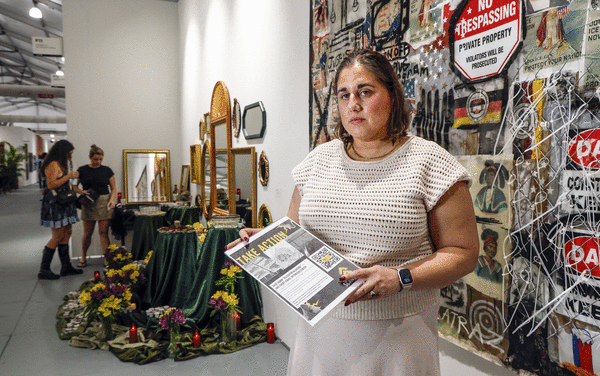
Amy Fischer, the director of refugee and migrant rights at Amnesty International USA, speaking to a Herald reporter at the Scope Art Show on Miami Beach, said it is important to “raise alarm” about the operations at state-run Alligator Alcatraz, “so that we can really start to bring global accountability for the suffering that is ongoing.”
Fischer said that, as Amnesty International researchers spoke with people in South Florida, many were surprised to learn that Alligator Alcatraz was still open. In August, a federal judge ordered the site shut down within 60 days, but an appeals court quickly reversed the decision.
“That is why we know it’s so important for this report to come out, for us to be having this art exhibit, to remind people that, yes, there has been a legal back and forth, yes, maybe it’s not on the front pages of the news every day,” Fischer said.
“Every single day, our immigrant friends and neighbors are being taken from their families, from their communities, and put into this facility that prolongs and profits off their suffering,” she said. “And we can’t let that leave the news.”
In the report, the detainees Amnesty International spoke with described a “2X2” cage-like structure called the “box” at Alligator Alcatraz, where they said detainees are placed for punishment, sometimes for hours, while chained and restrained to the ground in the heat. A detainee shared a story with Miami Herald news partner WLRN about the outdoor cell during the facility’s first weeks of operations, but said it was twice as large as the dimensions described in the Amnesty International report.
“The use of the ‘box’ at “Alligator Alcatraz” amounts to torture or other ill-treatment,” the report concluded.
Accusations of Inhumane conditions
The researchers from Amnesty International concluded that in its aggressive crackdown on illegal immigration, the state did not comply with either domestic or international human rights standards in its detention facility.
The alleged violations described in the report include:
•At Alligator Alcatraz, the lights remained on permanently, the men told human rights researchers, making it hard to sleep.
•The men the human rights organization interviewed said they lived in unsanitary conditions. The toilets were often clogged, and feces overflowed into their sleeping area. They also told the researchers they did not have access to showers, sometimes for over two weeks.
•Others complained of being shackled for hours. One man said he was held on a bus shackled for 10 hours. Another said he spent 28 hours shackled on a bus, before being transferred to Alligator Alcatraz. At the facility, they were shackled whenever they left the chain-linked cell, sometimes even when eating or when they needed medical care, the report states.
•At Krome, the men told the researchers they faced “arbitrary disciplinary action.” A detainee said he was held in solitary confinement for 24 days after a confrontation with a guard. During the tour of the solitary confinement area, human rights groups said a detainee slipped a note through a metal flap, which read, “Help Me. I’m on Hunger Strike.” The report found that the use of solitary confinement at Krome “amounts to torture or other ill-treatment in violation of international law.”
•Also at Krome, detainees told the human rights group that a temporary, soft-sided processing area was crowded, and they were held there for more than seven days. One detainee said they had been there for a month.
The organization called on the state to immediately shut down Alligator Alcatraz, and recommended that Florida’s state and local law enforcement agencies terminate their 287g agreements allowing officers to actively engage in immigration enforcement activities otherwise reserved for federal agents.
Amnesty International also called for members of Congress to use their oversight authority on ICE detention centers, reduce funding for DHS departments like ICE and CBP and prohibit the use of federal funds to reimburse states for performing the federal function of immigration enforcement.
“Cruelty is the point”
Amnesty International timed the release of its report to the opening of an art exhibit on Wednesday featuring two commissioned pieces at the Scope Art Show on Miami Beach.
Fischer said the organization sought out artists to create an exhibit that makes people “feel that people are suffering nearby while we’re here enjoying art.”
“Art allows people to really engage with a subject from multiple dimensions, really sort of put themselves in the experience,” Fischer said.
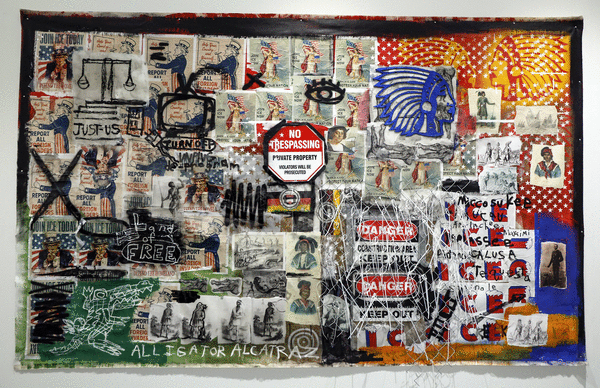
Clarence James, a Washington, D.C.-based artist, said he drew inspiration from ICE recruitment posters circulating on social media that resembled World War II-era posters, calling on recruits to “defend the homeland.”
One poster with Uncle Sam reads, “Help your country..and yourself.” Another reads “America needs you.”
James said he took those posters and juxtaposed them with the “idea of freedom.” That meant, for James, incorporating pieces of American history, such as Native American tribes like the Miccosukee, whose tribal land and reservation is close to Alligator Alcatraz.
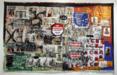
On the 10-by-6-foot piece, called “Cruelty is The Point,” he also included a chain-link fence representing the makeshift facility’s structure. The piece also has instructions for people to attach zip ties to it as a form of solidarity with the detainees.
James said he wants to “give people a chance to have some empathy and realize we’re all human, and we’re all participating in life out here, and just to understand the immigrant and what their history is.”
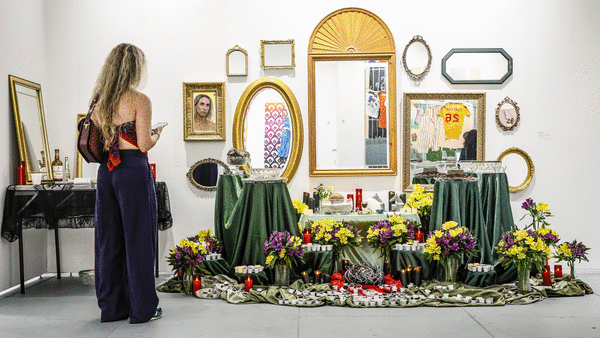
A few feet away, is the second piece, by Agua Dulce Gloriosa, a Miami-based artist and activist who created an altar with artifacts from the city to honor those detained at Alligator Alcatraz.
Dulce Gloriosa, who was born and raised in Miami, wanted the piece to be intentional about the representation of Miami. The multi-piece includes earth elements such as soil and water from outside Alligator Alcatraz, flower and mulch from Miami organizations, and seawater to represent the beach on which the exhibit was taking place. The artist included Haitian rum, coffee and a domino table surrounded by mirrors.
The piece, “Untitled (a hope is but a dream is but a plan yet put to action),” offers onlookers a moment to look into the mirror and reflect on the current times and the world they would like to create.
“I want people in relationship to this space to be able to believe, not just hope, but believe that another world is possible,” Dulce Gloriosa said. “And understand that it is their personal responsibility to act and to take responsibility to be a part of creating that different world, that new world, that more loving, just, equitable, caring world.”
The piece invites viewers to take a cafecito cup filled with sand or coffee and place it at the bottom of the altar to honor the detainees at Alligator Alcatraz. On the first public opening on Wednesday, more than three dozen cups of sand and coffee had been laid at the altar. Some placed a dollar as an offering.
The exhibit is open to the public from 11 a.m. to 8 p.m., closing on Sunday evening.
©2025 Miami Herald. Visit at miamiherald.com. Distributed by Tribune Content Agency, LLC.






Comments